
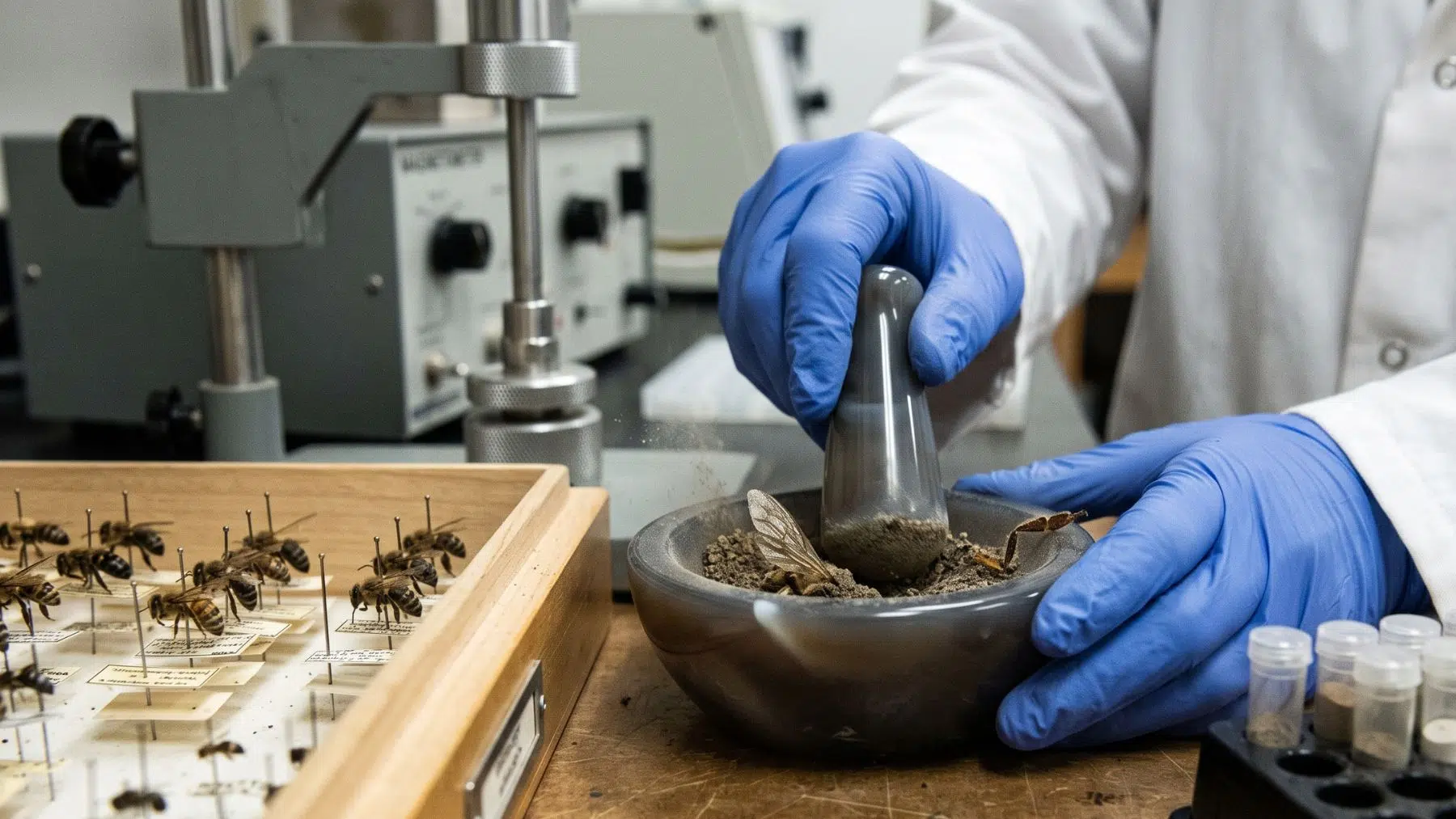
A researcher takes a dried bee out of a museum drawer, grinds the whole insect into powder, and drops the powder into a magnetometer.
The instrument is the one geologists use to find iron bearing minerals in rock.
Run that on 96 bee species and 74 of them come back magnetic.
Which sounds like a discovery about bees, and it is not quite that.
It is a discovery about how common something already known turns out to be.
What was already on the record
Because the honeybee half of this is old news, and that matters for reading the rest of it.
A paper in the late 1970s reported that honeybees carry magnetic remanence, meaning the insect holds a magnetic signature of its own.
Work since then has located magnetic material in the honeybee abdomen and tied it to behavior inside the hive.
So the idea that a bee has iron in it is roughly as old as the pocket calculator.
What stayed thin was the breadth. Before this survey, only about five bee species had ever been measured that way.
Five out of more than twenty thousand species is not a pattern. It is a handful of data points.
Which is why nobody could say whether the iron was a honeybee quirk or something the whole group carries.
How you measure a bee
And closing that gap took a materials laboratory rather than a field station.
The team pulled dried specimens from collections covering the whole bee family tree, from bumblebees down to solitary ground nesters.
Each specimen was ground to powder, because a whole pinned insect gives a messy reading and a powder gives a clean average.
The magnetometer then measures how strongly that powder holds a magnetic moment once an applied field is switched off.
That property is ferromagnetism, and in an animal it usually points to magnetic particles of magnetite, an iron oxide.
The work ran across six years and eventually took in wasps, beetles and flies alongside the bees.
Museum drawers made that possible, since a dried specimen from decades ago still holds whatever mineral the animal carried.
What came back
Then the results landed, and the headline number is the easy part of them.
Of 96 bee species tested, 74 were magnetic, and the signal turned up in every family the team sampled.
Nocturnal bees had it. Bees that dig burrows in bare soil had it. Bees that nest in cavities had it.
That spread is the reason the result matters, because a trait shared across a whole family usually has a reason behind it.
But the signal was not evenly spread, and that is the part flattened in most of the retellings.
Larger bees registered more strongly than small ones, cavity nesters more strongly than ground nesters, and social species more strongly than solitary ones.
So sociality did not turn out to be irrelevant here. It turned out not to be required.
What the team refuses to claim
Which is where the paper gets unusually careful about its own finding.
Magnetic material inside an animal is a hint that the animal might sense a field. It is not evidence that it does.
The lead author said the trait is probably ancient and well conserved, and then said plainly that they cannot prove it, as the researchers wrote.
Proving it means experiments on living insects inside controlled fields, which are difficult, slow and easy to misread.
Plenty of animals carry iron for reasons that have nothing to do with sensing anything at all.
There is a second complication. The signal showed up in several body regions rather than one, which is awkward for any theory placing the receptor in a single organ, as the university laid out.
Magnetoreception is the most contested sense in animal biology, and nothing in this survey settles it.
Short trips rather than long ones
And the researchers point away from the story most people reach for first.
The obvious comparison is a sea turtle crossing an ocean or a songbird crossing a continent on a magnetic heading.
That is not what this team suspects. Their working idea is short range navigation, the scale of a foraging trip rather than a migration.
A bee works a patch within a short flight of the nest and has to find its way home every time it fills up.
The same question comes up around any built site, whether the object is an offshore project or a ground mounted solar site, where people ask what the structure does to the animals using the ground.
For bees the honest answer today is that nobody knows, because the sense itself has not been demonstrated.
What has been demonstrated is that the iron sits almost everywhere in the group, and in the wasps and beetles and flies measured beside them.
Which makes it old, and probably useful, and still unexplained.
Read the whole thing?
Get the week's signal, not the noise
Our sharpest reporting on energy, climate and nature — free, once a week.


