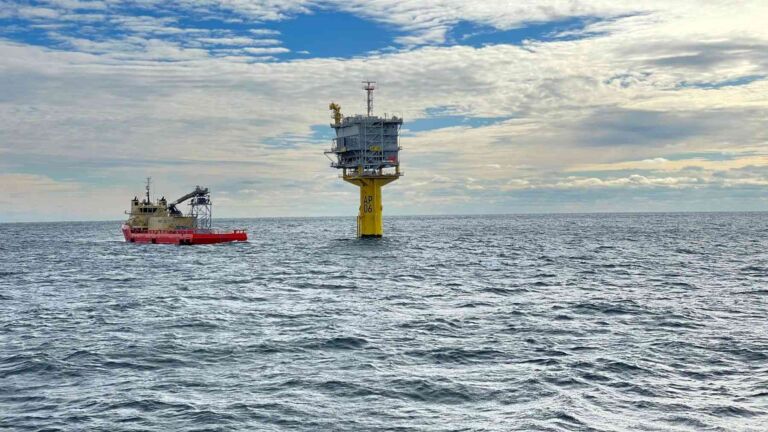
About four miles off the Swedish island of Öland, sixteen wind turbines stand on concrete bases sunk into the Baltic seabed.
Around each base sits a skirt of quarried rock, laid there to keep the current from digging the foundation out.
Then something different went down nearby.
180 hollow concrete cubes, the smallest about six inches across, the largest close to thirty.
Nobody expects them to stay bare.
A hollow shape is built to do two jobs at once
Offshore foundations need weight around the base because fast water scours out the sediment holding them steady. For decades the standard answer has been rock armor dumped and left to settle. At the Kårehamn wind farm in the Swedish Baltic, cast concrete blocks with open chambers and holes through every face were set on the seabed instead of more of the same stone.
The shape is the whole argument. A rock pile presents mostly smooth faces and little interior space.
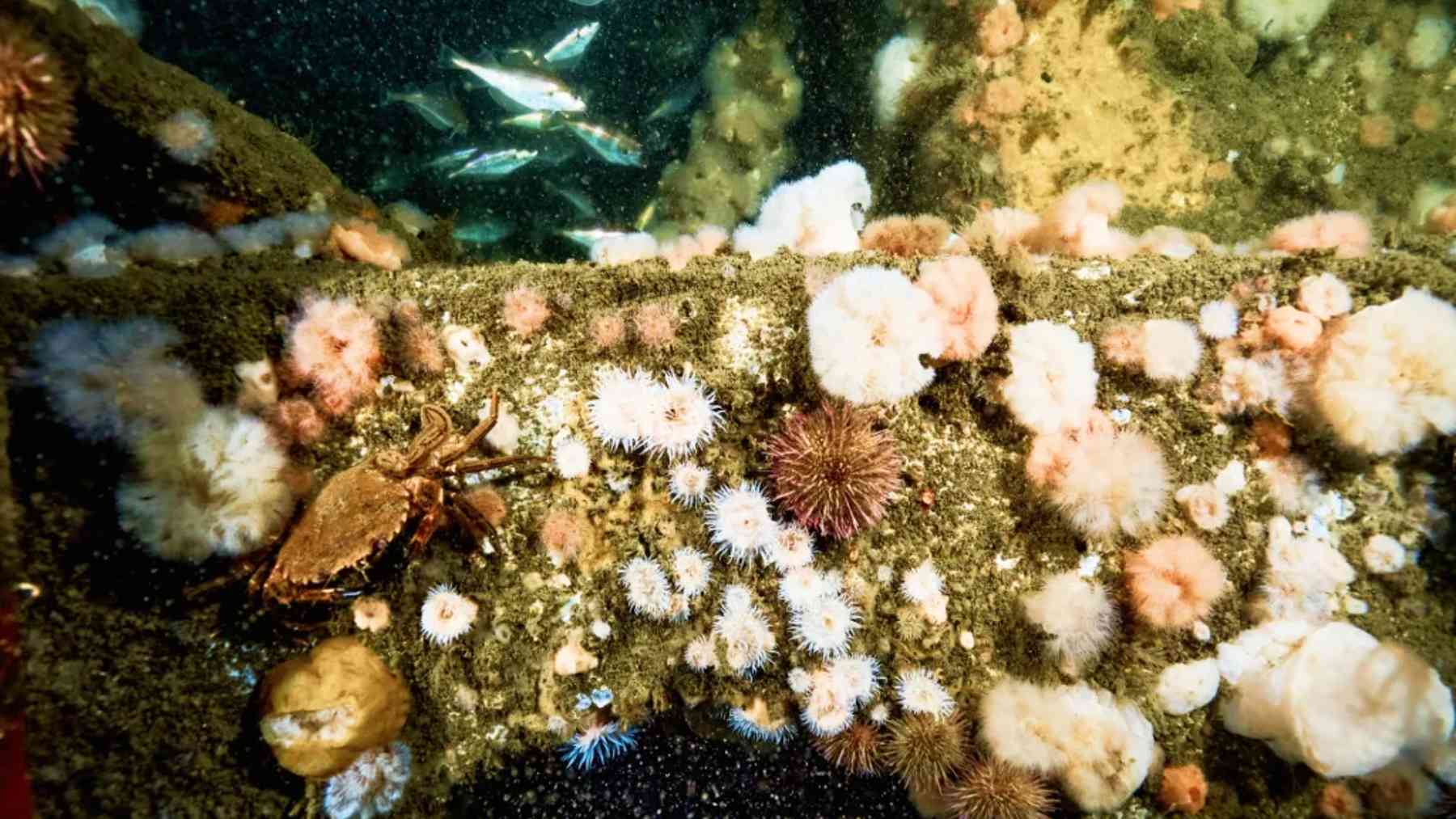
A hollow cube offers dark chambers, sharp edges and far more textured surface per block. The bet is that more hiding spots give a mussel larva or a young fish more places to settle than bare stone does.
That hard structures in the Baltic get colonized is not in doubt. Whether a deliberately shaped block does it faster or better than plain rock armor is still a proposal rather than a demonstrated mechanism, which is exactly why the cubes went in as a test cluster rather than a replacement for the farm’s rock.
The turbine legs already carry a mussel crust
The location was not picked at random. RWE, which operates the farm, says the site was chosen because species development had already been observed on the turbine foundations themselves, and the species of interest are blue mussels, algae and fish.
That pattern is documented more widely in Swedish Baltic waters. Survey work at offshore wind sites found blue mussels and barnacles covering most of the submerged parts of the turbines, with fish abundance greater near the turbines than in surrounding areas.
On the piles themselves, total fish abundance was higher but species richness and diversity were notably lower than on the surrounding seabed. So the reef effect is real without being uniformly positive.
The foundations already do part of what the cubes are meant to do. The open question is whether a designed block can carry that effect out onto open seabed, away from the steel and concrete of the structure itself.
A 2023 survey set the baseline before anything went down
The pilot began in 2023 with a before picture: seabed sampling, water samples, and an eDNA survey to identify the mussels, vegetation and fish already living in the area. That gave the team something to measure change against rather than a single later snapshot.
The practical phase followed in May 2024, when 180 reef cubes were submerged at the 48 MW, 16 turbine farm, in sizes from roughly 6 by 6 inches to 30 by 30 inches. RWE ran the study with Linnaeus University and the Kalmar based marine contractor Baltic Offshore Kalmar, using cubes designed and manufactured by ARC Marine.
The colonisation phase runs from 2024 through 2026, with the cubes and surrounding ecosystem examined over that span. No settlement results have been published yet.
A flume tank measured a 50 to 80 percent drop in wake flow
Away from Öland, flume experiments have measured what the shape does to the water. Researchers placed cubic and hemispherical reef units in a tight three by three pattern around a scaled monopile and found the cubic units almost eliminated downward flow on the upstream side, cutting wake flow by 50 to 80 percent and scour depth by up to 100 percent.
The same tests found the catch. Edge scour around the cubic units could displace them, which undercuts protection over the long run, while the hemispheres gave less scour reduction but also less edge scour. No single block shape wins on every measure, and the lab work modelled a monopile rather than the gravity bases used at Kårehamn.
Scour protection and habitat value have usually been treated as separate problems solved with separate materials. A turbine rotor pulled from a river after months underwater shows how much attention engineers now pay to what a structure becomes once it is wet and left alone.
180 blocks off one island cannot answer a fleet wide question
None of this turns the Baltic into a reef. The cluster covers a small patch of seabed at a single wind farm, and the measured flow benefits come from scaled tank work, not from the Swedish site.
Even so, the two strands point the same way. Where turbine foundations already carry mussels, a shaped block placed nearby is a reasonable thing to try, and the hydrodynamics at least do not argue against it.
The honest caveat is that 180 blocks off one island cannot answer what happens across an entire offshore wind fleet. What they offer is a carefully baselined first look at whether a deliberately designed surface can do more for a cold seabed than quarried rock already does.
Read the whole thing?
Get the week's signal, not the noise
Our sharpest reporting on energy, climate and nature — free, once a week.