
It may seem like oyster farmers only have to place oysters in the water and wait for them to grow.
Equipment requires constant attention. Barnacles and other organisms also attach themselves to it (biofouling).
These tasks require a tremendous amount of physical effort. They also take an enormous amount of time.
One oyster farm in Maine is taking a different approach.
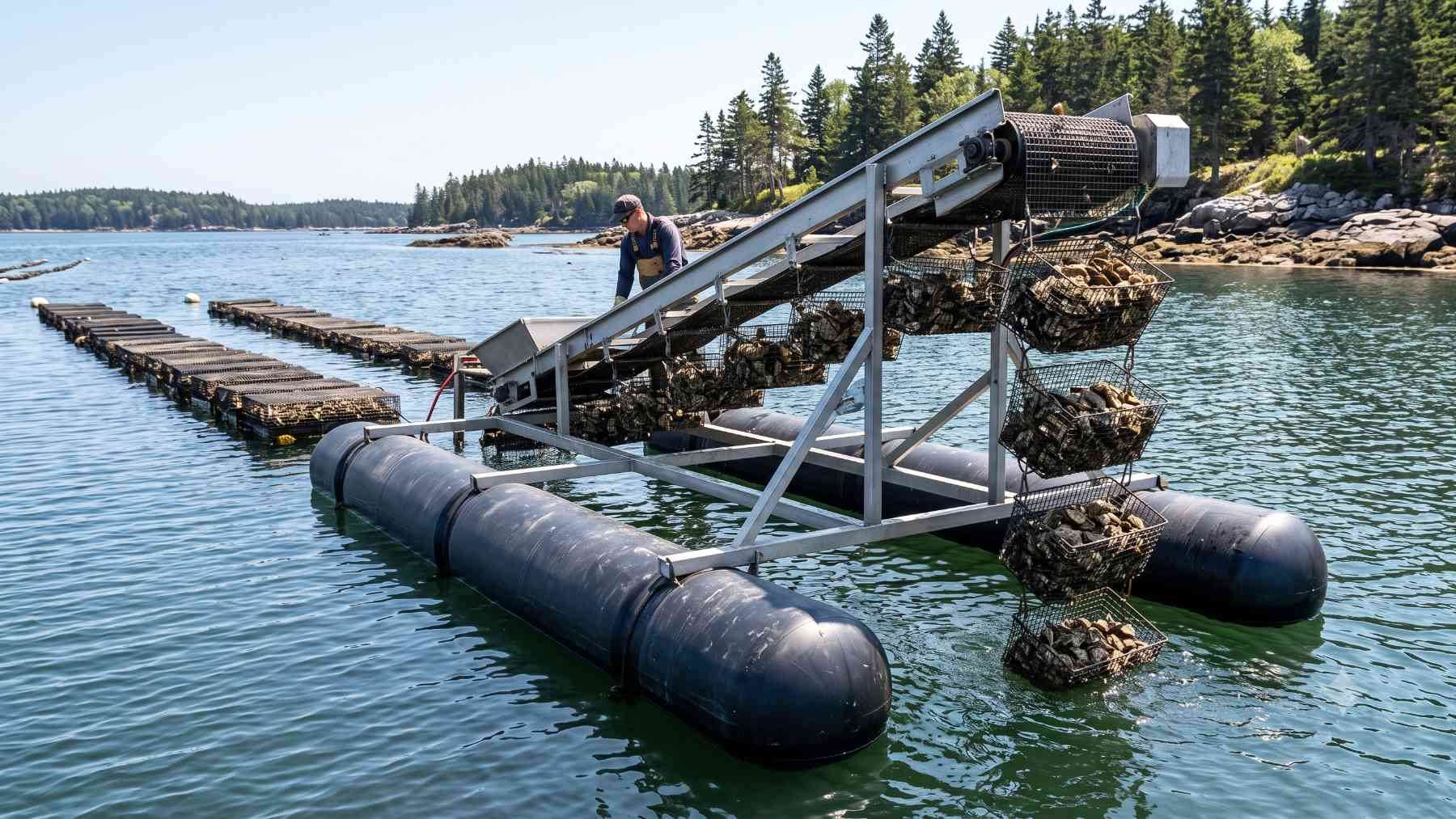
The farm created a floating system that keeps oyster baskets in motion rather than leaving them stationary.
At certain points, it will even lift the oyster baskets out of the water and into the air.
Why oyster farming requires so much labor
According to “The World Is Your Oyster”, most of the physical labor associated with commercial oyster farming involves cleaning oyster baskets.
Farmers also manually turn over oysters to create water circulation. These actions help provide adequate water flow around the oysters. They also help produce a more consistent end product.
Farmers repeat these actions many times during the growing season.
Cleaning and handling large quantities of oyster baskets represents much of the labor on many oyster farms.
Labor costs can make it harder for oyster farms to operate efficiently. Starting a profitable oyster operation can be difficult. Many shellfish growers want to produce the same number of oysters with less labor.
This helped motivate the creation of a new oyster cultivation platform called 3D-COAST.
Maine is testing a different way to grow oysters
The 3D-COAST platform is a floating oyster cultivation raft under development in Maine. This project has benefited from funding provided through the Sustainable Agriculture Research and Education Projects program. Unlike existing systems, 3D-COAST utilizes the vertical space available in the water.
Developers believe that a single raft could support the growth of nearly 125,000 oysters annually in mid-coast Maine waters.
Developers continue to monitor the raft as they evaluate its long-term performance.
The project is still being tested for reliability while developers collect data from the raft at The World’s Your Oyster Co.
The platform moves oysters through the water column
Oyster baskets hang vertically from rotating conveyor-like mechanisms. This allows growers to use more of the available space in the water column. The constant movement exposes the oysters to different conditions as they travel.
The process works by moving the oyster baskets up and down through the vertical column of water.
As they move, the oysters are gently tumbled due to the rotation.
According to the project description, the tumbling can help produce better-shaped, higher-quality oysters.
The system also lifts oysters into the air
When the baskets reach the highest point of their travel cycle, they expose the oysters to light and oxygen for several hours. No additional handling is required to create this exposure cycle. The exposure occurs automatically as part of the normal operating cycle.
It happens as the baskets continue moving through the system.
Exposure to sunlight and oxygen reduces biofouling. Biofouling is caused by organisms such as algae and barnacles that develop on oyster cultivation equipment.
All movement is generated by solar power. According to the developers, two solar panels generate enough energy to keep the raft in continuous motion.
The overall result is a platform designed to eliminate many common manual tasks. It also allows growers to make better use of available farming space. Developers believe these efficiencies could improve production. They may also reduce the labor required for each oyster grown.
Development of the floating raft is still ongoing.
If successful, lessons learned in Maine could guide new methods for cultivating oysters.
Those methods could become increasingly valuable as interest grows in the broader benefits oysters provide to coastal ecosystems.
Read the whole thing?
Get the week's signal, not the noise
Our sharpest reporting on energy, climate and nature — free, once a week.


