
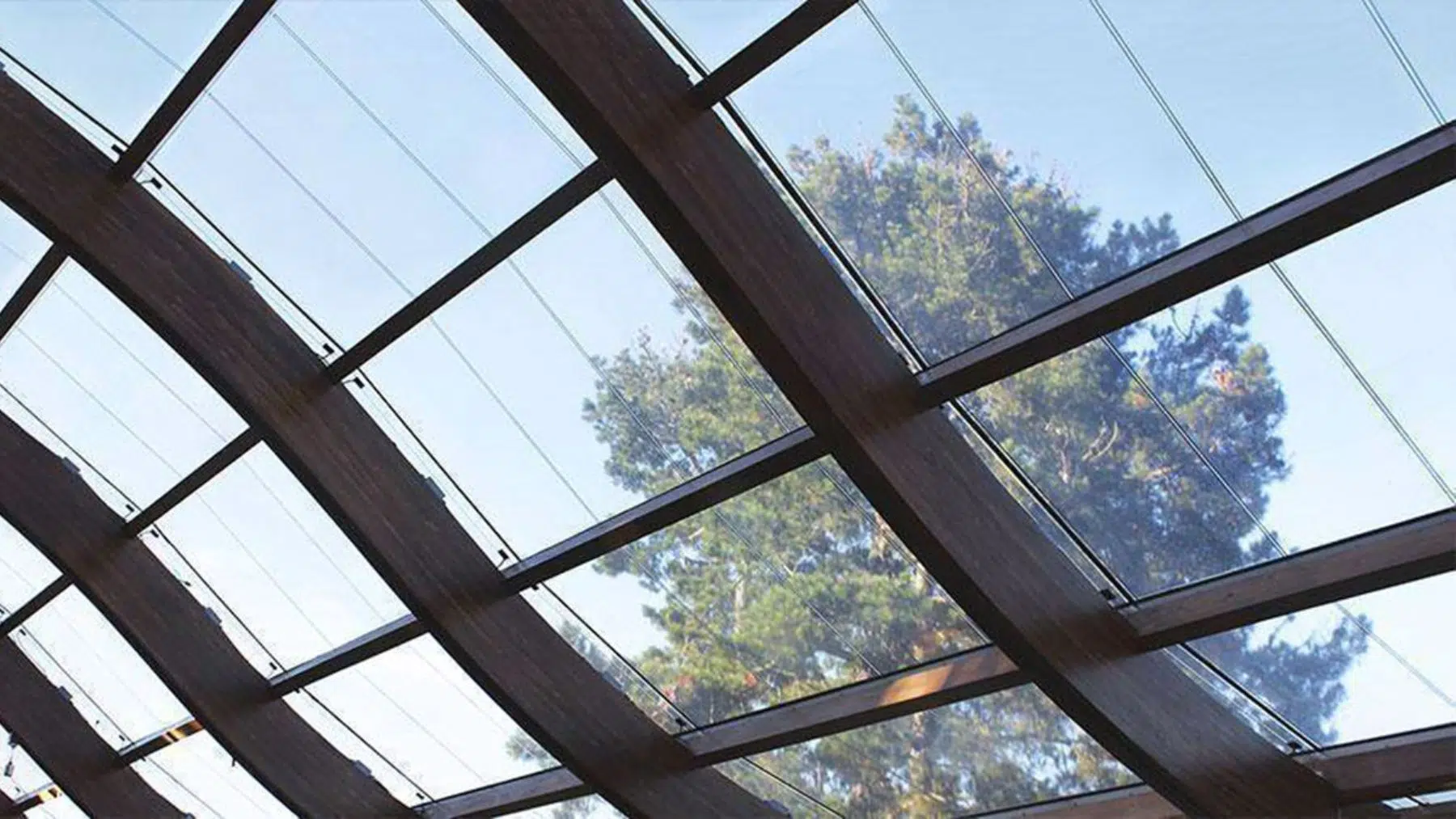
It’s an idea so genius in its simplicity that it seems implausible, but the first energy-producing window is very real and its potential is through the roof. The photovoltaics industry has never been short on innovation, but it’s a space that requires constant innovation as society pivots towards green energy. Transparent solar cells may offer the world a window into the future, and that future is blindingly bright.
Aren’t energy-producing windows already a reality?
While there are transparent solar cells (TSCs) available on the market already, they have their limitations. Some TSCs make use of dyes, which are known as Grätzel cells. Some TSCs use thin perovskite layers, most of which are only semi-transparent. The main issue with many of the TSCs that are currently on the market is that they aren’t very practical.
Many TSCs lack flexibility and aren’t completely see-through, often resembling tinted windows. A team at the Ulsan National Institute of Science & Technology (UNIST) is looking to change that, and has already demonstrated a surprisingly flexible cell with remarkable color control. The team hasn’t necessarily reinvented the wheel, but this innovation would be the equivalent of inventing run flats.
UNIST published its initial findings in 2019 in Light: Science and Application, which they followed with an article in Advanced Functional Materials in 2021. However, UNIST has continued to innovate and has already published research on all-back-contact neutral-colored transparent crystalline silicon solar cells as recently as 2024, in Proceedings of the National Academy of Sciences (PNAS). They are clearly on a mission.
Here’s how transparent solar cells work
The solar cells have silicon rods fixed in a pliable and see-through polymer, which appears completely transparent. The rods are responsible for converting sunlight into electricity, as silicon is a semiconductor. The possibility of using TSCs on windows makes them an extremely lucrative innovation, but what separates UNIST’s cells is their efficiency, as they can control the reflection of sunlight off the rods, as well as the fact that they don’t use rigid glass as a substrate.
Speaking on the most recent research published by UNIST, researcher Jeonghwan Park and research assistant Professor Kangmin Lee stated, “This study fundamentally solved the aesthetic problem of the existing solar cell modularization method through the design of the new device structure. It presented the possibility that transparent silicon solar cells can be used in various industries, such as small devices, as well as buildings and automobile glass.”
How long until the new photovoltaic technology hits the market?
While UNIST is based in South Korea, American institutions like Michigan State University (MSU) and Massachusetts Institute of Technology (MIT) had already put their researchers up to the task as far back as 2014. In 2022, the World Economic Forum reported that companies like the California-based Ubiquitous Energy were investing heavily in technology that combines architectural glass and TSCs.
The commercial implications for TSCs are extraordinary and will no doubt become a point that large companies gloat about. We could potentially see carbon-positive skyscrapers within the decade. The market for TSCs is essentially a rolling conveyor belt; they are already in production, and they are constantly being updated and improved upon.
The real question is when will we have cars with solar cells in the windscreens or houses with solar panel windows. That question is difficult to answer, but it’s coming sooner rather than later.
What the researchers at UNIST, and indeed other researchers around the world, have accomplished in terms of pushing solar technology forward in the past decade is unprecedented. It surely won’t be long before TSCs are so indistinguishable from regular glass that they become the new normal. While the outlook for the future always appears grim, it’s not because of a lack of scientific ingenuity.
Read the whole thing?
Get the week's signal, not the noise
Our sharpest reporting on energy, climate and nature — free, once a week.


