
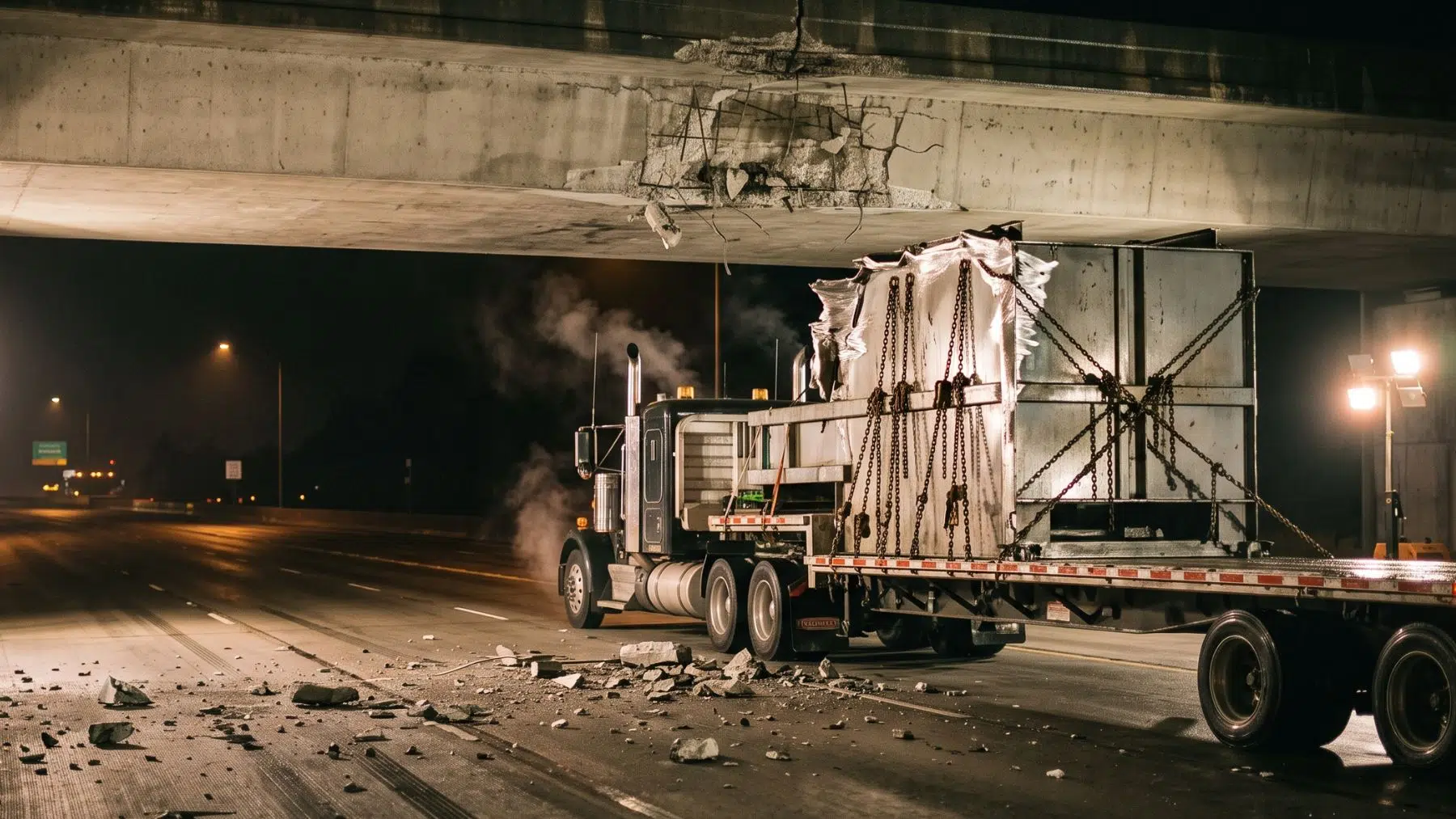
Late on a rainy night, a truck hauling a huge steel machine rolls west on Interstate 90 near Cle Elum, Washington.
Taped in the cab is a permit that spells out exactly where it can go.
One line tells the driver to leave the freeway at the next exit and rejoin it past a low bridge.
The exit slides by.
The truck stays on the highway, headed straight for the overpass.
So what happens when a load skips the one turn its permit demands?
The exit the driver was told to take
The permit was not vague. It ordered the oversize load to pull off at Exit 80 and loop back onto Interstate 90, a short detour built to steer it clear of a bridge it could not fit beneath. Instead the driver held his lane and drove straight into the Bullfrog Road overpass.
That single skipped ramp was expensive.
The strike tore into the span so badly that the state had to demolish and rebuild it, a job that ran to about 8 million dollars and 86 days of work. The turn he was told to make would have cost him maybe five minutes. Exit 80 sat right there, the last ramp before the bridge, and taking it would have dropped the load onto a side road and back on past the low span.
Why the load could not fit
The problem was height, not weight alone. The truck carried a massive steel machine, a squat, heavy piece of industrial equipment tall enough that it would not clear every bridge on the route. An oversize permit exists precisely to route such a load around the tight spots.
Not every overpass has the same room underneath.
State engineers know the clearance of every bridge on the interstate, and a permit is really a custom map that threads a tall load past each one.
When a bridge sits too low, the permit sends the truck off the freeway and back on, around the pinch point. Those routes are worked out in advance from a database of every structure’s height, so a legal permit is really a promise that the load and the road have been matched foot by foot.
How one missed ramp became a demolition
The impact did not just chip the concrete. It cracked and buckled the overpass so badly that inspectors condemned the whole span, and crews spent the following days tearing it down rather than patching it. A routine night turned into a wreck site.
Westbound lanes shut down entirely.
For weeks, one of the main routes over the Cascades funneled through detours and delays, hitting truckers, commuters and mountain towns that lean on the pass. A single load on a single night had knocked out a critical link for a whole region.
Interstate 90 is the main corridor between the coast and the eastern half of the state, hauling heavy freight and thousands of vehicles a day over the mountains, so a closure there ripples out for hundreds of miles.
What the permit system is built to prevent
This is exactly the disaster the permit process is meant to head off. Oversize loads move under detailed routing, often with a pilot car running ahead to watch for hazards. On paper, a bridge like this one should never get hit.
The same paperwork governs weight, which is how a Wisconsin semi crossed the scales at 110,000 pounds with no permit at all, and the same thin margin put an Oregon fish tanker on its side on a sharp corner.
But the system only works if the route is followed.
Investigators pointed to a likely mix up in the radio chatter between the driver and his lead vehicle. A state patrol spokesman said the driver had simply kept goingpast the exit, and the tall load met the low beam at highway speed.
The driver was an experienced operator holding a valid permit, not a rogue trucker, which is what made the miss so striking. One wrong call in a noisy cab was all it took.
The 250 dollar lesson
The math of the penalty stunned people. The driver was cited for violating his permit, and the fine for that came to about 250 dollars, set against a bridge that cost eight million to replace. Local officials quickly pressed for far stiffer penalties. A charge that small, they argued, is no deterrent when one missed exit can cost the public millions and choke a highway for months.
The repair itself was a small marvel of speed.
Crews used precast concrete beams, built off site and craned into place, to rebuild the span and reopen it ahead of schedule. The governor had signed an emergency order to speed the money and the crews. The new span reopened in the middle of January, weeks before the first estimate, a rare piece of fast public works.
The bridge is whole again, faster than anyone expected. The bill landed on the public, while the fine for the man who caused it came to about the price of a tank of gas.
Read the whole thing?
Get the week's signal, not the noise
Our sharpest reporting on energy, climate and nature — free, once a week.


