
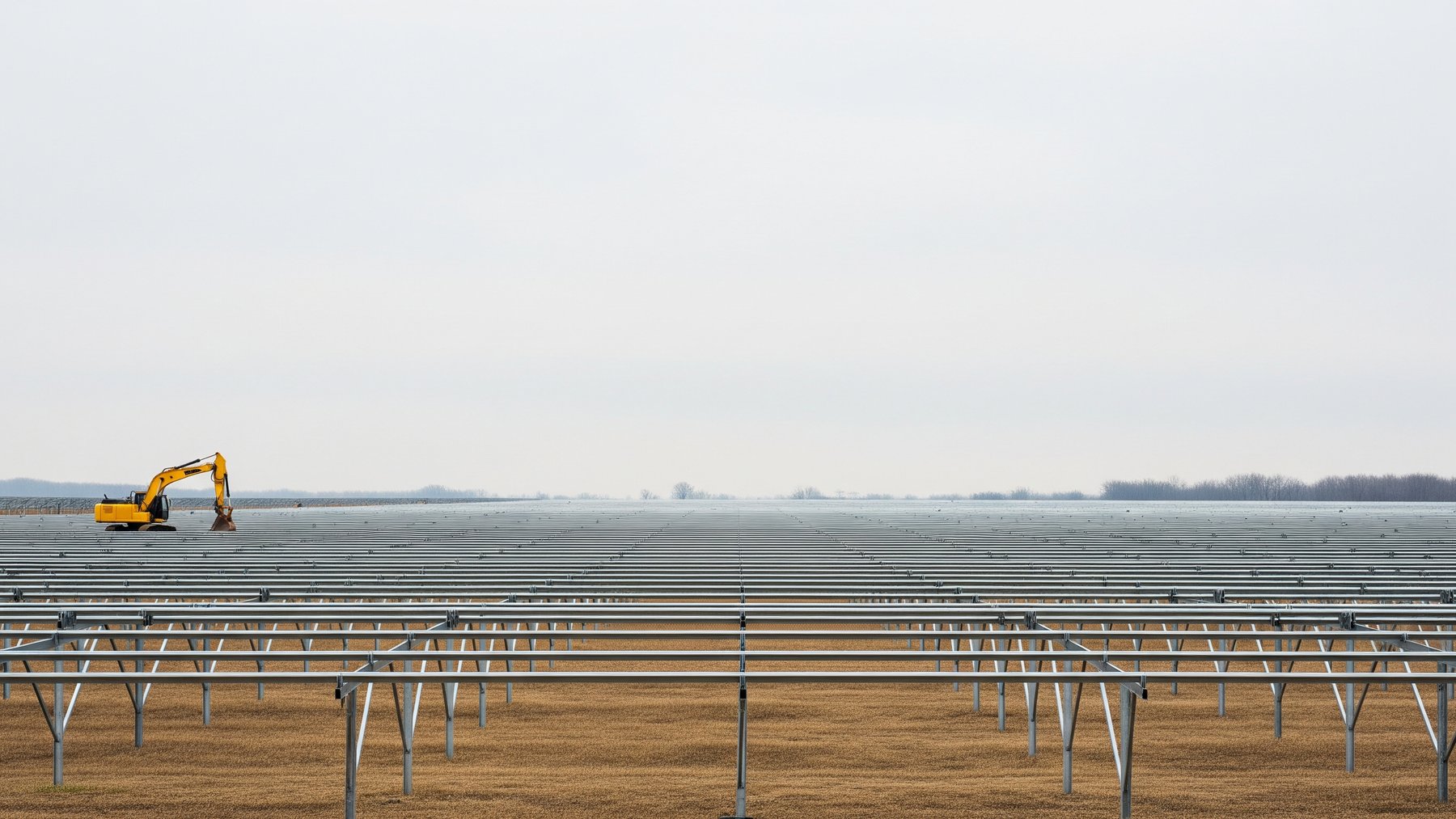
Somewhere in the American heartland sits a wide, flat field.
It was supposed to be covered in solar panels by now.
The land was leased, the permits filed, the money lined up.
Everything was in place for the work to begin.
And then, quite simply, nothing happened at all.
It was not because the panels had grown too expensive.
And it was not because the town said no.
The field that was ready but never got built
Picture a 200 acre farm in the middle of a flat state.
Rows of steel racking already stand bolted into the ground.
A site trailer waits at the edge of the property.
But the crew that was meant to arrive never came.
This is not some rare or isolated scene.
Fields like it sit stalled all across the country.
Some hold their steel frames for a year or more.
Others were canceled before a single beam went in.
Nearby counties had even started paving roads to future sites.
Then they shelved those plans as well.
Something had abruptly stopped a whole wave of clean energy.
And almost no one outside the industry noticed it.
Cheap panels, stalled projects
The strange part is that solar power has never been cheaper.
Panel prices stayed low and steady right through 2025.
Demand for electricity, meanwhile, kept on surging higher.
Data centers and factories were hungry for new power.
The sites were ready and the hardware was affordable.
So the cost of the panels was clearly not the problem.
Even the old worry of project delays was easing.
Government data showed fewer solar projects slipping their dates.
By late 2025, delays had dropped compared with the year before.
So a growing backlog of late projects was not the issue.
But delays were not the real story here at all.
Something else was erasing projects from the map entirely.
They were not just late, they were gone for good.
And the dollar total kept climbing every month.
Why a ready solar farm still goes nowhere
Building a solar farm is really two separate problems, not one.
The first is making and then installing the panels themselves.
Falling prices have largely solved that first problem.
The second problem is connecting the farm to the grid.
And that is where project after project gets stuck.
A finished farm cannot sell a single watt until it is hooked up.
New projects must join a long line called the queue.
They wait their turn for studies, approvals, and upgrades.
By the end of 2023, that queue held nearly 2,600 gigawatts.
That is more than twice all the power capacity now installed.
Worn transformers and a shortage of skilled crews slow it further.
A field of panels that cannot connect is just an expensive lawn.
The wait can stretch on for years.
The 68 billion dollar answer
Here is the single number that stops people cold.
According to one report, 216 large clean energy projects were canceled or downsized since early 2025.
Together they represent more than 68 billion dollars in lost private investment.
The same projects would have supported nearly 470,000 American jobs.
And they would have added over 90 billion dollars to the wider economy.
A new federal law played a big role in the collapse.
It abruptly shortened the window to claim clean energy tax credits.
For years those credits had made big projects possible to finance.
Projects not already well underway faced a sudden hard deadline.
A slow grid queue suddenly turned into an outright death sentence.
The panels sat in warehouses as the window slammed shut.
What looked like a delay became a permanent loss.
What a stalled queue means for a real place
The queue is not just some far off industry problem.
It is the reason a specific small town loses real tax revenue.
It is the reason promised construction jobs never appear.
A canceled project takes its wages and spending with it.
Factories that would have built parts stay closed as well.
Families that hoped for steady work look somewhere else.
The wider loss has already been counted in the billions.
The good news is that none of this is permanent.
According to one account, most of the queue is solar, wind, and storage.
A faster connection process could unlock much of it again.
Steadier tax policy would bring many canceled plans back.
The same tug between clean power and the real world shows up elsewhere, from a solar farm fox to the seals near an offshore wind farm.
The field still sits there, its racking bare and waiting.
The panels are cheap, but the connection is the missing piece.


