
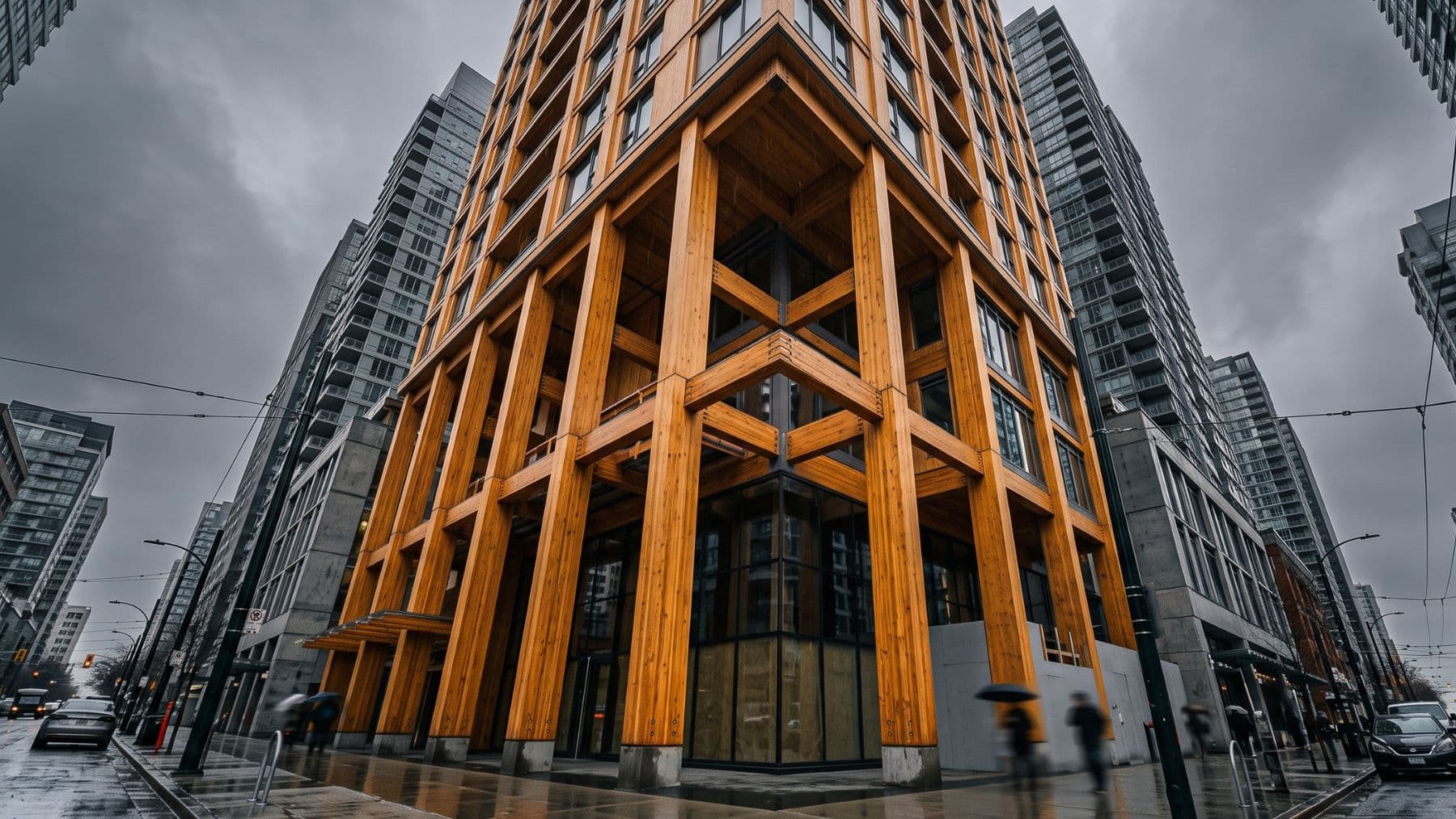
Picture a 25 story apartment tower rising above downtown Milwaukee.
Now picture that nineteen floors of it are made of wood.
Not trim and not paneling, but the actual skeleton, the columns and the beams and the floors themselves.
Most people assume a wood tower that tall sits one stray spark away from disaster.
What settled that question happened inside a laboratory in Madison, and the result surprised seasoned engineers.
A building nobody thought the city would allow
In 2017, Milwaukee developer Tim Gokhman came across a concept study for an 80 story high rise framed in wood.
The design was called River Beech Tower, and it was never built.
He decided to build one of his own anyway.
What followed was a five year fight through permits, engineering reviews and fire codes that nobody had written with a wooden skyscraper in mind.
The city had no rulebook for this.
Nobody did.
The building, called Ascent, had to prove it could meet the same fire safety standards as a concrete or steel tower before a single approval came through.
That proof had to come from measured data rather than from a hunch.
The material that surprises every engineer who tests it
Mass timber is not the thin framing lumber inside a typical house.
Two products matter here, and they are built differently.
Cross laminated timber stacks boards in alternating directions and bonds them into panels, which is what makes a floor stiff in both axes.
Glue laminated timber, or glulam, runs its laminations the same direction, which is what lets a column carry load straight down its length.
Ascent uses both.
Glulam is not as strong as steel in absolute terms, and any structural engineer will say so plainly.
What it offers is a remarkable ratio of strength to weight, and that ratio changes everything below ground.
A lighter building needs fewer piles driven less deep.
Shallower foundations mean shorter excavation, which cut weeks off the early schedule.
What fire actually does to a wood wall
Here is what most people expect: wood burns, so a wood building burns faster.
Here is what actually happens.
The outer surface of a heavy timber member turns to charcoal.
That char layer insulates the wood underneath it.
The interior stays cool enough to keep carrying load long after most observers assume it has already failed.
Steel does not char.
Steel loses strength and deforms as temperatures climb, while a thick wood column buys time.
That difference matters enormously when firefighters need a window to work inside a burning structure.
The open question was never whether char protects the core, but how fast it eats inward.
The number that came out of the fire lab
To leave roughly half the timber structure exposed inside the finished building, the team had to show Ascent could meet Type I standards.
Working with the Forest Products Laboratory in Madison, they ran the world’s first three hour glulam column fire test.
Douglas fir, black spruce and Austrian spruce all went into the chamber.
American code assumes wood chars at a nominal 1.5 inches per hour, and that assumption had only been validated out to two hours.
The columns charred more slowly than that, at roughly 1.3 inches per hour across the full three, according to the published results.
The wood burned back slower than the rulebook demanded.
The columns met or exceeded the required rating, and the code figure was confirmed as deliberately conservative.
The project drew support from the Wood Innovations program, and the findings were released publicly for anyone designing the next tower.
Hardware evidence of that kind decides whether a project happens at all, much as an offshore project lives or dies on the equipment available to build it.
Why the Milwaukee record did not last, and why that is the point
Ascent opened in July 2022 with 259 apartments across 493,000 square feet in the Yankee Hill neighborhood.
At 284 feet it took the world record for a mass timber building.
It does not hold that record anymore.
Atlassian Central in Sydney topped out in July 2026 at 591 feet across 39 floors, more than doubling the Milwaukee mark, as architecture coverage reported.
Milwaukee is not standing still either.
The Edison broke ground in the same city in June 2025, aiming to become the tallest mass timber tower in the Western Hemisphere.
Every one of those projects rests on public test data that did not exist before Ascent forced the question.
One honest caveat remains, because timber frames still carry a cost premium over reinforced concrete.
Closing that gap needs more projects and more shared engineering, the way public argument around a solar site usually outlives the technical questions.
Mass timber also locks carbon captured from the atmosphere for as long as the building stands.
The record moved on within four years, and the reason it could move sits in a laboratory report from Wisconsin.


