
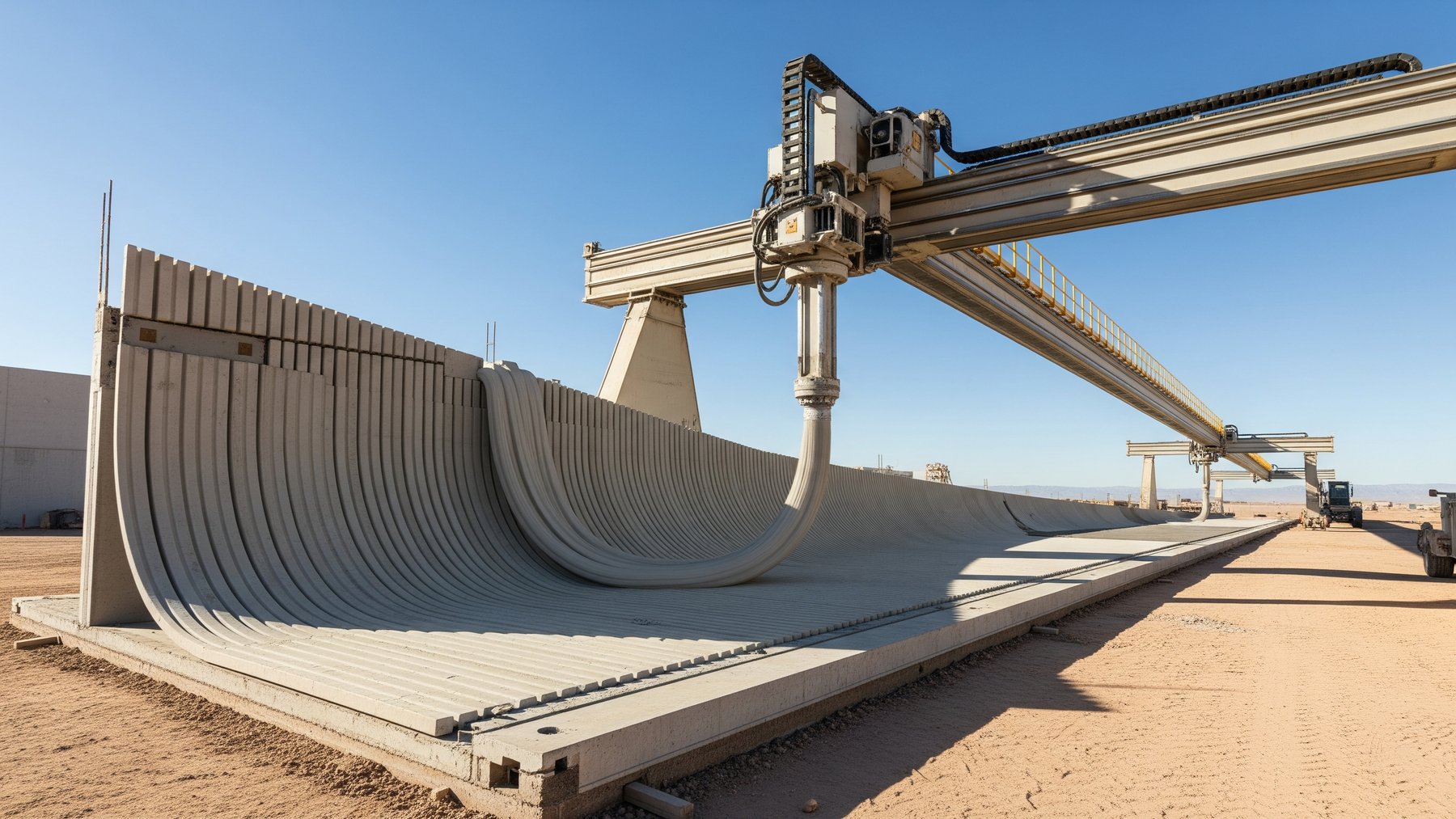
Somewhere in Doha, a robotic gantry printer spanning 50 meters in length is drawing walls out of thin air.
It moves back and forth in the desert heat, squeezing out a thick ribbon of concrete, one layer at a time.
No forms, no shuttering, no army of laborers stacking block on block.
Just a machine tracing a blueprint, building up walls the way a pastry chef pipes frosting, except the frosting weighs several tons per pass.
What it is building will break a record so completely that the old record barely registers by comparison.
The building that used to hold the crown
Until very recently, the biggest 3D printed building on Earth was a horse barn.
Not a stadium, not a skyscraper.
A horse barn in Wellington, Florida.
The Printed Farms equestrian facility in Wellington earned the distinction of being the largest 3D printed building on the planet, surpassing the previous record holder in Oman by roughly half again its size.
It spanned just over 10,000 square feet and it was, genuinely, a marvel.
The facility proved that printed buildings could hold up in hurricane prone Florida, demonstrating real resilience in extreme weather.
Engineers pointed to it as proof that printed structures could be durable and practical.
Then Qatar came along and rewrote everything.
A number that takes a moment to land
The new project is not slightly bigger than the Florida barn.
It is not twice as big, or five times as big.
The 3D Printed Schools Project in Doha spans 40,000 square meters across two large scale public schools, part of a programme to deliver 14 new educational facilities across the country.
That is forty times larger than any previous 3D printed structure in the world.
Picture the Florida barn sitting inside one corner of one of these schools and barely filling a hallway.
Each school is a two storey building with flowing curved walls and a 100-by-100-meter footprint.
Both schools are being printed, wall by wall, in one continuous robotic operation.
The sheer scale of that task required a machine that had never existed before.
The printer that swallowed a hangar
To build something this large, the construction team needed to invent a new category of machine.
UCC Holding and Qatar’s Public Works Authority commissioned COBOD to produce two customized BODXL printers, each measuring 50 meters in length, 30 meters in width, and 15 meters in height.
For scale, that is roughly the size of a Boeing 737 hangar.
The printer is over four times larger than the next largest 3D construction printer ever developed.
It rolls across the site on rails, its nozzle arm sweeping back and forth with robotic precision, extruding a cement based mixture in layers that harden as they stack.
Construction runs largely at night to avoid Qatar’s extreme heat and to optimize how the material sets.
The school designs draw on the surrounding desert landscape, with curved walls intended to mirror local dune formations, shapes that would be costly through conventional methods.
What the machine is actually doing to construction
The project, confirmed in June 2025 by COBOD and UCC Holding, is now on record as the world’s largest 3D printed construction project.
It is also being considered for a Guinness World Record as the largest structure ever built using 3D printing technology.
The printers extrude a cement based mixture through a robotically controlled nozzle, following a digital blueprint and building up the structure automatically.
Once the printed shell is complete, human builders add the roof, doors, windows and everything needed to turn a structural shell into a working school.
That division of labor is the real shift: the machine handles every wall, every curve, every structural layer.
Engineers conducted over 100 test prints at a dedicated trial site in Doha before the main build began.
Why this moment matters beyond Qatar
The honest caveat is that 3D printed construction is still young, and a building of this scale has never been finished before.
Whether the walls perform as well as poured concrete over decades in a desert climate is a question only time will fully answer.
COBOD’s third generation machines incorporate advanced automation expected to reduce timelines and reliance on manual labor.
If it works at this scale, the implications reach well beyond Qatar.
School districts in the American South, where construction costs keep rising, are watching projects like this one closely.
A printer that can lay out a full multi story school without traditional formwork could change how fast communities build the places where their children spend their days.
The stakes are real, and so is the machine proving it is possible.
For now, it keeps moving through the Doha night, layer by layer, drawing a building out of the desert floor, while a very different kind of record fades in a barn in Florida.


