The deck had held cars since the late seventies, thousands of them, every day, without complaint.
That morning it was holding one thing instead.
Then it was not.
The operator rode it down, climbed out with a cut on his hand, and was checked over and released.
Which leaves the question the crew asked before anything else got moved. How does a floor built for traffic fail under a single load?
Why a deck that carried cars gives way under one machine
A parking structure is designed for weight spread thin.
The number the engineer works to is a live load per square foot, sized for a bay full of light vehicles, each one resting on four small contact patches and none of them staying long.
A tracked machine is the opposite of that in every way that matters.
Its whole mass sits on two tracks, and the moment it slews, or reaches out, or sets a bucket down, that mass moves onto part of one track.
The slab does not sag under it. It shears, in a ring, and the piece under the machine goes down as a plug.
Demolition makes the arithmetic worse hour by hour.
Walls, beams and columns are coming out in sequence, so the path a load takes to the ground is different in the afternoon from what it was at breakfast.
The protection against that is a written sequence and temporary shoring, plus a rule about exactly where the machine may stand. The margin is not generous, and it does not warn you.
What was being torn down, and what replaces it
The site is Courthouse Square in Washington, Pennsylvania, a small city southwest of Pittsburgh.
It carried a seven story county office building from the late 1970s and an attached parking garage, both of them long past useful.
The plan is to clear the block and put up a three story public safety center in its place, holding the emergency dispatch center, the sheriff’s office, a booking center and county offices.
The demolition contract runs to about 1.555 million dollars.
Before any of it started, the county had already approved a separate 1.44 million dollar job to shore up the walls.
The order things happened in
Demolition began on 2 March 2026.
The excavator went through on 3 March, the second day of the job, dropping about 15 feet into a basement level and coming to rest on its side.
The machine weighs roughly 135,000 pounds, which is the 67 tons in the headline and nothing more than that.
Recovery work started on Monday 9 March and the excavator was out of the hole within a few days.
A federal safety investigation opened and closed before the lifting began, and the contractor, a demolition firm out of Detroit, admitted fault in a letter to the county.
How they actually got it out, and what the numbers are not
It was not a crane job.
Crews backfilled gravel underneath and alongside the machine until they had a working platform in the pit, then used a heavy rotator wrecker to hold it steady while a second recovery unit, rated above 150,000 pounds, rolled it back onto its tracks and drew it out.
At the critical moment they started the excavator’s own engine and retracted its boom, which shifted the center of gravity enough to finish the lift.
Two figures in circulation are wrong. The excavator does not weigh 147,000 to 176,000 pounds, and the second machine is not rated at 138,000, as the local paper and the trade coverage between them make clear.
Early reports disagreed too, one putting the machine at 30 tons and another counting three mobile cranes on the street.
And the week is the machine, not the job. Demolition did not resume until early April, because engineers had to go through what was left of the structure first.
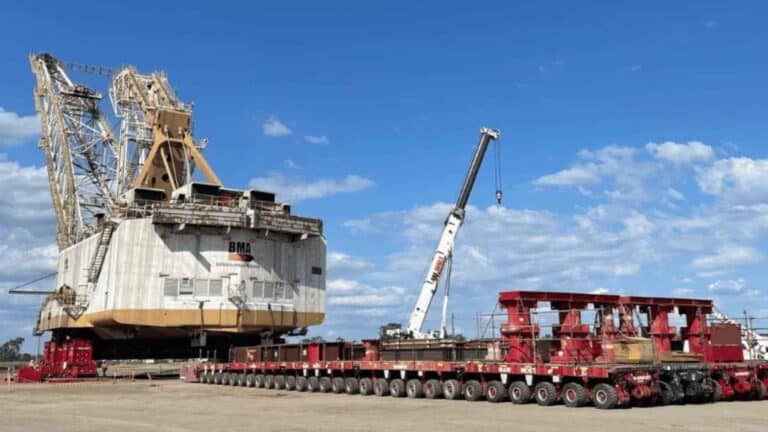
Slabs failing under load they were never given is an old story, as props under a wet floor showed when they gave way, and getting a stranded giant back on its feet is its own trade, as a mine dragline put onto wheels showed.
What the month cost, and who pays for it
Nobody was seriously hurt, which is the only part of this that went well.
The county says the contractor’s insurer covers the recovery, not the taxpayer, and the letter admitting fault is what makes that stick.
What insurance does not cover is the calendar.
A month of a stopped site is a month of crew, plant and interest, and it lands on a schedule that ends with a dispatch center somebody is waiting on.
The lesson is unglamorous and old. On a demolition the structure is a moving target, and the machine standing on it is the heaviest thing that structure has ever been asked to carry.
Where it stands is not a detail. It is the whole plan.