
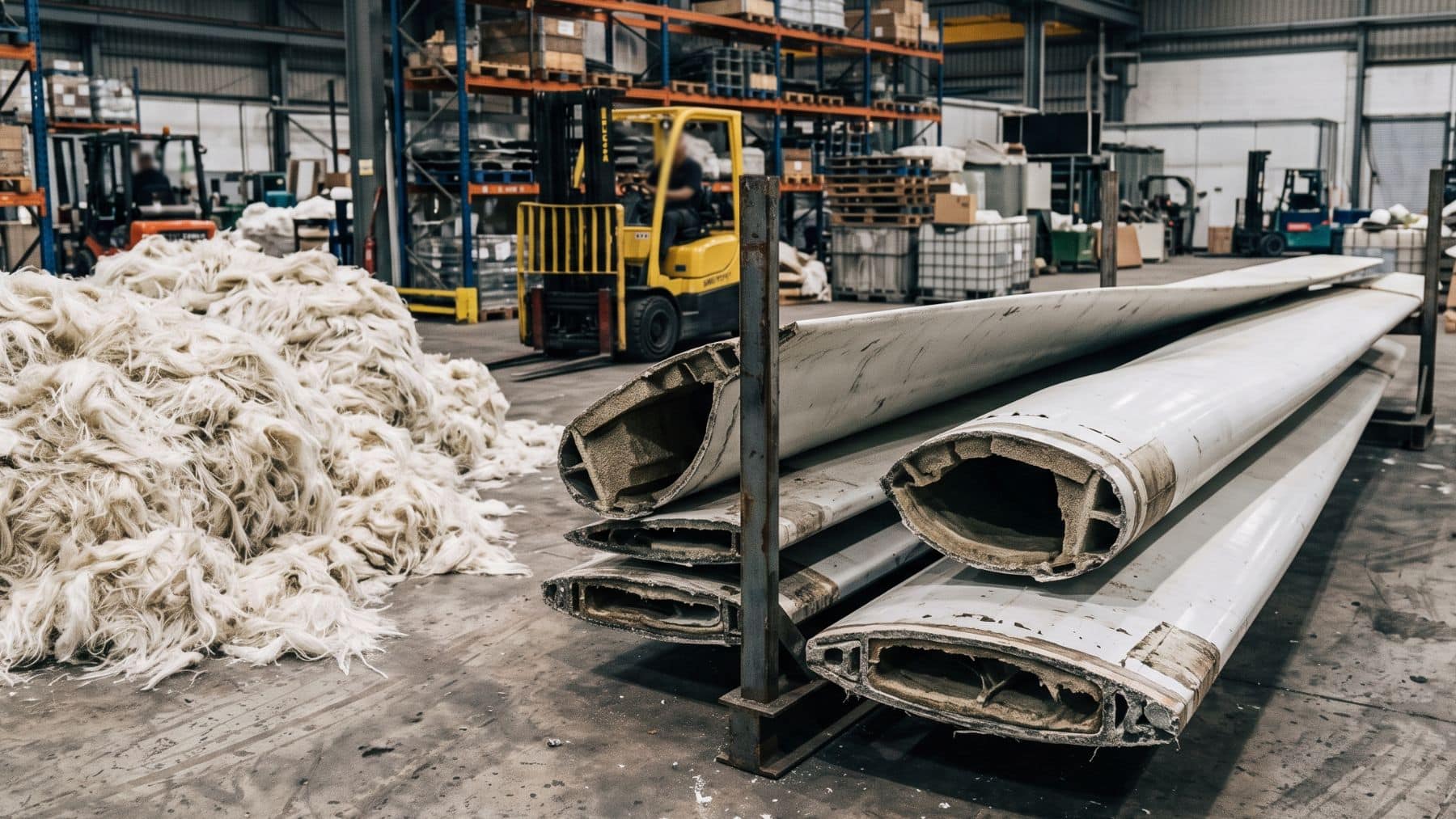
Picture a blade taller than a 15-storey building, curved and white, leaning against a sky it spent two decades slicing through.
When a wind turbine reaches the end of its working life, that blade has to go somewhere.
For years, the answer was a landfill in the middle of nowhere, a decision that felt permanent and a little embarrassing for an industry built on clean energy.
But something has changed, and the surprise is hiding inside the blade itself.
The giant thing almost everyone overlooks
A modern wind turbine blade is, by almost any measure, one of the most remarkable objects humans make at scale.
Most stretch well beyond 170 feet from root to tip on land based turbines, with the largest offshore models now exceeding 350 feet, so long that the full rotor sweeps a diameter wider than a football field end to end.
Each one is built to flex in gale force winds without snapping, to spin year after year through ice, salt air and baking summer heat.
That toughness is the whole point.
It is also the problem.
The same composite materials that make a blade nearly indestructible in the air make it almost impossible to break down on the ground.
Traditional recycling equipment struggles to process it, and with first generation wind farms now hitting 20 to 25 years of service, the blades are coming down by the thousands.
A wave of retirements no one fully planned for
Wind energy grew fast in the United States, and the machines installed during that first boom are aging out all at once.
Tens of thousands of turbines globally are expected to reach end of life by 2030, according to market analysts tracking the sector.
Each turbine carries multiple blades, and depending on size each blade can weigh several to around 10 tons.
Landfill was the default.
Workers would saw a blade into sections, haul them on flatbed trucks across state lines, and bury them in long narrow trenches cut into open ground.
Photographs of those trenches, rows of white blade sections sticking out of the dirt like the bones of enormous fish, spread widely and made a lot of people uncomfortable.
The industry knew it had a blind spot.
What a blade is actually made of
To understand why engineers got excited, you have to look inside the blade itself.
A typical turbine blade is roughly half glass fiber by weight, with carbon fiber used selectively in higher performance models, bonded together with tough resins to create a shell stronger than steel at a fraction of the mass.
That glass fiber is the key.
It is the same material used in high performance boat hulls, aircraft interiors and premium car panels.
New glass fiber is expensive to produce, energy intensive to manufacture and increasingly in demand as construction and automotive industries look for lighter, stronger materials.
A used turbine blade, in other words, is not a pile of garbage.
It is a stockpile of raw material that industry has been paying to bury instead of selling.
The moment engineers started treating it that way, the numbers changed completely.
The dollar figure hiding in every old blade
A Knoxville, Tennessee company called Carbon Rivers, backed by the U.S. Department of Energy’s Wind Energy Technologies Office, has commercialized a process that recovers clean, mechanically intact glass fiber using a pyrolysis method.
Their process produces high quality recovered fiber at a level that allows it to go directly into new composite manufacturing.
That fiber can supply car panels, building materials and new turbine blades themselves.
Carbon Rivers has already upcycled a few thousand metric tons and is building capacity to take in over 50,000 metric tons annually.
The vast majority of a wind turbine’s mass, steel, copper and concrete, is already commercially recyclable, meaning the blade is the last frontier.
A pile of old blades in a field is no longer a liability waiting for a landfill permit.
Engineers now treat it as a feedstock worth competing for.
Where this leaves the turbines turning right now
The shift in thinking has already begun to change how new blades are designed before they ever spin.
Major turbine manufacturers have announced zero blade to landfill targets by 2030.
Future blades are being built with thermoplastic resins that can be reheated and reshaped, making end of life recovery far more straightforward.
Recycling still costs more per ton than landfilling where landfill remains legal, and closing that gap is the real challenge of the next decade.
But the trajectory is clear and the incentive is real.
Every blade that comes down today represents a choice between a landfill trench and a factory feedstock, and the financial case for the second option grows stronger every year.
That same white fiber, cleaned and pressed, could form the door panel of a car, the hull of a boat or the wing of the next turbine to rise.
The blade that spent 20 years making clean energy is not finished yet.
One update belongs at the end of this story.
Readers have pointed us to an open enforcement case involving Carbon Rivers.
In February 2026 the Tennessee Department of Environment and Conservation ordered the company to stop accepting material at its processing site and to clear everything within one year.
The case number is SWM25-0034.
Inspectors visiting on July 21, 2026 reported shredded fiber still escaping into the environment.
They also reported that the company had not demonstrated a viable market for the recovered fiber.
Carbon Rivers neither admits nor denies the findings.
The company says an offtake customer ended its agreement in early 2025, and it has committed to clearing the site by February 2027.
The paperwork sits in the state’s public enforcement register, where anyone can read it.


