
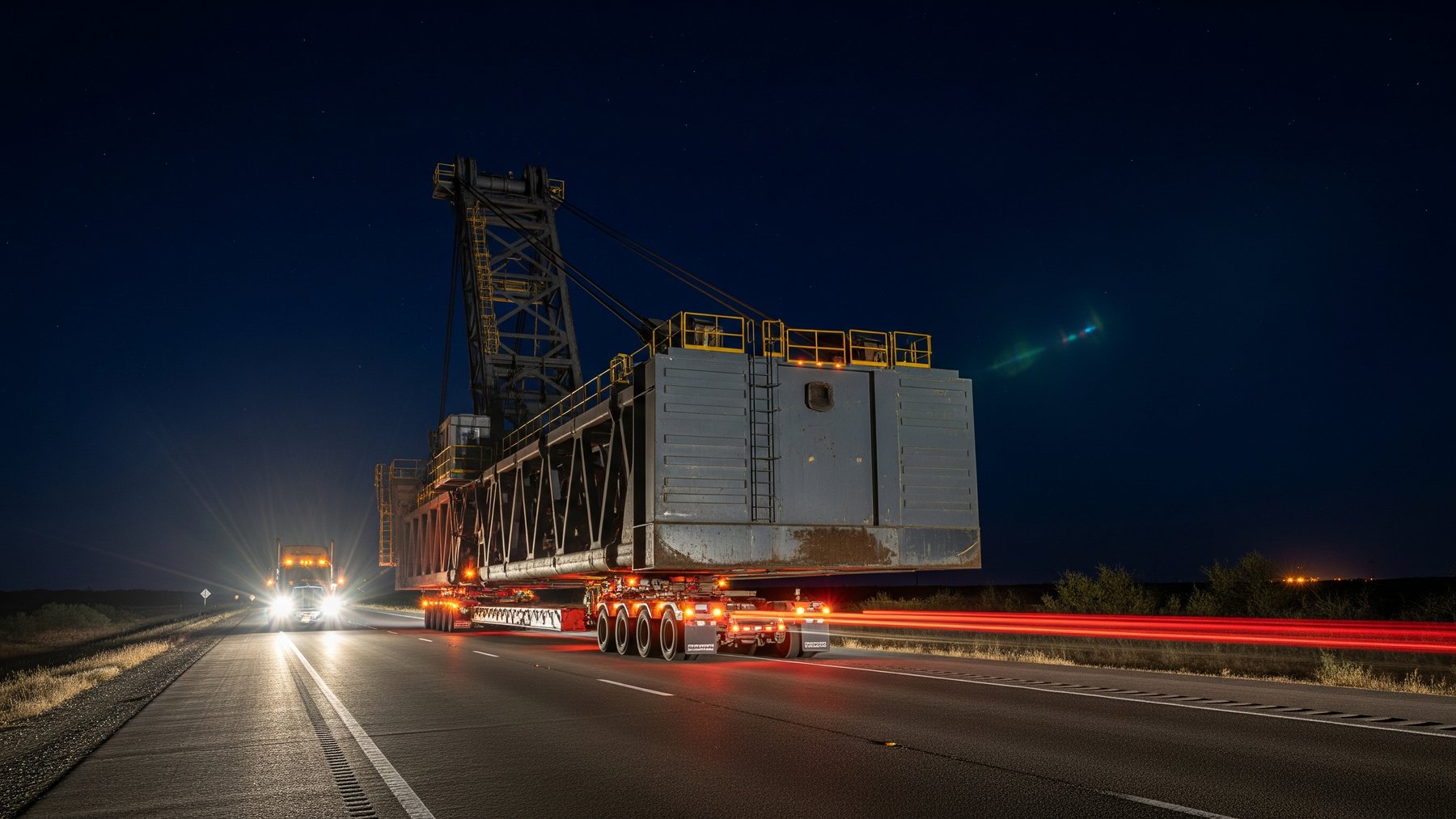
Something enormous moved through Texas in 2024, and most people had no idea it was happening.
It traveled at a crawl, spreading across multiple lanes, bending traffic detours around small towns and low bridges.
It was not one load.
It was not ten.
It was 27 separate convoys, each carrying a piece of something so large that no single truck on the planet could move the whole thing at once.
And what that machine had left behind at the Texas mine it called home was about to become something nobody in the industry saw coming.
The kind of machine that redraws the land
A dragline does not look like any excavator you have ever seen beside a highway.
It walks, slowly and methodically, on two giant flat shoes called pontoons, shifting its own weight forward one lurch at a time.
The Marion 8200 is a very large walking dragline, originally manufactured by the Marion Power Shovel Company and now produced under the Caterpillar name.
Its boom stretches 328 feet into the sky.
Its bucket hangs from cables thicker than a man’s arm and can swallow up to 80 cubic yards of earth in a single bite.
To put that in a picture: one scoop fills roughly five standard dump trucks in a single motion.
The machine does not chip or scratch at the ground.
It rewrites it.
The job that no convoy driver forgets
When a dragline finishes its work at one mine and needs to move to another, it has to be taken apart piece by massive piece and loaded onto specialized trailers built to carry loads that would crush ordinary trucks flat.
With a working weight of 9.1 million pounds, the Marion 8200 is a genuinely staggering machine.
One such machine completed a project at a location in Texas and needed to reach another mine, also in Texas.
The Frontier Heavy Haul team moved 27 loads with a combined weight of 4,412,000 pounds.
The lightest piece weighed 39,500 pounds and the heaviest reached 412,000 pounds.
Each load required its own route survey, its own permits, and its own team of pilots guiding it around obstacles.
The convoy crept through the Texas landscape for weeks.
The road that never really ends
Moving a dragline across a state is one of the most demanding logistics puzzles in all of heavy industry.
Load dimensions ranged from 18 feet up to 135 feet 6 inches in length and from 2 feet up to 28 feet in width.
Several specialized trailers were required, including a 13-line Scheuerle highway giant platform trailer with pull and push trucks.
Bridges had to be checked and sometimes bypassed entirely, and power lines had to be lifted out of the way by utility crews at each crossing.
The goal was to cut the machine into as few pieces as possible, since reassembly alone would take about a year and a half.
That means the Marion 8200 will not take another bite of Texas earth until well into 2026.
But back at the mine it left, something else entirely had already started to happen.
What a 9 million pound machine leaves behind
A dragline’s real legacy is not the coal or ore it uncovers.
It is the landscape itself: vast sculpted pits that can stretch hundreds of acres wide and plunge dozens of feet deep.
For decades, those pits were seen as scars left on the land.
Then wildlife biologists began watching what happened when the machines moved on and the water crept in.
Across the American South and Midwest, old dragline pits have filled slowly with groundwater and rain to become unexpected lakes and wetlands.
Ospreys, great blue herons, and wood ducks have colonized them.
Largemouth bass and bluegill have established self sustaining populations in water that was bare rock just years before.
Reclamation scientists document how these flooded pits can develop complex food webs within a single decade.
The machine that tore the earth open also carved the bowl that life rushed in to fill.
The pit and the pelican
It is a genuinely strange truth that some of the most productive dragline machines in American history have left behind some of the most surprising wildlife refuges on the continent.
Birders in states like Alabama, Kentucky, and Illinois have learned to seek out old surface mines the way they once sought pristine national forests.
American white pelicans, once considered rare this far inland, now appear in substantial numbers across Illinois each spring and fall.
None of this was planned, and none of it appeared in any engineer’s original blueprint.
It happened because nature, given a bowl of still water and a little time, does not wait for an invitation.
The Marion 8200 is being bolted back together at its new Texas mine right now, piece by enormous piece.
It will dig again.
And eventually, when its work is done, the ground will fill and the herons will return, just as they always have.
The biggest machines on earth keep leaving gifts that nobody ordered, and the wildlife keeps showing up to collect them.


