
Something enormous is happening about 43 miles off the Suffolk coast right now, and almost no one can picture what it looks like.
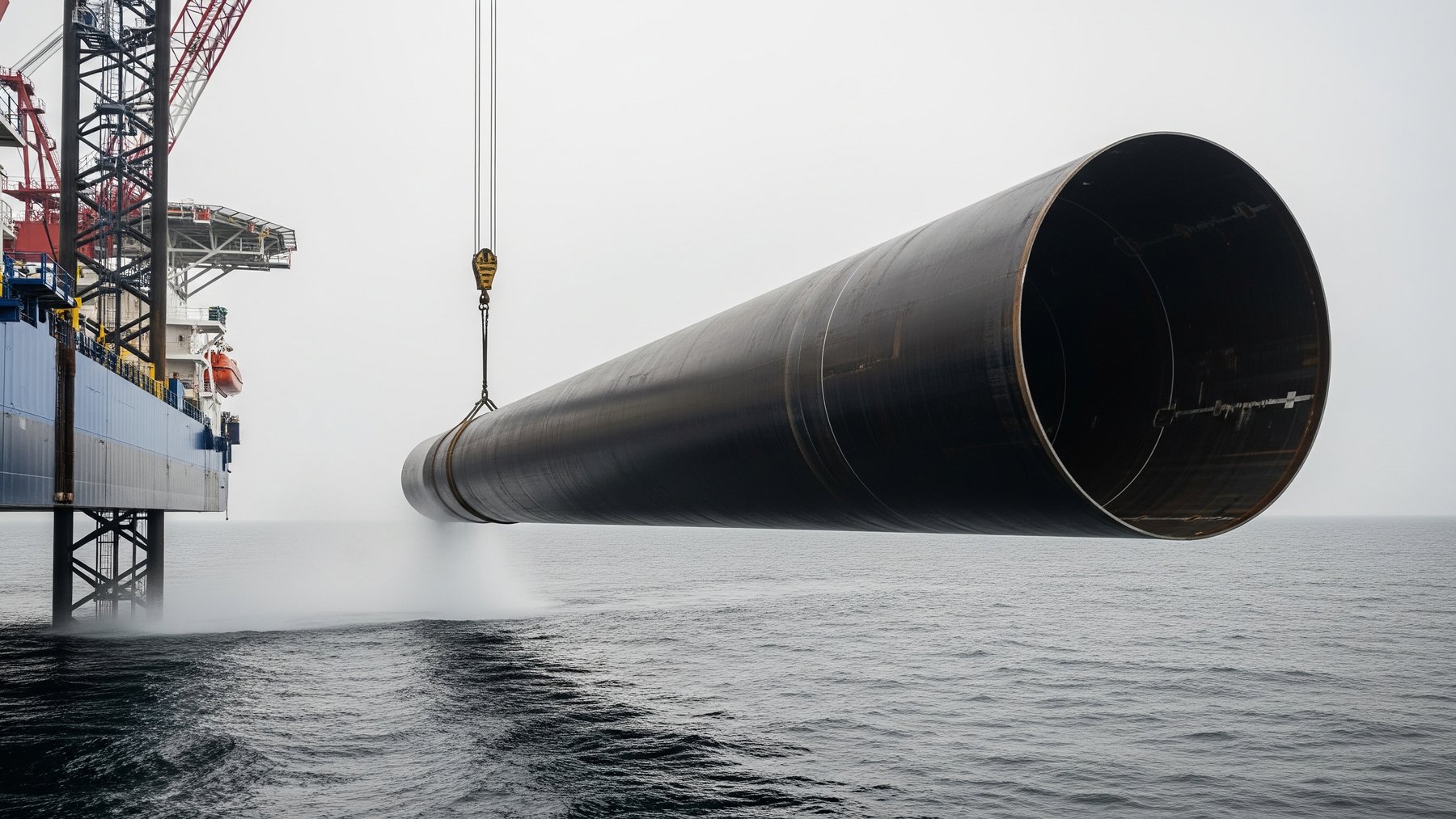
A vessel the size of a small office building is standing on four giant legs planted on the seabed.
From its deck, a crane is lifting a steel tube so wide that a school bus could drive straight through it.
Then, with extraordinary precision, engineers drive that tube deep into the ocean floor and walk away.
What holds a turbine standing in open ocean for thirty years is not what most people imagine.
And it is not the blades everyone watches.
A machine parked on the sea
The vessel doing this work is called the Seaway Ventus, a jack up installation ship.
Jack up vessels are a remarkable piece of engineering on their own.
They sail to the site as a normal ship, then extend four steel legs down through the water.
The legs push into the seabed until they grip it firmly.
The hull is then jacked upward, lifting the whole vessel clear of the waves.
That creates a stable working platform in the middle of the ocean.
It is immune to the rolling swell that would make a precise crane lift impossible.
It is the only way to hit a target on the sea floor dozens of feet below.
Everything about the vessel is built to work far from any shore.
The engineering challenge does not end with the vessel, though.
The scale is genuinely hard to picture
The tube the Seaway Ventus is handling is called a monopile.
This one just set a European record at 275 feet tall.
That is roughly the height of a 27 story building, except it is a hollow steel cylinder.
It measures nearly 35 feet across and weighs 1,800 tons.
To put 1,800 tons in terms a person can feel, that is heavier than roughly 900 full size pickup trucks stacked together.
The wall of the steel cylinder is several inches thick all the way around.
It is rolled and welded from marine grade plates built to last a generation in salt water.
And this is just one of 95 going into the same patch of sea.
The North Sea does not hold still
Wind, tidal current, and wave action push on anything standing in open water with relentless force.
A turbine running at full power adds enormous rotational loads on top of that.
All of those forces travel down the tower and concentrate at the base.
There they try to rock the structure back and forth like a finger pressing on a pencil.
The solution engineers settled on seems almost too simple for a problem this large.
They drive the steel tube into the seabed the way a person hammers a nail.
A hydraulic pile driver mounted on the vessel does the pounding.
The seabed then grips the steel on all sides.
And friction alone holds billions of dollars of turbine upright against decades of storms.
Why the East Anglia THREE record matters
In April 2025, ScottishPower Renewables began offshore construction on its biggest ever project.
It is the East Anglia THREE wind farm, a 5 billion dollar build in the North Sea.
That first monopile, 275 feet tall and 1,800 tons, set a European record as the largest installed from a jack up vessel.
According to the project team, the vessel carried a custom built equipment spread designed and fitted in under two years.
Each of the 95 monopiles will support a 14.7 MW Siemens Gamesa turbine.
Together they add up to a combined 1,400 MW of clean energy.
Located about 43 miles from the Suffolk coast, the farm is expected to power over 1.3 million homes.
The same push into offshore wind shows up beside a solar farm fox on land.
Foundation technology like this is steadily recalculating what these piles can support.
The number that surprises even engineers
The monopile concept sounds crude next to the sleek turbine it supports.
But the numbers behind it are genuinely striking.
Average monopile weights have climbed sharply over the past decade.
The push toward bigger turbines in deeper water drove that change.
Around three quarters of offshore wind installations now rely on monopile foundations.
That makes this buried steel tube the single most common piece of hardware in the whole industry.
According to one account, a factory in the Netherlands can now roll monopiles about 36 feet across and nearly 400 feet long.
That is a steel column taller than a 39 story building, dropped into the sea floor.
The honest truth the project shows is simple enough.
The most important part of a modern offshore wind farm is the piece you never see, buried beneath the waves.


