
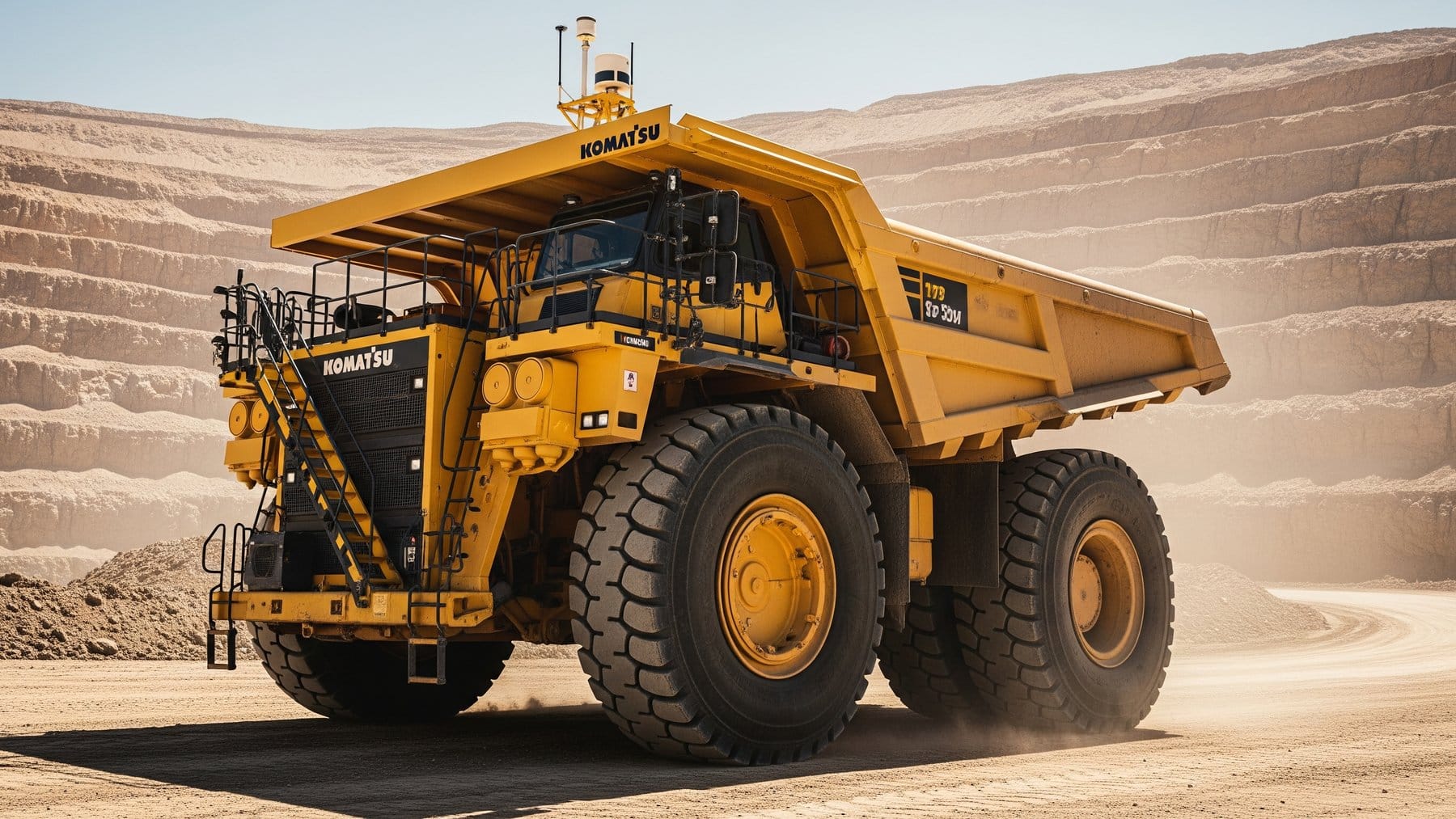
Komatsu commissioned its 1,000th autonomous haul truck on April 21, 2026, placing the milestone machine at Barrick Mining’s Nevada Gold Mines operation in the United States.
The achievement makes Komatsu the first equipment manufacturer in history to reach that number, building on its position as the first commercial autonomous mining haulage provider when it launched the system in 2008.
The location matters because it marks a significant step extending Komatsu’s autonomous haulage into gold mining with a key strategic partner.
What the 930E-5AT actually does at the mine
The truck deployed at Nevada Gold Mines is a Komatsu 930E-5AT, an ultra class electric drive vehicle with a 290 metric ton payload, roughly 320 US tons per load.
At that capacity, each load weighs about as much as 200 full size pickup trucks stacked together.
The 930E-5AT is the most widely deployed model in the FrontRunner fleet, representing more than 500 of the autonomous trucks now in service.
The truck follows a mapped route through the open pit, responding to obstacles, intersections and loading shovels without a person in the cab.
A remote operations center monitors the fleet, and mine supervisors can intervene or reroute any truck from a desk.
That remote oversight model is now standard across every major autonomous fleet operating in North America.
How FrontRunner, the system behind the fleet, works
FrontRunner is Komatsu’s proprietary haulage system, combining onboard sensors, high precision GPS, machine to machine communication and a centralized traffic management layer.
Each truck builds a live picture of the haul road, flags any unexpected object and slows or stops before making contact.
Komatsu recently demonstrated autonomous operation of an electric drive truck connected to a dynamic trolley line, an industry first.
That trolley capability lets a truck draw power from an overhead wire on a long uphill grade, cutting diesel use on the most fuel hungry stretch of any haul cycle.
Combining autonomy with trolley electrification in a single machine is a direction the broader mining industry has been watching closely.
No other manufacturer has publicly matched that combined capability in a production ready truck.
Scale of the fleet and the material it has moved
Since FrontRunner’s commercial introduction, Komatsu customers have collectively moved over 11.5 billion metric tons of material across sites in North America, South America, Australia and Europe.
To put that figure in perspective, 11.5 billion metric tons represents an extraordinary volume accumulated over nearly two decades of autonomous haulage.
As of mid-2024, analysts counted 2,080 autonomous trucks operating on surface mines globally.
Komatsu’s 1,000 units represent nearly half that total.
The largest population of autonomous trucks at that time was in Australia with 927, followed by China, Canada and Chile.
That distribution makes the United States a growing but smaller share of a worldwide market that is expanding steadily.
Why Nevada Gold Mines was chosen for the landmark truck
Nevada Gold Mines is a joint venture managed by Barrick Mining and is one of the largest gold mining complexes in the world, spanning multiple operations across northern Nevada.
Placing the landmark truck there signals that Komatsu and Barrick intend to expand driverless haulage across the full Nevada complex, not just run a demonstration unit.
Gold mining historically adopted autonomous haulage more slowly than copper and iron ore operations, partly because gold pits tend to be narrower and harder to navigate.
The 930E-5AT’s deployment suggests that pit geometry constraints no longer limit the system the way they once did.
Komatsu’s official announcement confirmed the Elko, Nevada site as the deliberate choice for the milestone machine, with Barrick’s president and CEO citing improved safety and production outcomes at the Nevada operations.
Limits, costs and what comes next
Komatsu has not publicly disclosed the per unit price of the 930E-5AT with the FrontRunner system fitted, and full fleet deployment costs vary widely by mine layout and infrastructure.
The system requires significant upfront investment in mapping, communications infrastructure and operator retraining before the first driverless cycle can run.
Critics of autonomous haulage point to job displacement in mining communities, a concern that is pointed in rural Nevada where the industry provides a large share of steady employment.
Komatsu says the technology shifts workers into remote monitoring and maintenance roles rather than eliminating headcount, though independent assessments of net employment effects remain mixed.
Caterpillar is developing competing autonomous systems and ranks among the sector leaders in total autonomous truck deployments; together the two companies account for 74 percent of autonomous haul trucks tracked by industry analysts.
For the broader mining sector, giant machines operating at the edge of engineering limits have become a defining feature of how the world extracts metals and minerals.
Reaching 1,000 driverless trucks in service is a concrete number, but the more meaningful question for mine operators, workers and regulators is what the next 1,000 units look like and where they go.


