
Every time the wind picks up across a Texas plain or a ridge in Iowa, a turbine starts its slow, powerful spin.
The promise on paper is simple: clean electricity for 20 years, almost automatically, with the wind doing all the work.
But deep inside the nacelle, that steel pod perched more than 200 feet in the air, a component is working toward a very expensive problem.
And most of the people paying for wind energy on their monthly bills have no idea it exists.
The machine that makes a turbine actually work
A wind turbine blade turns slowly.
On a typical utility scale machine, the rotor completes somewhere between 10 and 20 full rotations per minute at most.
That is nowhere near fast enough to generate electricity on its own.
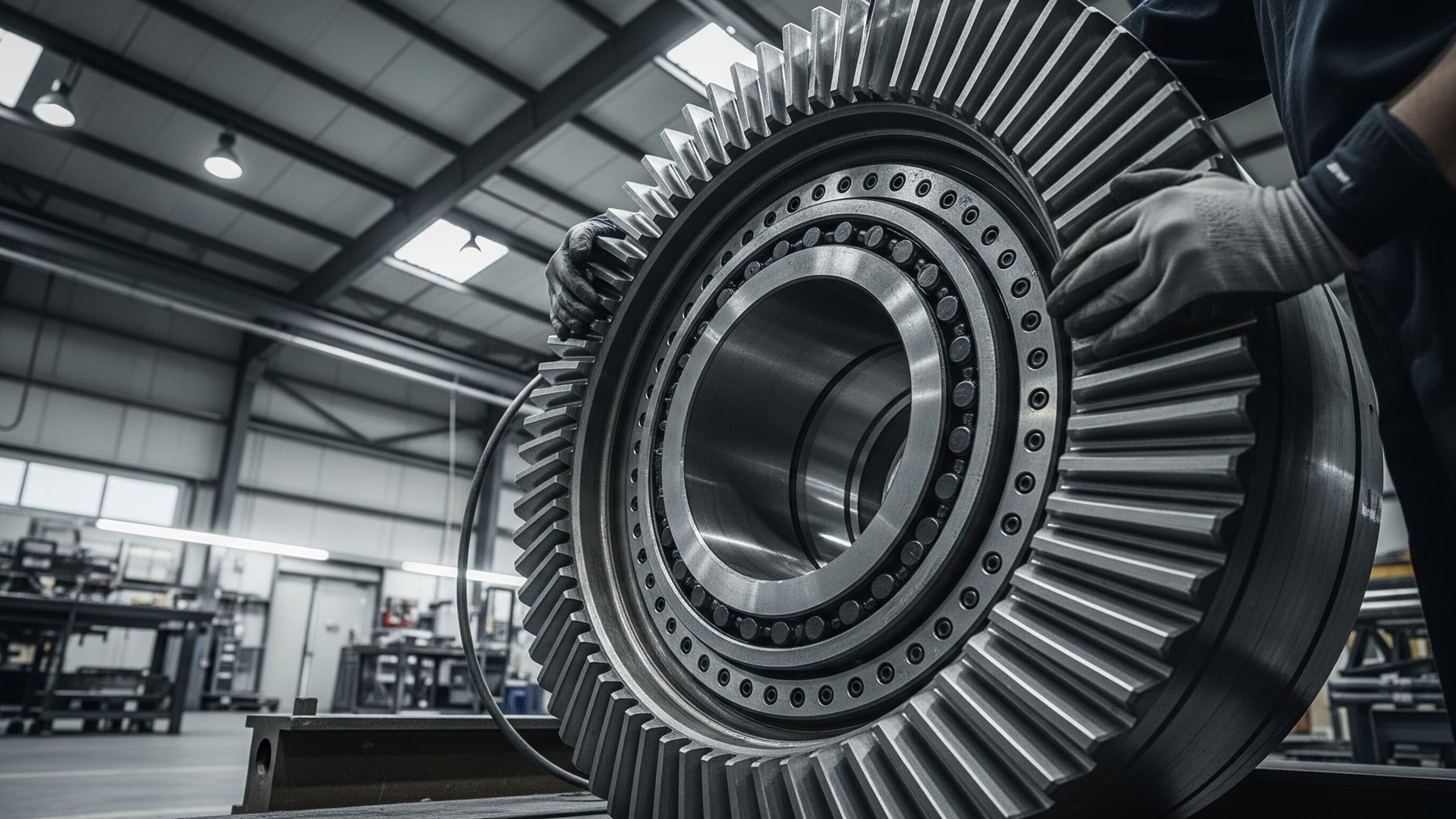
So engineers put a gearbox between the slow rotor shaft and the fast generator.
Its entire job is to take that lazy, powerful rotation and multiply it up to 1,500 RPM or more so the generator can actually make power.
It is a brilliant piece of engineering, and one of the hardest working components on the whole machine.
Every gust, every lull, every shift in wind direction sends a new jolt of stress rattling through its gears and bearings.
The number the industry does not put on the brochure
Wind turbines are designed to last 20 years.
The gearbox inside them is designed to match that same 20 year life.
In practice, it frequently does not come close.
NREL’s own research under its Gearbox Reliability Collaborative documents turbine gearboxes failing well in advance of their 20 year design life, with bearing damage accounting for 76 percent of all gearbox failures.
Axial cracks forming on bearings in the high and intermediate speed stages are the dominant failure location within that bearing category, according to NREL and the DOE.
Current industry data puts the annual gearbox failure rate at roughly 0.7 to 1.0 percent of operating turbines per year.
That compounds into a meaningful cumulative toll over a 20 year life.
That is not a rare edge case.
And the stress patterns that cause the damage are not fully predictable from the outside.
What the bearings are actually enduring
Inside a modern gearbox sits a set of bearings, the rolling steel components that let all those spinning shafts turn smoothly.
A modern utility scale turbine carries many bearings, all of which factor into any system level reliability calculation.
The loads those bearings absorb are not steady.
Wind is chaotic, and every gust creates a sudden spike of force the design models did not always fully capture.
NREL’s Gearbox Reliability Database shows that bearing failures account for 76 percent of gearbox failures, while gear failures account for 17 percent.
The bearings do not announce their damage loudly.
They degrade through tiny, invisible fatigue cracks that multiply over years of punishing stress.
By the time a technician notices a vibration or a rise in oil temperature, the damage is deep.
The up to $400,000 moment nobody plans for
When a wind turbine gearbox finally fails, the bill arrives fast.
A full gearbox replacement currently runs $250,000 to $400,000 including crane mobilization and installation.
If a damaged bearing is identified early, the repair may only cost $15,000 to $70,000.
The difference between those two numbers comes down almost entirely to timing.
A farm operator in Kansas or Wyoming can wait weeks for the right crane, losing output every single day.
The offshore challenge makes logistics even harder, where a service vessel must reach the turbine before any repair can even start.
The US Department of Energy’s NREL has been tracking gearbox failures for years through its Gearbox Reliability Collaborative, because the premature failure problem spans turbine brands and manufacturers.
The fix that is slowly changing the math
The good news is that the industry has known about this problem long enough to start solving it.
Vibration sensors and oil analysis systems can now detect early bearing damage months before it reaches a critical stage.
That early warning window enables planned replacements during low wind seasons, cutting both crane costs and revenue loss.
That single shift, from reactive to planned, can turn a $400,000 emergency into a far smaller up tower repair.
Smaller designs are also emerging, including the low cost approach explored by a Wyoming startup with a compact machine, as covered in our piece on the oval track turbine.
Wind power is still one of the most cost effective sources of electricity the US grid has ever built.
But the gearbox hidden 200 feet above the ground is a reminder that the most powerful machines always carry a hidden bill, and the farms that catch it early are the ones that make the 20 year promise real.


