
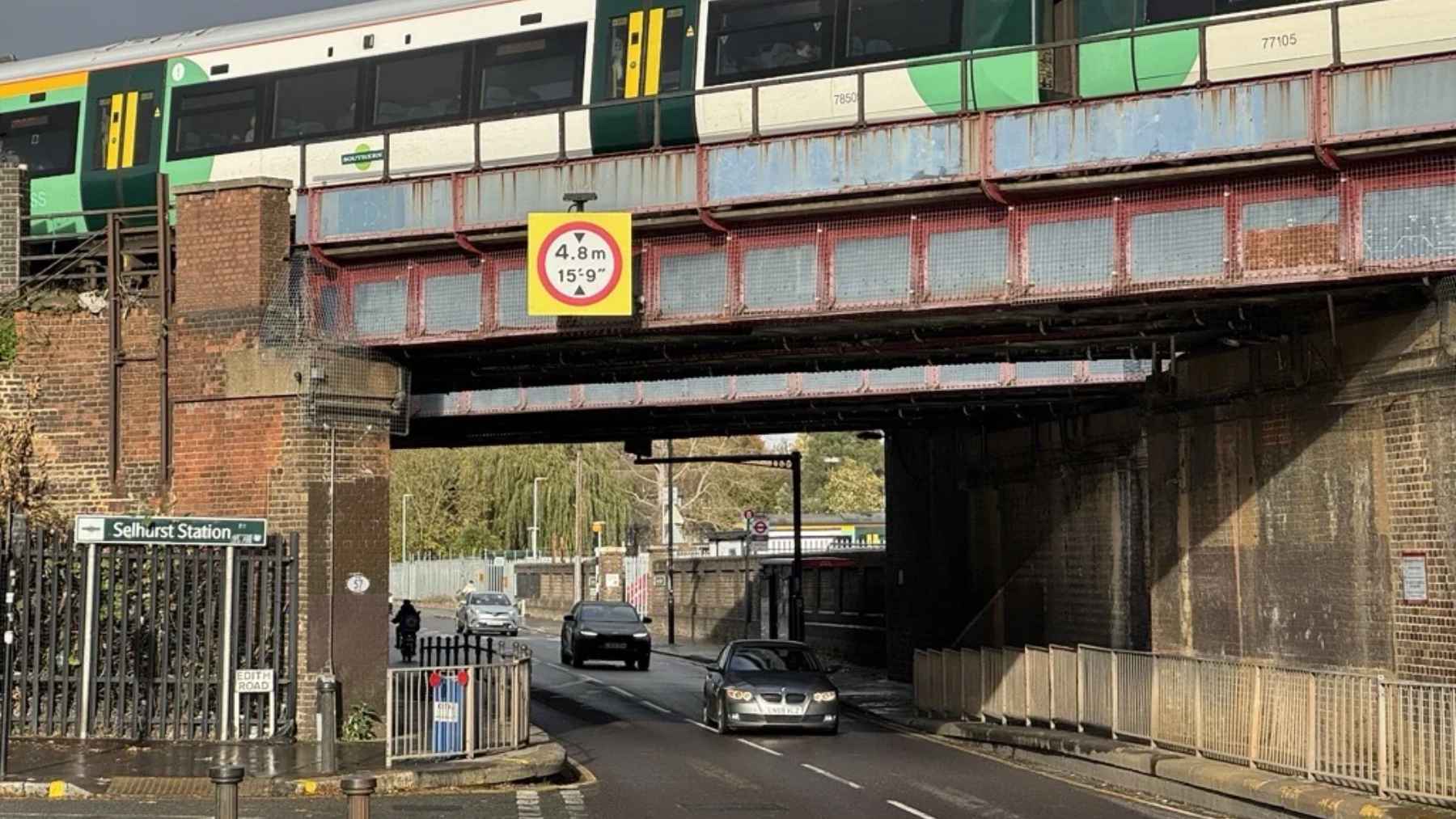
A main road through south London is shut to everything, including people on foot.
Above it sits a wrought iron deck that has carried trains since the eighteen sixties.
The road stays closed from the twelfth of December, 2026, until the tenth of January.
That is twenty nine days to swap one deck, and the heavy part takes a week of it.
No crane will be standing in the street. Not one, and not for an hour.
Which leaves the question that decided everything. What is wrong with a crane?
Why 1 crane pad is the whole problem
Nothing is wrong with the lift. The problem is where the lift has to stand.
A mobile crane does not rest on its wheels when it works. It extends outriggers and puts its own weight plus the whole load through four pads, and every one of them concentrates that into a patch about the size of a doormat.
Under this particular road run utility pipes, and the operator says flatly that their presence means a conventional heavy lift crane cannot be used safely here.
That is a ground problem rather than a lifting problem. The capacity exists. The surface to react it against does not.
So the method changes to one that never concentrates anything, and the deck arrives on wheels instead of on a hook.
165 years and 29 days of closure
The structure itself is modest and very old.
It carries the railway over Selhurst Road beside Selhurst station, and it was built in 1861, which makes it 165 years old rather than the 160 the announcements keep repeating.
The road beneath is a main route between Croydon and South Norwood, and the closure takes it out entirely along with vehicle access on a second street nearby.
The station stays open throughout, which is the part most people will notice least and care about most.
The timing is not sentimental either. It lands across five home football fixtures, including matches on the twenty seventh and thirtieth of December.
The route director says the bridge has had repeated repairs and has reached the end of its serviceable life.
What a dozen axles do that 4 pads cannot
Now the machine that replaces the crane.
A self propelled modular transporter is a low platform riding on many small wheel sets, each one steerable through a wide angle and carried on its own hydraulic leg.
Those legs are linked in groups so the oil can move between them. When one wheel meets a hump the leg gives way, the pressure equalizes and the platform above stays level without anyone touching a control.
Two things follow from that. The deck can be driven sideways into a gap rather than swung into it, and the load is spread across dozens of axles instead of four pads.
The vehicles are driven remotely, which keeps people out from under a span that weighs more than the building next to it.
The heavy phase runs from the twenty seventh of December to the second of January, around the clock, because a railway shut over the holidays is a railway nobody is riding.
What the notice does not say
Here is where the published account thins out.
Nobody has given the weight of the old deck or the new one, in the way that a moved church or a jacked span turns into a simple number.
No span, no transporter count, no axle count and no cost appear anywhere official, and the operator notice is the whole of the technical record so far.
A local news account fills part of that gap with an estimated price drawn from comparable jobs rather than from anyone involved, and the local report is clear that the operator never stated one.
The trade is stated plainly though. This method needs a longer road closure, and the alternative was a series of multiple weekends spread over many months.
Four weeks of one shut street is the price of not shutting the railway.
Where the next old deck goes
The interesting part is how ordinary this is becoming.
Britain is full of railway bridges built in the same decades by the same methods, and they are arriving at the end of their lives at roughly the same time.
What has changed underneath them is the street. A Victorian road carried water and gas. A modern one carries those plus power, telecoms and fibre, laid shallow and mapped imperfectly.
So the buried services, not the span, increasingly decide how a railway bridge gets replaced, and the method follows from a survey rather than from a catalogue.
The bridge was never the hard part.
Somebody still has to close the road.


