The bicycles stand in a row on a quay in northern Denmark, under something that arches over them.
From underneath you can see the taper, a faded painted band, and a saw cut at one end showing raw laminate.
Nobody built a roof here. Somebody put a roof down.
It is a length of wind turbine blade with almost nothing done to it.
No frame underneath. No rafters.
The shape was already the answer.
Why a blade arrives as a finished roof
A blade is a monocoque. The skin is the structure, stiffened by internal webs and thick spar caps running along its length.
Build a shelter the ordinary way and you need posts, rafters, purlins and a covering, four separate systems doing four jobs.
A blade shell does all four at once. It spans, it holds its own shape, it keeps the rain out, and it is the finished surface.
The aerodynamic curve is what makes that work. A doubly curved surface is stiff in a way a flat sheet never is, and it sheds water without a single detail being added.
The material helps. Glass fiber composite does not rot, rust, or absorb water, so there is no painting schedule and nothing to corrode.
Which is the quiet joke of it. The properties that make a blade impossible to recycle are exactly the ones you want in outdoor cladding.
How a section of blade ended up on a quay
The Port of Aalborg sits in the middle of Danish wind manufacturing, which is why the idea started there rather than in an architecture office.
The port’s environmental coordinator worked the concept up himself, building a model at home before anyone committed to it.
A nearby turbine manufacturer then donated a section of decommissioned blade for the build.
That donation is the part worth underlining. There is no market where you buy a retired blade, so somebody gives you one or you have no project.
The finished shelter went up on the quay several years ago and has been standing in North Sea weather since, which in Jutland means salt air and horizontal rain most of the winter.
It has needed nothing done to it, which was the whole claim and is now a modest amount of evidence.
What the same material does under real load
A shelter asks almost nothing of a blade. It carries its own weight, some snow, and whatever the wind does to a curved surface bolted down at two ends.
The harder question is whether the material can be structure rather than shelter, and that has been tested elsewhere.
Footbridges built from blade sections have gone in across Ireland, north and south, over the past few years.
One of them was loaded until the team ran out of concrete blocks. It took more than 30 tons and the middle dropped about a third of an inch.
Nothing tore. That is a serious result for a beam nobody designed to be a beam.
So the ladder runs from shelter to bridge, and the rungs are very far apart.
Why there are more shelters than bridges
A bike shelter needs no design code and no structural sign off. If it fails, bicycles get wet.
A footbridge needs a permitting authority to accept a structural member with no mill certificate, no standard, and a fatigue history nobody recorded.
Engineers can test one, and they did a load test to prove it, but a test report is not a standard.
Every blade is also a single item with no paperwork. Different maker, different length, different internal layout, and no way to see inside without instruments.
That opacity is not theoretical. A blade with a bad bond inside looks exactly like a sound one from the outside.
For a roof that hardly matters. For something people walk across it is the entire question.
What one shelter is worth arguing about
Not much, taken alone. A few tons of composite kept out of a landfill against a waste stream measured in millions of tons.
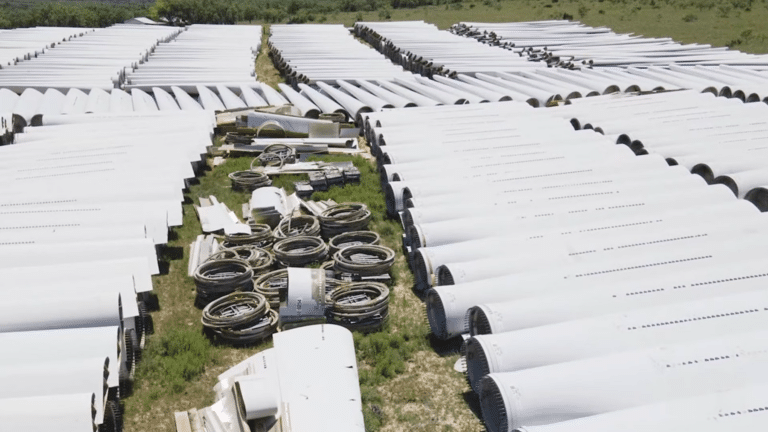
What it changes is the default. A decommissioned blade stops being a disposal cost and becomes a component looking for a job.
The Danish version of that idea is deliberately unambitious, which is why it exists and why it works.
Grinding a blade destroys a precision engineered structure to make low value filler powder. Burning the resin off in a furnace recovers the glass fiber and destroys the shape along with it.
Keeping it whole keeps the engineering that was already paid for, and the shape itself turns out to be worth something.
The next hundred of these will not solve anything either, and they will still be better than burying them.