
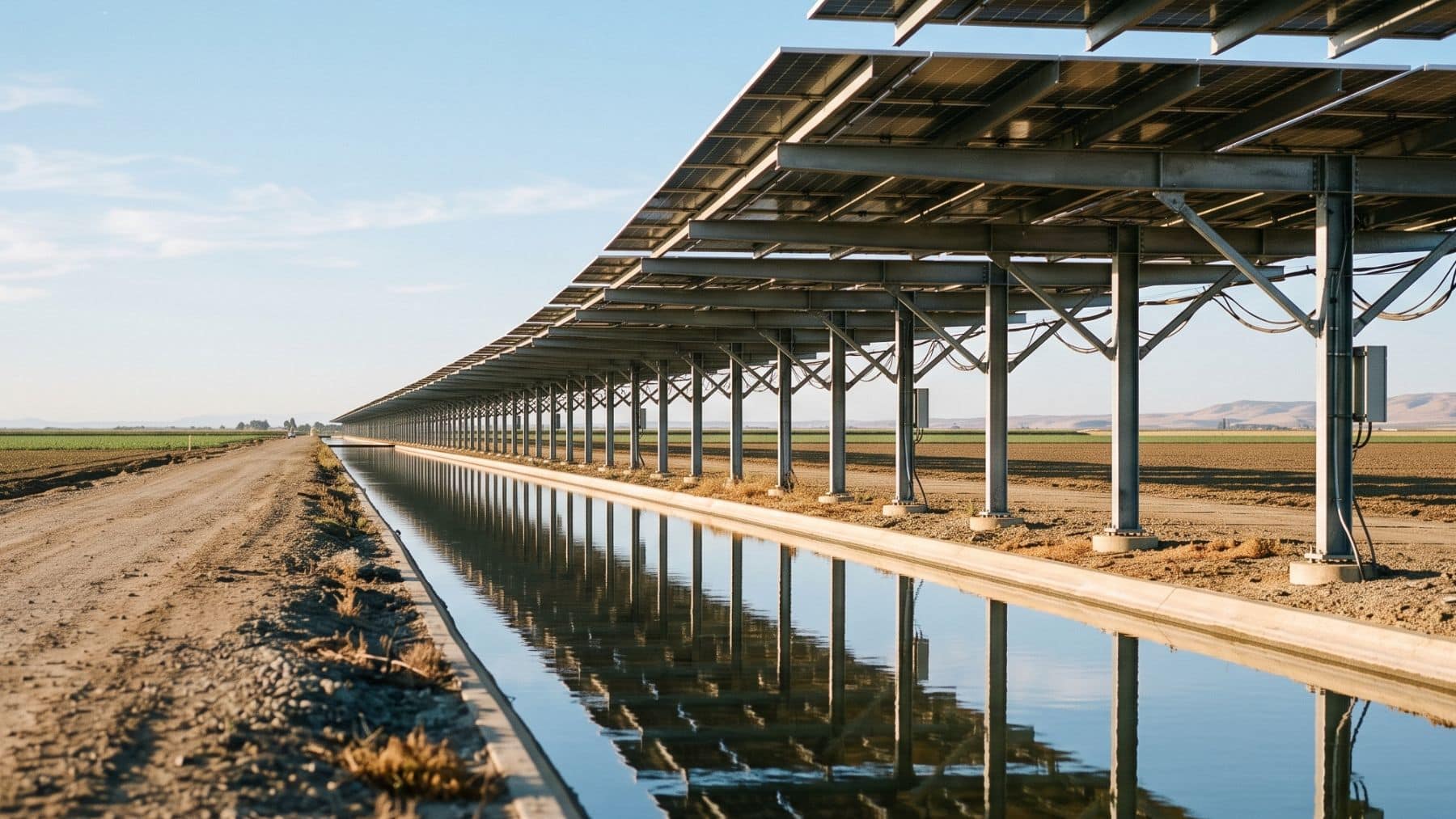
In the heart of California’s Central Valley, something new sits over a strip of open water.
Long rows of dark panels stretch above it on steel frames.
From the road, it looks like a solar farm that lost its field.
There is no dusty lot and no acres of bare ground underneath.
Underneath the frames, water keeps flowing on to the fields.
Instead, the panels are doing two jobs at once.
And together those jobs could change how a dry state survives.
The water California loses to thin air
California moves much of its water through a vast network of open canals.
Those canals run for roughly 4,000 miles across the state.
All of that water sits open to the sun and the wind.
The state ships water hundreds of miles through this system.
Warm dry winds pull even more moisture off the surface.
On a hot day, a shocking amount simply evaporates into the sky.
Whole reservoirs worth of water can slip away in a season.
In a state that fights over every drop, that loss really stings.
Droughts have pushed farms and cities to their limits for years.
Engineers have long wanted a cheap way to cover that water.
But shading thousands of miles of canal sounded far too expensive.
So for decades, the water just kept vanishing.
The land problem no one talks about
Solar power has a very different headache.
Big solar farms need enormous amounts of land.
A single large project can cover thousands of acres.
In farm country, that land is precious and often already in use.
Every acre used for panels is an acre no longer farmed.
Fights over land can tie up a project for years.
Turning good cropland into a solar field can spark real fights.
So developers are always hunting for space nobody else wants.
Rooftops help, but they only go so far.
Some towns have pushed back hard against sprawling solar plans.
The perfect spot would be open, unused, and already owned.
Something that needed shade anyway would be even better.
A simple idea hiding in plain sight
Put those two problems side by side and an idea appears.
One is a strip of open water losing itself to the sky.
The other is a technology desperate for open, unused space.
What if you simply set the panels above the water?
The panels would shade the surface and slow the evaporation.
The water would cool the panels and help them work better.
On paper, each problem cancels part of the other.
It sounds almost too neat to be real.
The pieces had been sitting there in plain view for years.
Yet nobody had tried it at real scale in the country.
So a group in California decided to actually build it.
The canal that makes power
The pilot is called Project Nexus, in the Turlock Irrigation District.
It brought together the state water agency, a company called Solar AquaGrid, and UC Merced.
Crews mounted solar panels on canopies directly over two stretches of working canal.
It is the first project of its kind in the country.
According to the state, the 20 million dollar pilot covers about one and a half football fields of canal.
The two spans together make about 1.6 megawatts of power.
Early results show the shade cut evaporation by up to 70 percent.
Weed and algae growth in the water dropped by about 85 percent.
The panels sit on steel trusses that span the water.
Sensors track how much water the shade actually saves.
The same blend of clean power and nature shows up beside an offshore wind build and a curious solar farm fox.
And the cool water below kept those panels running better.
What it could mean for the whole West
The pilot is small, but the math behind it is not.
A 2021 study looked at covering all of California’s canals with panels.
According to the researchers, it could save about 63 billion gallons of water a year.
It could also generate enough clean power for millions of homes.
All of that without paving over a single new acre of land.
Other dry regions around the world are watching the results.
If it scales, the same canals could help power nearby towns.
The honest caveat is that this is still one small pilot.
Building over water costs more than building on flat ground.
Engineers still need to test it through heavy storms and heat.
Not every canal will suit the panels, and the results need years to prove.
But the idea turns wasted space into power and savings.
For a thirsty and very sunny state, that is a rare kind of win.


