
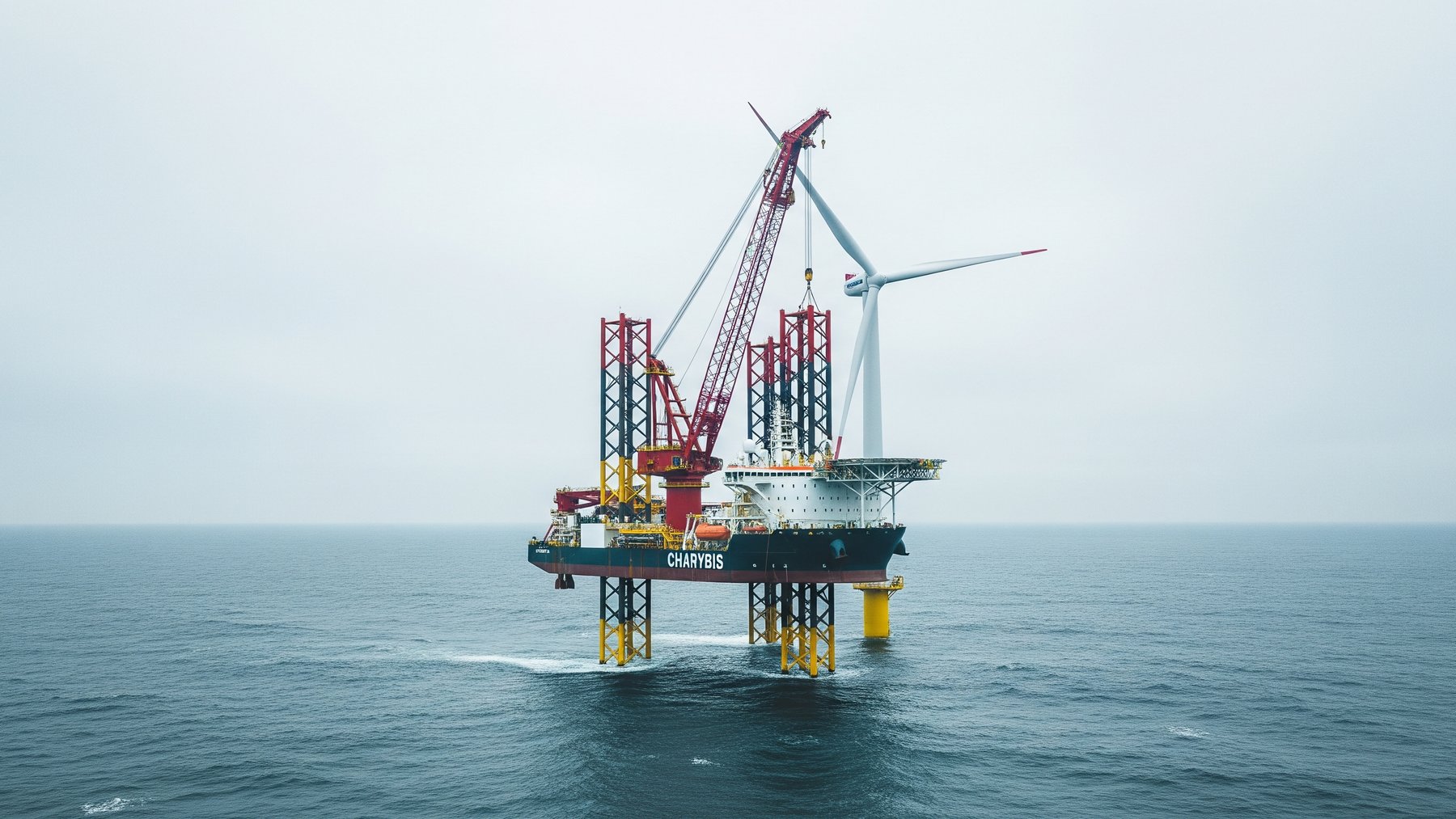
America’s first domestically built offshore wind turbine installation vessel, Charybdis, placed its first 14.7 MW turbine at the Coastal Virginia Offshore Wind farm off Virginia Beach, marking a concrete step forward for both the $10.7 billion project and the US offshore wind supply chain.
Dominion Energy commissioned the vessel specifically for the project and now has it working 27 miles off the Virginia coast, where 176 Siemens Gamesa turbines are being installed across the 2.6 GW array.
What the Charybdis is and how it works
The Charybdis is America’s first domestically built offshore wind turbine installation vessel, known in the industry as a WTIV.
At 472 feet long and 184 feet wide, the ship carries a 426 foot crane rated to lift up to 2,200 tons.
The vessel uses a jack up design, meaning it extends four enormous steel legs down to the seabed and lifts its hull clear of the water before any lift begins.
That stable platform is essential when hoisting a nacelle, the turbine’s power generating housing, more than 300 feet above the ocean surface.
Equipped with a dynamic positioning system, Charybdis transports turbine components from Portsmouth to the offshore array field on each run.
The vessel’s open deck spans roughly 58,000 square feet, enabling it to transport and install some of the largest wind turbines available today.
Why Jones Act compliance matters for US offshore wind
The Jones Act is a 1920 federal law requiring that vessels moving cargo between US ports be built in the United States, owned by US companies, and crewed by American mariners.
Until Charybdis, no installation vessel met that standard, which forced US developers to charter expensive foreign ships at premium rates.
As a Jones Act compliant vessel, Charybdis will be operated by US crews and gives Dominion Energy a home grown installation solution.
After completing work at Coastal Virginia, the vessel will be available for charter hire to other offshore wind developers along the US East Coast.
That future availability could ease the vessel bottleneck that has added cost and scheduling pressure across multiple American offshore projects.
Readers who want a closer look at offshore foundations will find the monopile engineering behind projects like this one worth a read.
The Coastal Virginia project by the numbers
The Coastal Virginia Offshore Wind project is a 2.6 GW fixed bottom offshore wind farm located 27 miles off Virginia Beach.
The largest offshore wind project in the US, CVOW carries a $10.7 billion price tag.
When complete, it will feature 176 Siemens Gamesa 14.7 MW turbines and provide enough power for roughly 660,000 homes.
Monopile foundation installation is complete across all 176 positions, with transition piece and turbine work continuing through the construction schedule.
Steel for the foundations came from domestic suppliers, and turbine components are staged at the Portsmouth Marine Terminal in Hampton Roads before each offshore run.
Work on the offshore export cables and the inter array cabling is underway, while onshore transmission installation is advancing toward completion.
How Charybdis was built and what it cost
The vessel was constructed at the Seatrium AmFELS shipyard in Brownsville, Texas, using over 14,000 tons of domestic steel, with nearly 10,000 tons sourced from Alabama, North Carolina, and West Virginia.
At peak construction, over 1,200 workers were employed on the shipyard project.
The vessel was originally ordered in 2020 for roughly $500 million, but cost estimates rose to $625 million and then to $715 million by 2024.
Dominion set the vessel’s final cost at $715 million and said that owning the ship outright provided enhanced schedule certainty for the broader project.
Dominion has reported a total project investment running into the billions, with construction of the offshore wind farm remaining on schedule for completion in late 2026.
After CVOW is complete, Charybdis will be homeported in Hampton Roads, Virginia, with a US crew.
Timeline, delays and what comes next
Commissioning of the vessel ran into delays before the ship arrived in Virginia in September 2025, pushing some turbine installation work into a tighter schedule.
Dominion has acknowledged that the delays could affect the timeline for the final turbines, with overall construction of the offshore wind farm remaining on schedule for completion in late 2026.
The vessel delay is a reminder that building the first of anything rarely goes exactly to plan, and the original $500 million price tag climbing to $715 million reflects that reality.
Offshore wind developers watching the Charybdis closely include those behind Empire Wind and Sunrise Wind, both off the New York coast, which could eventually charter the vessel.
For more on how smaller land based machines compare, see our piece on a Wyoming wind startup cutting costs in a completely different direction.
The US offshore wind industry has long depended entirely on foreign ships, and the Charybdis, despite its cost growth and schedule bumps, marks the first time an American built vessel has placed a turbine in US federal waters.
Whether that precedent grows into a full domestic installation fleet will depend on how many projects are permitted and financed in the years ahead.


