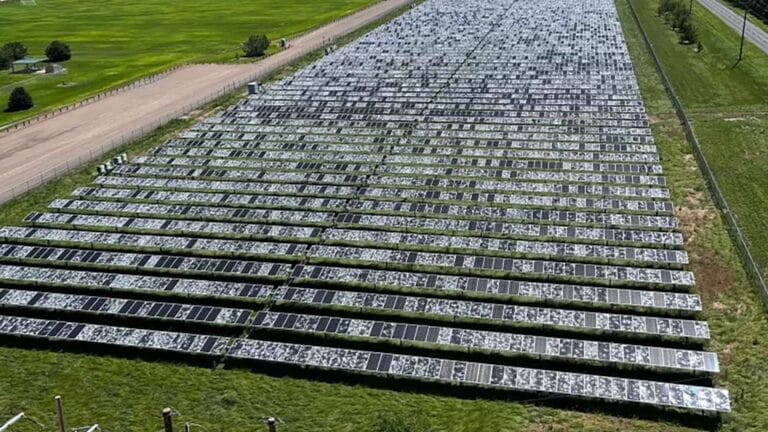
Water in a graveyard does not only fall from above.
It also rises, drawn up through fine soil the way it climbs a paper towel, and that movement does not stop at the level of the water table.
Fill makes it worse.
Ground reclaimed from marsh is packed with fine material, which is exactly the structure that pulls water up through it once the ground is saturated.
So the fix is a roof, not a drain.
Keep the winter rain from soaking in and the rise never starts, which is why 5,000 modules now stand on legs above a marsh cemetery.
Why draining the site was never an option
The whole district is marsh.
Lowering the water table under a graveyard means lowering it under the wetland around it, which nobody is going to permit and nobody could afford.
Pumping has the same problem.
A pump moves water somewhere else, and in a landscape that is already at the level of the marsh there is no somewhere else to move it to.
A canopy attacks the input instead.
Intercept the rainfall before it reaches the ground and the saturation that drives the capillary rise never builds, which makes the roof the cheap intervention rather than the clever one.
The ground this was built on
The cemetery is not old.
The site was filled in and laid out from the end of the 1960s, on land that had been part of the marsh until somebody decided otherwise.
That decision created the problem.
Families began complaining about water in the graves during winter, and the complaints got more frequent rather than less as the ground settled.
Nothing about the place is dramatic.
It is a flat rural graveyard on the edge of a wetland, with reeds beyond the wall and a water level that sits close to the surface all year round.
The structure covers most of it.
Roughly 86,000 square feet of canopy sits over about three quarters of the ground, carried on timber frames set on screw piles rather than on foundations.
What is actually up there
The array is small by utility standards.
Five thousand modules across that roof come to about 1.3 megawatts, which is a village scale plant rather than a solar farm.
The commune paid for it alone.
The budget came in around 3.35 million euros, funded by the municipality itself rather than assembled from a stack of regional grants.
Semi transparent is deliberate.
The modules let some light through so the ground below does not sit in permanent gloom, which matters for a place people visit and tend rather than simply pass.
They tested it first.
A prototype section of roughly 1,900 square feet went up in the spring of 2025 before anybody committed to covering the rest.
The rule they had to write themselves
Sharing the output is the hard part.
A collective self consumption scheme has to split production between members, and the standard formulas hand more to whoever draws more.
That would have favored the businesses.
A supermarket or a care home uses far more than a household, so an ordinary sharing key would have sent most of the output to a few large consumers.
The scheme has a radius.
Collective self consumption in France works inside a defined distance from the plant, and this one was granted an extended perimeter so more of the commune could join.
So the association wrote its own.
Members drew up a dynamic key that gives every participant the same entitlement and redistributes whatever they do not use, which is the genuinely new part of the project.
Joining costs almost nothing.
A one time fee of five euros makes you a member, and the trade press counted several hundred residents signed up well before the canopy existed.
The country keeps doing this.
French growers are putting the same modules over a vineyard rather than beside it, for the shelter as much as for the power.
None of it has stopped anything yet
The canopy is still going up.
The association’s own schedule puts installation across the spring and summer of 2026, which is a full year later than the plan announced in 2024.
So the flooding claim is a forecast.
Nothing has been through a winter under a finished roof, and whether the capillary rise actually stops is a question only a wet season can answer.
The water has a second job.
Rain caught on the canopy is meant to be stored and used to irrigate the sports pitch through summer, which needs something like 790,000 gallons a year.
Panels keep ending up over awkward ground.
The same logic put an array over a waste pond in the Andes, and the association is candid that the sharing scheme matters more than the roof.
Which leaves a fair description.
A marsh cemetery got a roof for reasons that have nothing to do with electricity, and the electricity is the second answer.