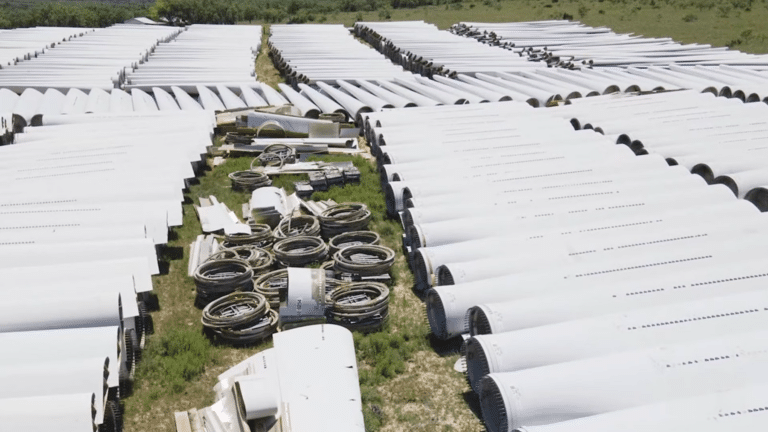
On the yard quay the tubes lie in cradles, end on, and they look identical.
They are not. Stand where the rims almost line up and one is wider than the other by about 20 inches.
Half a meter of steel, on a barrel already the width of a room.
Fifty two of them went out to sea, in two sizes, in a deliberate mix.
Nothing about the machines on top demanded it. They are all the same rating.
The reason is above the water, not below it.
What normally sets the width of a pile
A monopile is a rolled steel tube driven into the seabed, and its diameter answers four questions.
How heavy is the machine on top. How hard does the rotor push sideways. How deep is the water. What is the seabed made of.
Widening a pile makes it stiffer against bending, which is the load that matters, and stiffness rises far faster than width does.
It also costs. Steel is priced by weight, and half a meter of extra diameter on a pile this size adds real tonnage to every one you build.
So nobody orders two sizes for one site out of sentiment. A mixed order means the site is not uniform in something.
Here the thing that varies is tower height, and a taller tower on the same machine changes what the foundation underneath it has to resist.
Why some of the towers were raised
The farm sits about 33 miles off IJmuiden, permitted on the condition that it interfere with birds as little as a wind farm can.
Part of the answer was to lift some nacelles, widen the spacing, and leave a corridor through the middle of the layout that birds can cross.
Raise a nacelle and you lengthen the lever arm between the rotor and the seabed, so the bending moment at the mudline goes up even though nothing has got heavier.
That is what the wider pile is for. The steel foundations come in 8.8 and 9.3 meters across, roughly 29 and 30.5 feet, and the wide ones sit under the tall towers.
All 52 were made without a separate transition piece, at a single yard on the Maasvlakte in Rotterdam.
Which means the bird corridor is not a policy written on the plan. It is rolled into the steel.
How they got them into the ground quietly
Driving a pile is one of the loudest things anyone does in the ocean. A hammer strike into steel carries for miles underwater.
Here the contractor used vibration and water jetting instead, loosening the sand at the pile tip so the tube sinks under its own weight rather than being beaten in.
It is billed as the industry’s first silent monopile installation. Read that as quieter, not silent.
The first pile went in on the third of December in 2025 and the last of the 52 was in the ground by early April.
The vessel runs a dual fuel engine that can burn methanol, a 6,000 kilowatt hour battery, and catalytic reduction for nitrogen oxides.
Its crane lifts 3,000 tons and stands 509 feet, which is the real number behind a job like this.
What the ecology package actually is
The corridor is one measure among several, and none of them is proven yet at this site.
Seven of the 52 turbines carry a single blade painted red, testing whether a broken pattern makes a spinning rotor easier for a bird to resolve.
Red rather than black, which is the color the onshore trials used, because a black blade in open sun heats and the thermal load on the laminate becomes its own problem.
There is also adaptive curtailment, with radar and artificial intelligence watching for birds and bats and shutting machines down when they approach.
Below the surface the scour protection was built with deliberate crevices for fish, and some piles carry openings intended as habitat.
Proving any of it works is slow, because reading a population takes the kind of survey that aged 16 pairs of golden eagles in one California wind farm.
All of it is a hypothesis with sensors attached, which is the honest description and the useful one.
What has to show up in the data
The farm is 760 megawatts across 52 machines of 15 megawatts each, expected to produce about 3.3 terawatt hours a year.
That is roughly 3 percent of Dutch electricity demand from a single site.
The first turbine went up in June and the farm delivered its first power to the grid in July, with full operation planned for the last quarter of this year.
Everything structural is settled. The steel is in the ground and the towers are the heights they are.
What is not fixed is whether any of it works, and that answer comes from years of radar logs rather than from the installation record.
If it does, the next offshore project inherits a pile schedule shaped by birds, and if it does not, somebody paid for extra steel to find that out.