
Most people who go solar spend weeks choosing panels.
They compare wattage ratings, read warranties, argue about brands, and pick the one with the best reviews.
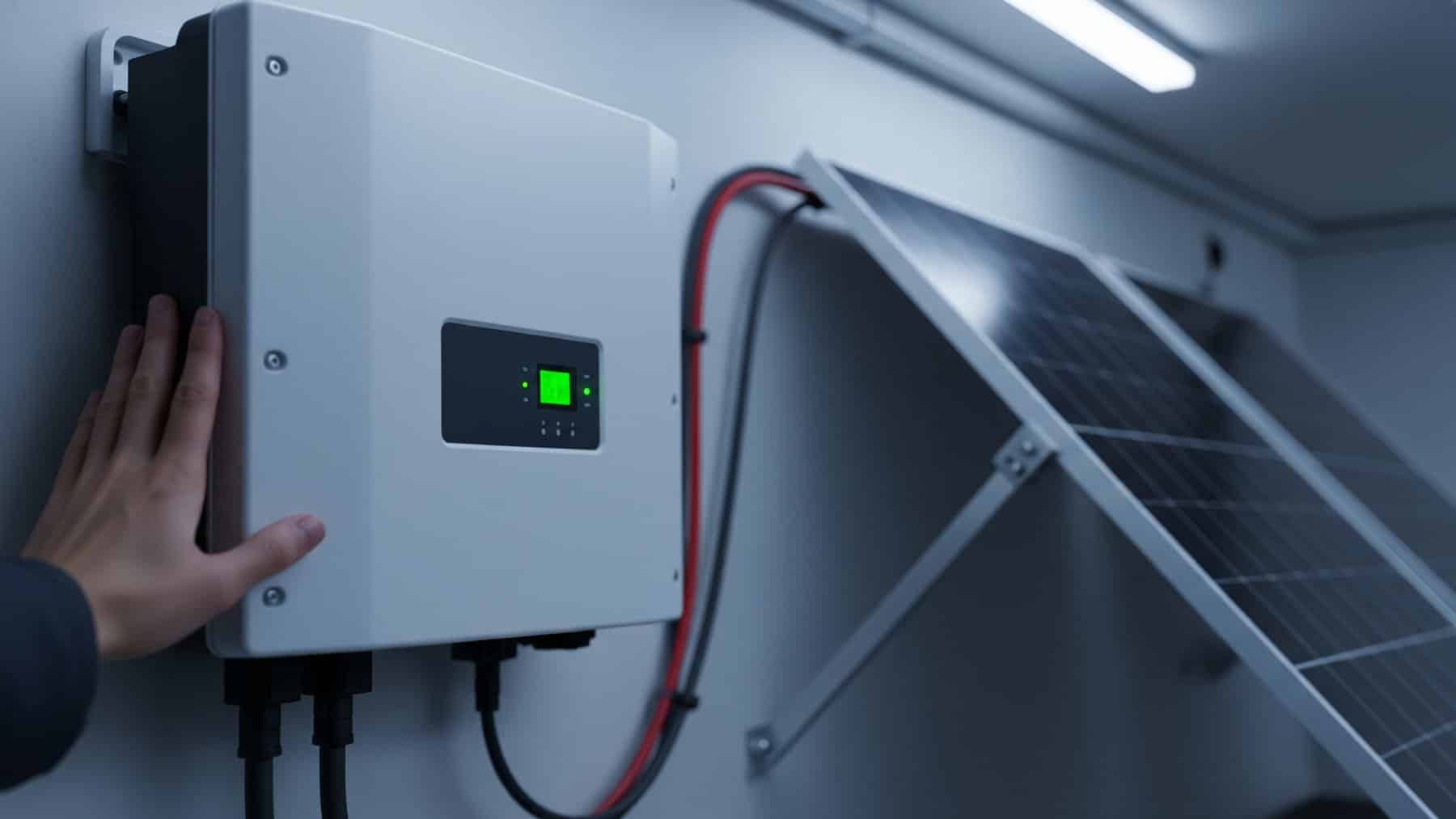
Then an installer mounts a plain white box on the garage wall, nobody asks what it does, and everybody moves on.
That box is doing something more important than anyone standing in the driveway realizes.
It is also the part most likely to fail first.
The device that almost every homeowner ignores
Walk into an American garage with rooftop solar and you will find the same object near the breaker panel.
A flat rectangle, roughly the size of a carry on bag, bolted to the drywall.
It hums faintly and blinks a small green light.
That is the solar inverter.
The panels get the magazine covers and the Instagram posts.
The inverter gets nothing.
Yet without it, your array cannot power a single lamp in the house.
The electricity a solar panel makes is the wrong kind entirely, and the inverter is the only fix.
It is the most overlooked piece of hardware in the entire system.
Two kinds of electricity, and why one of them is useless to your kitchen
Solar panels produce what engineers call direct current, or DC.
Think of it as water flowing steadily in one direction down a pipe.
Alternating current, or AC, keeps reversing itself instead.
On the American grid it runs at 60 hertz, which means it completes 60 full cycles every second.
Each cycle contains two reversals, so the current actually changes direction 120 times per second.
Your refrigerator, your television, your microwave, all of them built for AC.
The grid was standardized around it, so every appliance in a modern kitchen expects that vibrating current.
Your roof is generating a steady river, and the house is asking for waves.
The inverter stands between those two worlds and performs the translation.
A symphony of switching that happens thousands of times a second
Inside the inverter there are no gears and no moving parts you could see with the naked eye.
The fundamental building block is an arrangement of switches called an H bridge.
Those switches are transistors, usually IGBTs or MOSFETs, and they open and close thousands of times per second without wearing out.
Each rapid switch nudges the current to flip direction until it becomes the smooth sine wave your appliances expect.
It happens so fast that you cannot hear any of it.
The green light just blinks, steady and calm.
Running alongside all that switching is a tracking routine called MPPT, short for Maximum Power Point Tracking.
A panel’s peak power voltage shifts with temperature, climbing on a cold morning and sagging on a hot afternoon.
So the inverter samples the output, nudges the voltage, and hunts for the sweet spot without ever stopping.
Manufacturers quote tracking efficiency of 99.5 percent or better, which leaves almost nothing on the table.
Why the box will need replacing long before your panels do
Here is the part that rarely comes up at the kitchen table.
In 2025, utility scale solar generation in the United States reached 296,000 gigawatt hours, a 34 percent jump over the year before, according to federal data.
Every one of those gigawatt hours passed through an inverter before it reached a wire.
And every one of those inverters is running on a clock.
Panels are engineered for 25 years and frequently keep producing well past that mark.
A typical residential string inverter lasts roughly 10 to 15 years, according to industry reporting.
So you will very likely buy a second one while the original panels are still bolted to your roof.
That replacement is the single largest unplanned expense in residential solar ownership.
Microinverters and DC optimizers carry longer warranties, though the hardware is young enough that the 25 year promise stays partly untested.
The same lesson turns up across the industry, where an offshore project showed that unglamorous hardware decides the outcome.
What to check before you sign the contract
Ask which inverter is going on the wall, and write the model number down.
Compare the warranty rather than the marketing.
Ten years is standard, twenty is available, and the upgrade often costs less than one replacement will.
Set aside a few thousand dollars for that future swap and the surprise stops being a surprise.
Be skeptical of any sales page promising 20 to 30 percent more power from a smarter inverter.
That number comes from off grid battery controllers, where simple regulators are still sold alongside better ones.
It does not transfer to a home on the grid, because every inverter sold for that job already tracks the peak.
Even wildlife studies around solar sites keep showing how the small details outrank the obvious ones.
The panels grab the glory in the sun.
The plain white box beside the breaker decides whether you are still happy in year twelve.


