
Something was happening in the dark water beneath a Dutch lake.
And for a long time, nobody up on the surface had any idea.
The lake was covered by a vast raft of 73,000 solar panels.
They floated on the water, soaking up the northern light.
From the shore, the lake looked like a field of dark glass.
The engineers were proud of the clean power.
But they were not watching the water below.
A lake nobody wanted
The lake is called the Bomhofsplas, near the city of Zwolle.
It is not a pretty lake carved by ancient glaciers.
It is a sandpit, a hole left from years of digging out sand.
When the digging stopped, the pit slowly filled with water.
It sat there nearly lifeless, the way many old quarries do.
The steep sides dropped away into deep, cold water.
Little grew there, and few creatures had moved in.
Then a renewable energy firm saw a chance in that empty water.
The developer BayWa r.e. and its Dutch arm GroenLeven stepped in.
They built a floating solar farm right on the surface.
Some 73,000 panels made about 27 megawatts of power.
It was the largest such farm outside China at the time.
The plan was simply power, but the water hid a bigger question.
The worry about covering the water
Floating solar is still a fairly young idea.
And it carries a worry that nags at many engineers.
Cover a whole lake with panels, and you block the sunlight.
Less light means less of the tiny plant life in the water.
Less plant life means less food for the small creatures.
In a lake already nearly empty, that could be a disaster.
Critics warned the shade might smother whatever life was left.
The fear was that the panels would create a true dead zone.
So the developers decided to actually find out the truth.
They partnered with a university and an ecology consultancy.
The team from Hanze University planned a long study.
It would run from 2020 all the way to 2023.
The cages full of seashells
Then the team added something rather unusual to the lake.
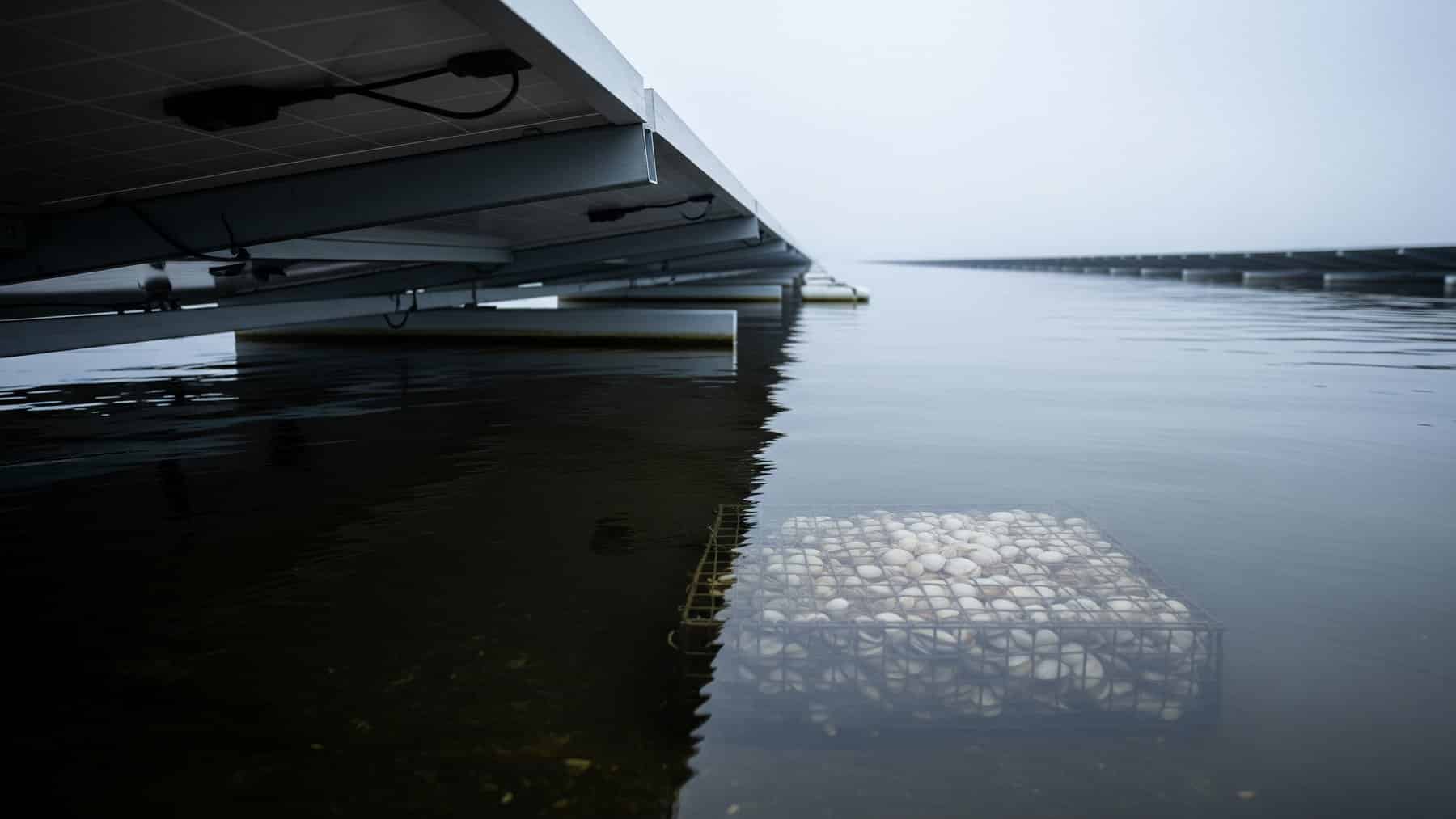
They lowered 20 metal cages into the dark water.
The cages bolted onto the same anchors that held the panels.
They are called Biohuts, made by a French firm named Ecocean.
Each one has an empty section where small fish can hide.
The other section is packed tight with old seashells.
The rough shells give larvae and mussels a surface to grip.
Young life struggles to cling to smooth artificial walls.
A bare anchor or cable gives them almost nothing to hold.
So the cages offered both shelter and a place to grow.
It was a small nudge to help nature get started.
Above them, the panels hid the water from hunting birds.
The open water below became a safe zone.
What moved in under the panels
Here is what the researchers slowly began to find down there.
According to one report, the water quality under the panels stayed healthy.
The oxygen barely dropped, and the lake held its own.
The water below stayed as clean as the water around it.
Then life started to take hold on the shells.
Mussels gripped the surfaces first, and sponges followed.
Small fish arrived to feed among the growing community.
Then bigger fish came to hunt the smaller ones.
Year by year, the cages became a small ecosystem of their own.
By the end of the study, they had drawn in a crowd.
The shelters held over 400 fish and nearly 2,000 small creatures.
A lake once written off was slowly filling with life.
The feared dead zone had become a living reef.
What it means for dead lakes everywhere
The Bomhofsplas result is more than just one happy ending.
Thousands of dead industrial lakes sit across the world.
Old quarries and pits fill with water and then go still.
The floating solar market is also growing quickly every year.
Engineers now wonder if the two could be paired on purpose.
The cages could be built into new floating projects from the start.
According to one account, early findings showed no harm to the lake at all.
A caveat matters here, not every lake will respond the same way.
Some rich, healthy lakes might do better with more light.
But a scarred, empty pit may have everything to gain.
The same pairing of clean power and wildlife shows up elsewhere, from a solar farm fox to the seals near an offshore wind farm.
The panels were built to catch the sun.
What they caught instead was a lake coming back.


