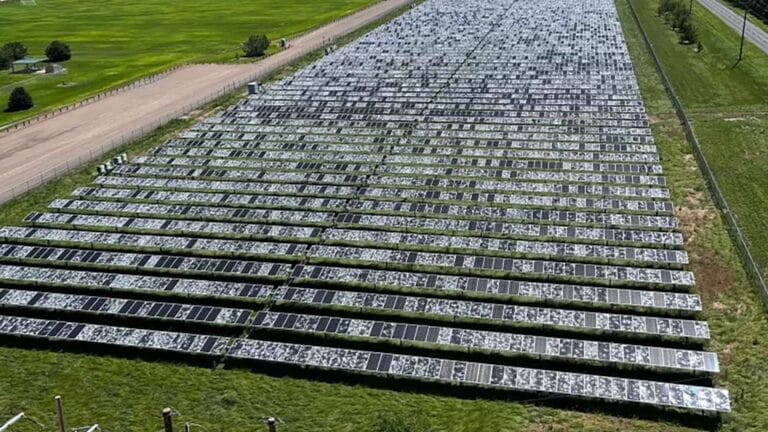
Broken glass on a solar site usually tells you what hit it.
There is a crater, a starburst, a point where the energy went in.
Crews are now finding panes that are fully shattered with none of that.
No impact mark anywhere on the surface, no storm in the log, sometimes nobody on site that week.
The sheet simply came apart.
So what breaks glass that nothing touched?
The margin closing from both ends
Tempering does not make glass strong. It makes the surface compressed.
Heat the sheet and cool the faces fast, and the skin locks into compression while the core is left in tension. A crack can only run if something pulls a surface flaw open against that compression.
Every sheet is full of such flaws already, invisible chips along the cut edges and in the surface, left by cutting and handling.
Now make the sheet thinner.
Two things happen at once, and both go the wrong way.
There is less depth available to hold the compressive layer, so less stored compression is standing between a flaw and a fracture. And the same wind load bends a thinner sheet further, which raises the tensile stress at the surface where the flaws live.
The flaw population has not improved, so the gap between the stress the glass sees and the stress it takes to run a crack closes from both sides.
Where the load actually enters the panel
The module in question is a large format bifacial unit, glass on the front and glass on the back, at least about 27 square feet of surface.
On a single axis tracker of the common single row type, it is held along its two long edges by short brackets, each running roughly 16 to 18 inches.
That is the entire load path. Two short clamps carrying a panel measured in tens of square feet, with everything outside them cantilevering.
Wind does not arrive as a steady push either. It arrives as pressure that rises, falls and reverses.
The glass flexes at every cycle, and the highest bending stress sits exactly where the bracket ends and the unsupported span begins.
Which is also, in a great many of the failures, where the fracture starts.
What the field and the lab each recorded
A forensic study of one solar farm found rear glass breakage on more than 15 percent of the bifacial modules mounted on single row trackers.
Investigators correlated the failures against site records and found two patterns: mid level wind speeds above about 22 miles an hour, matching both where and when panes broke, and a timing relationship with maintenance activity.
The breakages happened without the extreme wind events the modules are designed against.
On the laboratory side, one testing house running its mechanical stress sequence broke about a third of the module samples it put through in the second quarter of 2025, improving to about a quarter by the fourth.
It calls this the most significant reliability issue affecting modules today, and reports it across multiple countries, manufacturers and mounting systems.
The industry’s own explanation is blunt. Glass has been thinned, frames lightened, encapsulant reduced and mounting made more aggressive, and as one glass maker’s chairman put it, the shift to thinner glass is driven entirely by the customer.
What the tests were never built to catch
No single mechanism has been established, and the contributing list is long: edge flaws, lamination stress, glass touching frame, trapped debris, sealant filling, module sizes growing without the mounting growing with them.
The 15 percent figure is also one site, and a severe one.
The deeper problem is that certification does not look for this. The hail check fires a one inch ice ball at 51 miles an hour, and the static load test presses on the panel evenly and holds.
Both are pass or fail gates aimed at a single severe event.
Neither reproduces a flaw opening slowly under thousands of moderate wind cycles, which is what the field evidence describes.
A module can pass both and still be sitting in a category that ends up in the recycling stream years early, or moving through the secondary market before anyone has characterized the failure.
The arithmetic nobody wants to do
One percent sounds survivable until it is multiplied by a plant.
Take a 500 megawatt farm built with 500 watt modules. That is a million panels on the ground.
One percent of them is 10,000 modules to locate, disconnect, unbolt, lower, carry out, ship in, lift, bolt and reconnect, one at a time, across thousands of acres.
The glass itself is the cheapest part of that.
And a warranty claim only helps if the manufacturer is still trading, which on a twenty five year asset is its own bet, as the field study of the tracker site sets out.
Thinner rear glass saved a few cents a watt at the factory, as trade coverage of the testing data lays out.
The bill arrives at the other end.