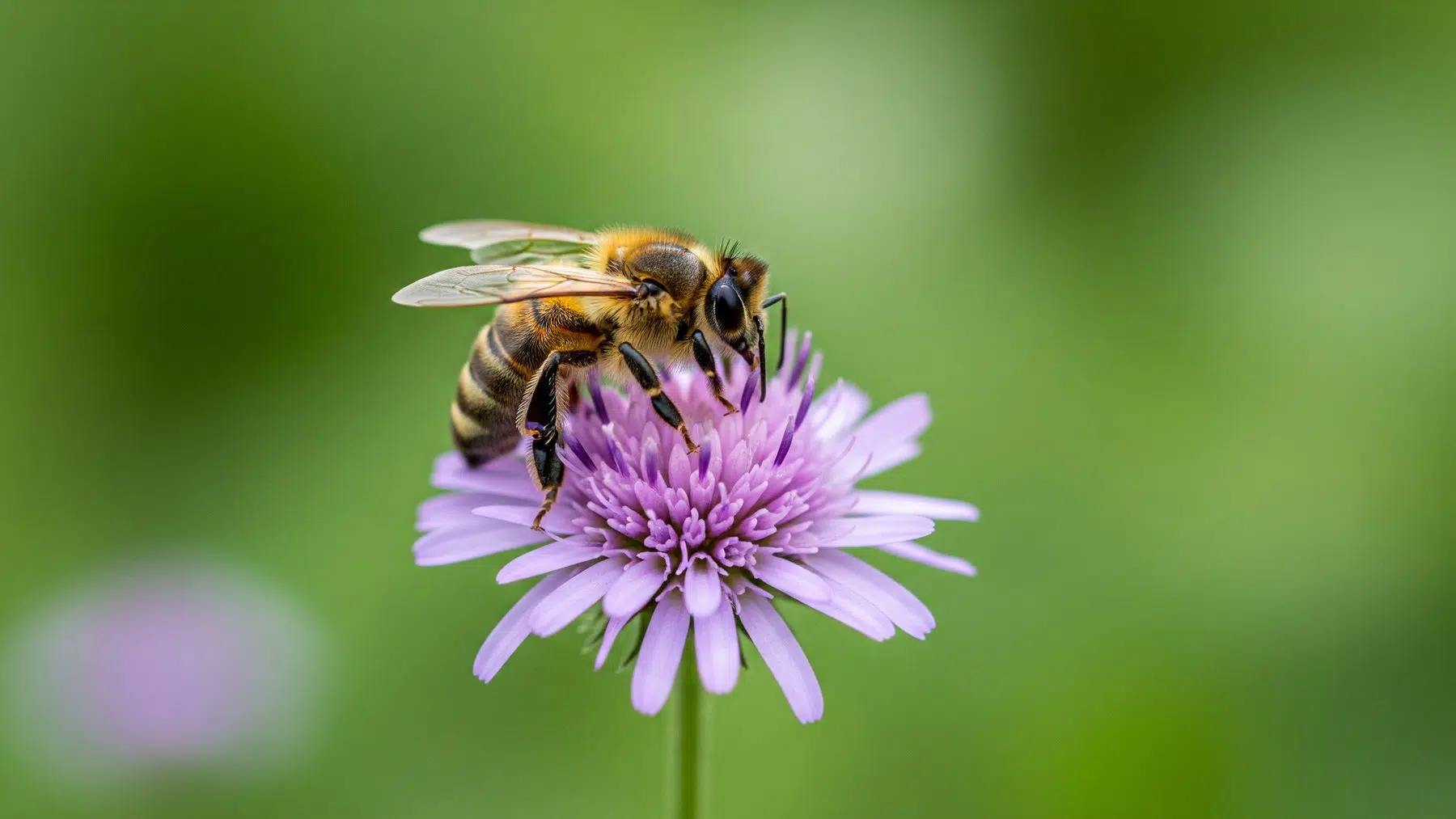
It visits your garden almost every day.
It finds the same patch of lavender, the same row of clover, then flies home to a hive it cannot see from the air.
For a long time, scientists assumed that the waggle dance and a pair of sharp eyes were doing all the work.
They were missing something extraordinary hiding inside the bee’s own body, and it took six years and more than 120 species to find it.
The insect that seemed so simple to understand
Everyone who has watched a bee work a flower bed has the same instinct: it must be following the scent.
That is partly true.
But scent fades with distance, and a honeybee can range two miles or more from the hive.
Scientists have long known that bees use the Sun as a compass and that their waggle dance encodes direction relative to the sky.
The dance is one of the most famous feats in all of animal behavior.
Yet it only works once a bee already knows roughly where to go.
Something else is orienting them at a more fundamental level, especially on overcast days when the Sun disappears entirely.
Six years, 120 species, one growing surprise
Three researchers at the University of Tennessee, Knoxville started comparing notes across their very different fields.
One studied how insects respond to chemical signals from plants.
The other studied the physics of magnetic materials.
A third brought deep expertise in native bee species and their ecology.
The question that linked them was simple: just how widespread is magnetic sensing in bees?
At the time, only five bee species had ever been confirmed to have any magnetic properties at all.
Over six years the team tested more than 120 bee species from around the world.
The numbers kept climbing in a direction no one expected.
The result that stopped the lab in its tracks
The team had assumed, reasonably, that any magnetic ability would cluster in highly social bees.
Honeybees live in vast colonies where navigation information gets shared constantly.
It seemed like exactly the kind of complex skill that would reward social living.
The new study shows the phenomenon extends far beyond honeybees, including solitary species that do not dance at all.
Orchid bees that live entirely alone registered a high magnetic response.
The researchers also expanded into wasps, the bee’s closest evolutionary relatives.
In testing nearly 300 wasp species, they found that 90 percent are magnetic.
Something ancient was at work here, far older than the hive.
The hidden compass inside the bees in your backyard
A University of Tennessee, Knoxville led team has found that nearly 90 percent of the bee species it tested appear to be magnetic.
The ability is called magnetoreception: the capacity to detect Earth’s own magnetic field, the same invisible force that steers migratory birds and guides sea turtles across open ocean.
The same magnetic mineral, magnetite, detected in migratory birds and sea turtles appears to be embedded in insects foraging in your own yard.
The data suggests that magnetism may play a crucial role in close range navigation, though scientists still do not know exactly why it has persisted for tens of millions of years.
The discovery was published in Science Advances after six years of testing; lead researcher Laura Russo describes the work as detecting magnetism across all six bee families, in both social and solitary species.
Magnetoreception remains one of the most contested animal senses, with scientists agreeing it is probably not the primary sense even in organisms confirmed to have it.
Why this changes the way you’ll look at your garden
The bee on your lavender is carrying something inside it that engineers have spent decades trying to replicate in machines.
A compass that weighs almost nothing, needs no battery, and has been operating reliably for tens of millions of years.
If scientists can map exactly how bees use magnetic cues, they may be able to design landscapes that work with that sense rather than against it.
Bees navigating by the planet’s own field also raises an uncomfortable question about electromagnetic interference from power lines and cell towers.
Researchers are already working to find out whether human made magnetic noise disrupts the signal and harms bee populations.
The next time a bee leaves your garden and vanishes over the fence, know that it is not just following its nose.
It is reading the Earth itself.
Read the whole thing?
Get the week's signal, not the noise
Our sharpest reporting on energy, climate and nature — free, once a week.