For 170 years, a star system just 16 light-years from Earth has refused to give up its secrets. In 1855, British astronomer William Jacob proposed that 70 Ophiuchi AB harbored a planet — the first such claim ever made about another star system. His case was eventually dismissed, but the system never stopped whispering. Decade after decade, astronomers noticed a subtle, persistent wobble in the stars’ light — the kind of signal that usually means something is tugging from the dark. Now, a team armed with a century’s worth of data and two powerful telescopes set out to finally settle the question.
A mystery that outlasted generations of astronomers
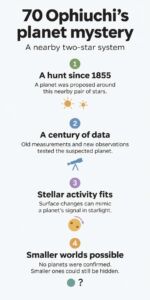
William Jacob’s 1855 proposal was the first official exoplanet candidate ever suggested around another star. His claim didn’t survive scrutiny, but it planted a seed. Astronomers kept returning to 70 Oph AB, drawn by its unusual closeness — at just 16 light-years away, it’s the third nearest binary to Earth, trailing only Alpha Centauri and 61 Cygni.
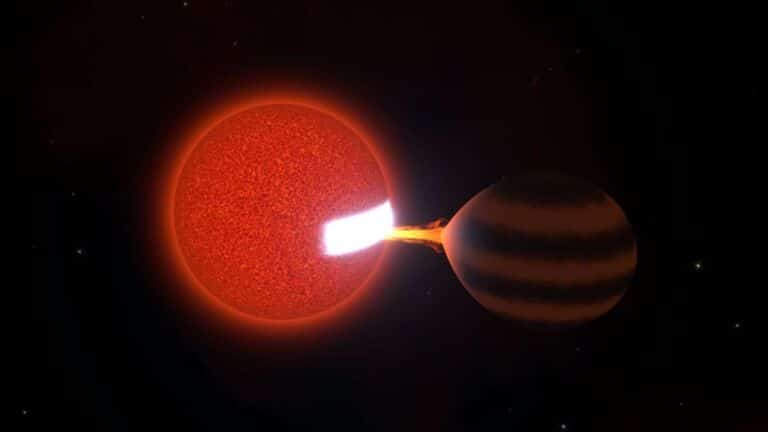
Measurements of the stars’ radial velocity showed a persistent wobble over decades. In planet hunting, that kind of wobble is exactly what you’d expect from a massive world pulling gravitationally on its host star. A Jupiter-sized planet seemed like a reasonable explanation. Nobody could prove it, and nobody could rule it out.
The wobble that wasn’t a planet
Radial-velocity detection works on a simple principle: an orbiting planet’s gravity nudges its star back and forth, shifting the wavelength of its light in a measurable way. The larger the planet, the stronger the tug. To resolve the ambiguity, the research team combined roughly a century of historical radial-velocity measurements with fresh observations from two major facilities — the 6.5-meter Magellan Clay Telescope in Chile and the 2.7-meter Harlan J. Smith Telescope in Texas.
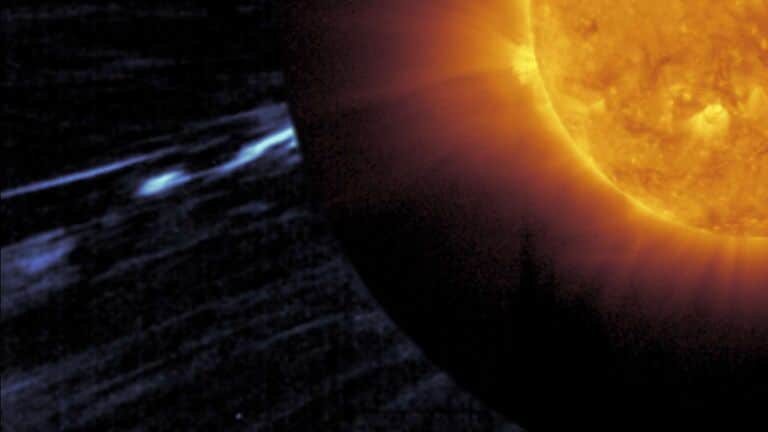
Stellar surface activity had been mimicking a planet signal the whole time. “It’s a cautionary tale about how stellar activity can mimic planet signals using the radial velocity,” said Michael Meyer, chair of the University of Michigan’s astronomy department.
What the system definitely does not have — and why that matters
The study produced firm exclusions. Around 70 Oph A, no planet equal to or greater than Jupiter’s mass exists within 5 astronomical units; around 70 Oph B, the same applies within 0.5 AU, according to the article published in The Astrophysical Journal.
These are the most precise giant-planet constraints ever established for this system. Knowing what isn’t there is genuinely useful — it narrows the search space for future missions and keeps observatories from chasing signals that already have an explanation.
The stellar orbits of both stars are now among the most precisely determined in the sky, a byproduct of assembling so much high-quality data in one place.
The door is still open: smaller, habitable worlds may remain hidden
Ruling out giants doesn’t mean the system is empty. Saturn-sized planets, super-Earths, and rocky worlds could orbit either star without triggering the signals this study was designed to detect. The habitable zones around both stars — where temperatures might allow liquid water on a surface — remain unsearched at those scales. “The study sets an upper limit, not a ban, on planets,” said Yiting Li, a postdoctoral researcher at the University of Michigan.
“Given how prevalent planets are in our universe and in the Milky Way, I would wager that we’ll find there are other planets there.” Binary systems like 70 Oph AB make up roughly half of all stellar systems in the Milky Way, which makes their planet-formation dynamics broadly significant.
Next steps: flagship missions and a system in the crosshairs
The University of Michigan is part of the team behind SHERA, a proposed space mission focused on binary star systems, with 70 Oph AB listed among its primary targets. NASA’s Habitable Worlds Observatory — a flagship-class mission still in planning — is also expected to examine the system for smaller planets that current instruments can’t reach. The new upper limits “enable us to design optimum search strategies in the future,” Meyer noted.
By eliminating one category of explanation, the team has handed future astronomers a cleaner map. The 170-year search ended without the prize it was chasing — but it cleared the ground for a targeted hunt for worlds small enough to be habitable, in a system close enough to actually study.
Read the whole thing?
Get the week's signal, not the noise
Our sharpest reporting on energy, climate and nature — free, once a week.