The Big Bang is widely considered to be the beginning of the universe, but scientists are not sure about this. According to the theory, the universe was in a hot, dense state and expanded quickly, creating space and time. But how accurate is this theory? In order for something to be created, it needs to have other things happening before. If this universe were born out of a hot, dense state, what happened to trigger the expansion? That’s the question experts are trying to answer.
When was Big Bang Theory created?
The idea of the rapid expansion has been around for almost a century. It started when scientists first found signs that the universe was expanding. If the universe is growing and cooling now, it makes sense to think that, in the past, it was smaller, hotter, and much denser. Some imagine this going all the way back to a single point – what’s known as a singularity. For many years, the two ideas – the early universe as a hot, dense state and the singularity itself – were treated as one and the same.
But in the early 1980s, scientists introduced a new idea called cosmic inflation. This theory suggests that before the expansion, the universe went through a different phase – pushing the possible singularity much further back, beyond what we can observe. Then, new evidence showed that something existed before the Big Bang. It suggested that the dense state of matter wasn’t really the beginning of everything after all.
Cosmic inflation entered the equation
When cosmic inflation was proposed in the early 1980s, it changed how scientists saw the Big Bang. The new theory suggested the universe didn’t start from a singular point after all. Instead, it began in an inflationary state – a phase that came before the hot, dense conditions we know as the expansion. In fact, evidence found in recent years strongly supports the idea that there was a universe before the Big Bang.
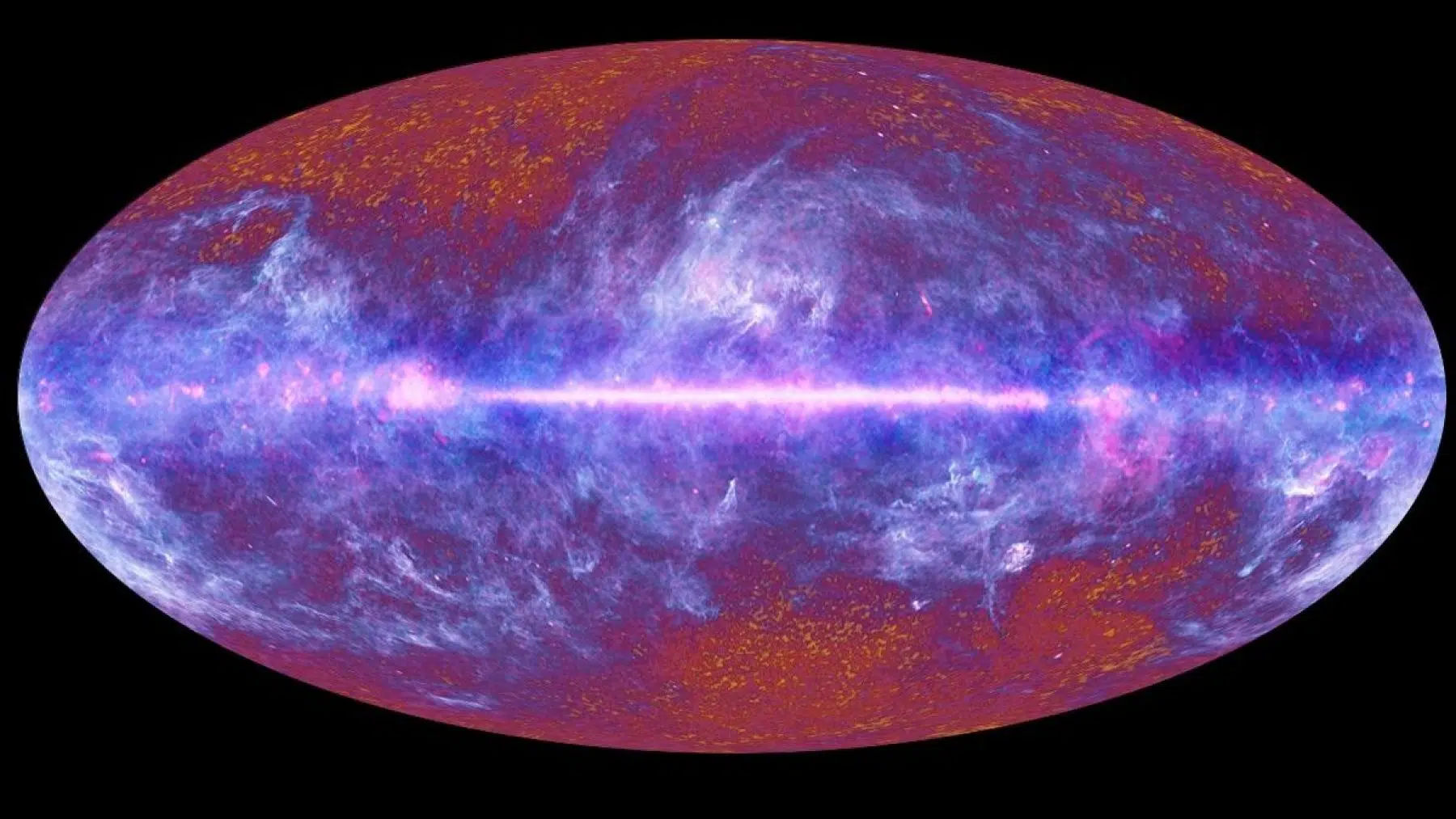
According to the theory, the Big Bang happened after a period of rapid inflation. During this time, tiny changes – called quantum fluctuations – took place. These are random shifts that happen naturally in quantum physics. As the universe expanded extremely fast, these small fluctuations were stretched out, shaping the larger structure of the universe we see today.
The inflation explains the space fluctuations
In a universe that went through inflation before the Big Bang, scientists expect to find density fluctuations at every scale – even on scales so large that light couldn’t have crossed them since the expansion began. That’s because during inflation, the universe grew at incredible speed, doubling in size many times in just tiny fractions of a second. Fluctuations that happened early during that phase were stretched so far that they’re now bigger than the part of the universe we can see today.
Even though newer fluctuations form on top of the older, larger ones, inflation explains why the universe has these massive fluctuations in the first place. Without inflation, and if everything had started from a simple singularity, these large-scale patterns wouldn’t be there.
The first stages of the universe
After around 150 million years, the first stars were born after the cosmic dark age ended, bringing light to a vast, yet obscure cosmos. 250 million years later, it was time for the first black holes to be born and accretion disks as well. From this point moving forward, the reionization happened – when the intergalactic space went from a neutral state to an ionized state with radiation from stars and black holes emitting ultraviolet radiation. Meanwhile, the first galaxies were being formed. The total process has been ongoing for over 13.8 billion years.
Read the whole thing?
Get the week's signal, not the noise
Our sharpest reporting on energy, climate and nature — free, once a week.