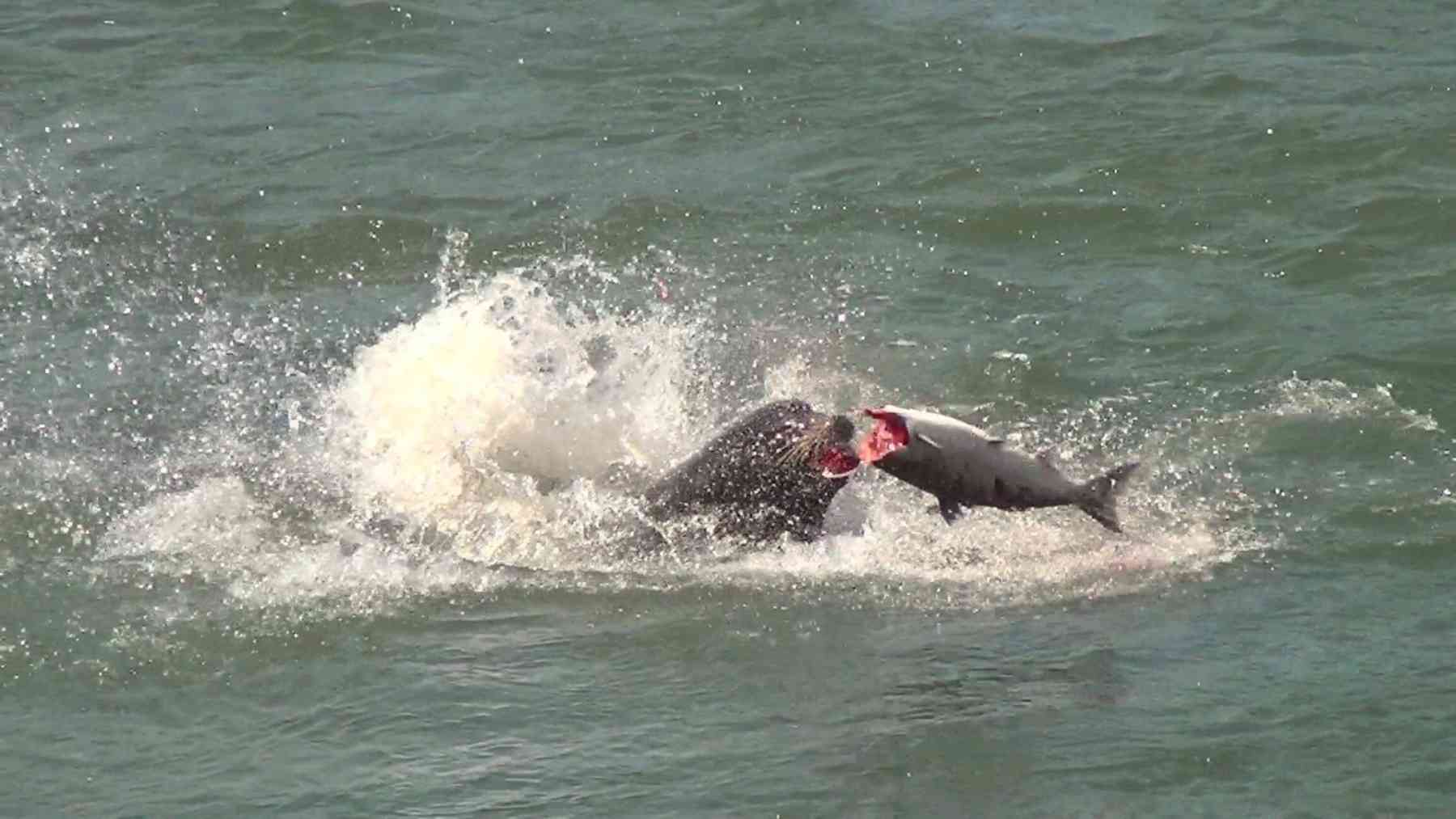
Below a concrete dam on the Columbia River, a dark head breaks the surface near a row of steel bars.
A salmon thrashes once, then goes still.
Every spring the same scene repeats at the base of Bonneville Dam.
Observers on the walkways above count the animals working the water below.
Then one official tally put a hard number on it.
A fish ladder built for salmon became an ambush point
Bonneville Dam was built to generate hydroelectric power and to let migrating salmon climb past it through a series of fish ladders. Nobody designed those ladders with a predator in mind, but the narrow concrete channels turned out to suit one perfectly. Corps biologists describe California sea lions as having learned to exploit concentrations of migratory adult salmonids below the fish ladders at Bonneville Dam.
Salmon and steelhead have to bunch up at the ladder entrances while they search for the current that leads them through, and that bottleneck is exactly where a sea lion can work with the least effort. Over a single record breaking season, officials estimated that sea lions took 7,329 fish in the Bonneville tailrace, 6,170 of them salmon. That is the kind of number that reframes a problem once it is written down.
Dozens of sea lions, not hundreds, crowd the tailrace
Picture the water just downstream of the dam, a wide stretch called the tailrace, where the river boils white below the spillway gates. Salmon pause there before attempting the ladders, and that pause is the whole problem. A sea lion can hang in the current, pick off a hesitating fish, and barely use any energy doing it.
The fish have nowhere else to go. The crowd below the dam runs into the dozens rather than the hundreds. Daily counts at the dam one recent spring peaked at 48 Steller sea lions, and the highest Steller count recorded there since the animals first appeared is 89. Both the Stellers and the smaller California sea lions work the same stretch of water.
Managers brand many of the regular visitors with individual identification numbers so the same animals can be tracked from year to year. That turns the tailrace into a kind of open air roll call each spring, with the same animals returning to the same slack water.
Twenty years of steel barriers have narrowed the gap without closing it
Crews have tried almost everything short of giving up the fish ladders altogether. Physical barriers were built starting in 2006 to block pinnipeds but allow fish passage, and these sea lion exclusion devices are now installed through the season at all eight fishway entrances, tall bar frames that let water and fish through. Smaller grating sits on the 16 floating orifice gates along the face of Powerhouse Two.
Acoustic deterrents, underwater pyrotechnics and boat based hazing have all been used alongside the steel. Research on Steller sea lions at the dam found hazing altered behavior temporarily, with limited effectiveness over the long term as animals resumed activity once hazing stopped.
The Corps keeps the exclusion devices in self leveling use year round, concluding that leaving the devices in place through the year is warranted. The headline tally comes from the Portland District’s pinniped predation report covering August 2021 through May 2022, which put the loss at about 12.4 percent of the salmon run accounted for during the observation period.
More than 200 sea lions removed from the river under one federal permit
When barriers and deterrents did not bring the numbers down, agencies turned to a more drastic step. Under federal authorization, trapping and lethal removal of repeat offenders became part of the management plan at Bonneville Dam and nearby Willamette Falls. Engineers elsewhere have found old hardware can be turned to new purposes instead of fighting a river outright, the same logic behind turbine blades recast as bridge beams or retired turbines stripped for their magnets.
From 2020 through December 2025, wildlife managers removed 124 California sea lions at Bonneville Dam and Willamette Falls, along with another 116 Steller sea lions. State managers report that both the average number of sea lions and the duration of their stay in the river and its tributaries have decreased since the work began.
Those managers estimate that more than 50,000 adult salmonids have been saved from predation as a direct result of the states’ efforts at the two sites. They are equally clear that predation below Bonneville Dam has not been eliminated. The state’s own account of the program frames it as reduction, not resolution.
Next spring’s count will decide what happens after
The tension at Bonneville has no tidy ending. Sea lion populations along the West Coast have rebounded strongly since federal protections took hold decades ago, which is itself a conservation success story. California sea lions now number more than 250,000, and the eastern stock of the larger Steller sea lions has grown past 70,000.
That recovery now meets salmon runs still trying to climb back from historic lows, on one pinch point in one river. Both trends cannot keep rising forever in the same half mile of water.
Meanwhile the dam keeps generating electricity exactly as designed, indifferent to the drama in its own tailrace. The fix there is built from steel bars, boat patrols and a running tally that every spring starts again at zero, with nobody quite sure which number will be the one that finally holds.
Read the whole thing?
Get the week's signal, not the noise
Our sharpest reporting on energy, climate and nature — free, once a week.