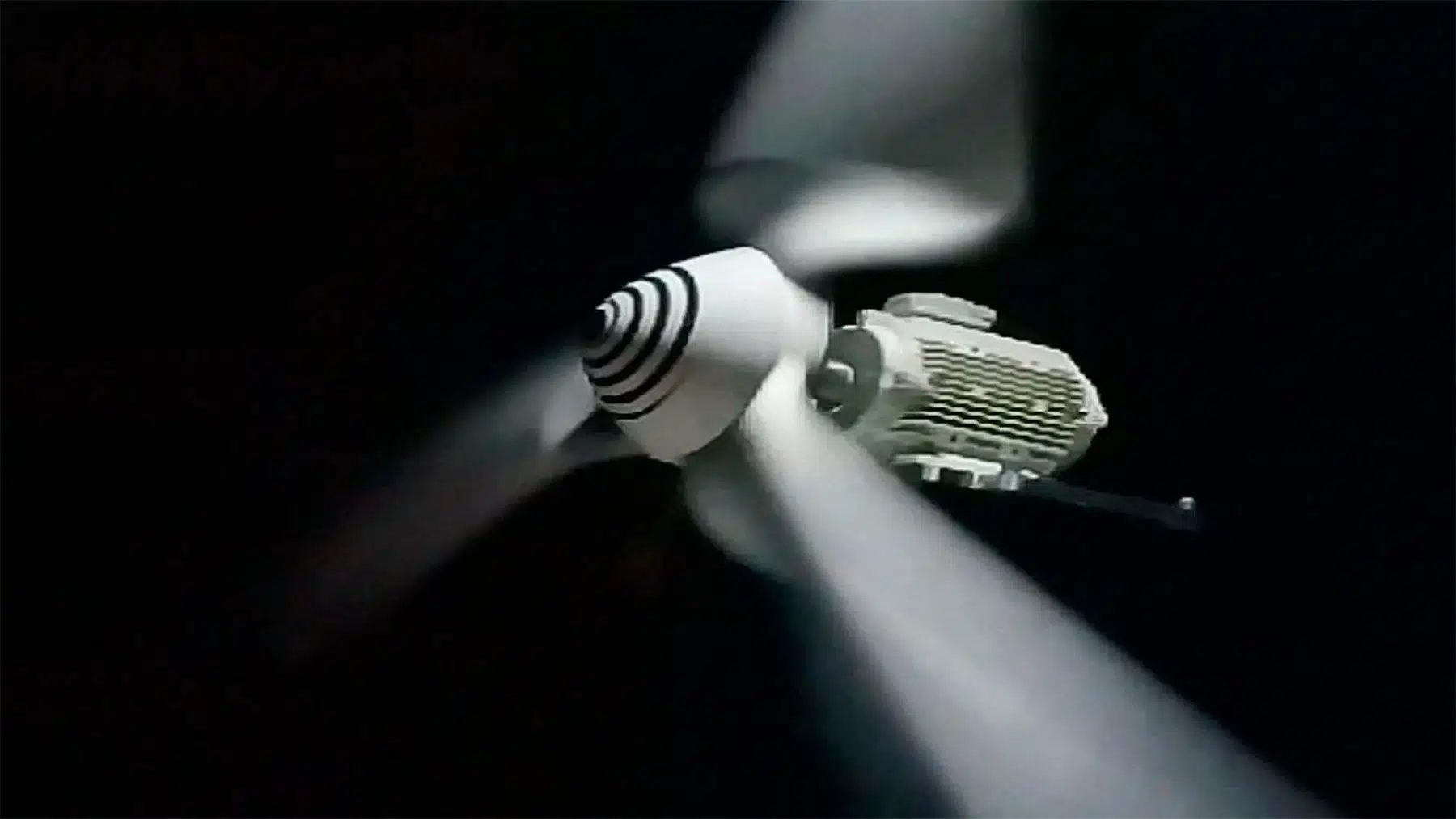
At first glance, it looks almost harmless. Small, light, and simple — more like something you’d see spinning in a garden than producing electricity. While most wind turbines stand still and wait for strong gusts, this little “pinwheel” starts moving when the air barely feels alive. What seems playful at first is quietly changing how wind energy can work.
When calm air used to mean no power
For years, wind power followed one strict rule: without enough wind, nothing happens. Entire regions were dismissed as useless for turbines because the air simply moved too slowly. Calm days meant no power, no matter how clever the design. That limitation shaped where wind energy could exist — and where it could not.
A different way of thinking about wind
Instead of building taller towers or heavier machines, engineers at the Fraunhofer Institute for Applied Polymer Research (IAP) began asking a different question: what if wind energy didn’t need strong wind at all? Their idea was to design something light, flexible, and responsive — a system that works with the wind instead of fighting it.
This playful-looking “pinwheel” is actually a new small wind turbine developed by Fraunhofer IAP in collaboration with BBF Group. It was designed specifically for very low wind speeds, starting to spin at around 2.7 meters per second — a level of airflow most turbines completely ignore.
Small size, real performance
Despite its compact design, the turbine can deliver meaningful power. In stronger breezes, it can produce up to 2,500 watts, enough to support homes, equipment, or small off-grid systems. Tests show it delivers up to 83% more power than comparable small wind systems and reaches an efficiency of around 53%, close to the theoretical maximum.
Why the design stays simple and reliable
The turbine’s hollow, lightweight blades reduce its weight by about 35%. Instead of resisting the wind, the blades flex slightly, helping the turbine adapt to changing conditions and avoid damage. This reduces the need for heavy safety systems and makes the turbine easier to maintain.
Fraunhofer researchers see potential far beyond private homes. The turbine could support remote cabins, island communities, emergency power systems, and disaster relief operations, where fuel is costly or hard to transport. Five prototypes are already being tested in real-world conditions, with more improvements expected.
A quiet shift in wind energy
What looks like a toy is anything but one. Germany’s “pinwheel” shows that clean energy doesn’t always need strong winds or massive towers. Sometimes, even a gentle breeze — once ignored — can be enough to make power flow.
Read the whole thing?
Get the week's signal, not the noise
Our sharpest reporting on energy, climate and nature — free, once a week.