Bat deaths have proven to be the most significant challenge associated with wind energy for wildlife.
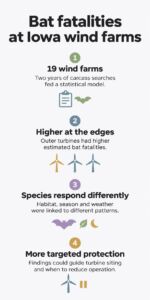
Over two years, bat fatalities were examined at nineteen (19) wind farms across Iowa. A clear pattern soon emerged.
The highest fatality estimates were not spread evenly across the sites.
Instead, certain turbines stood out from the rest. Understanding why became the next challenge.
The pattern was becoming too consistent to ignore
Bats provide additional services such as maintaining insect populations under control, contributing to healthy ecosystems.
As many species of bats continue to lose their habitat, disease continues to plague them.
Environmental change also creates challenges for them. Most of those threats occur far from wind facilities.
Wind turbines are different in that they can create direct mortality to bats.
Fatal collisions between turbines and bats have been documented for over twenty years.
The challenge remains finding why some turbines appear riskier than others.
Answers only emerged after the focus shifted
Another perspective emerged when the data were examined more closely.
They then examined individual turbines rather than the wind farm as a whole.
Researchers collected bat carcasses during routine searches around the base of each turbine over two years. In short order, a clear trend emerged.
Fatality rates were consistently higher at edge turbines compared with those that were farther in the same wind facility.
This finding clearly indicated that location or placement was also very influential.
Then the landscape itself became part of the story
Where a turbine was placed appeared to matter.
Locations near forests often showed different patterns of bat fatality estimates. So did locations near rivers and wetlands.
The biggest differences were observed where bats preferred to hunt or roost.
Those preferences created “hot spots” based on landscape features. Unfortunately, many of those hot spots overlapped with turbine locations.
That pattern revealed an important clue. However, it did not explain everything.
A second level was added beyond just where bats died
According to Ecological Informatics, the data suggested another layer to the story.
Many different bat species had lower fatality rates when there were lower wind speeds and warmer temperatures during nighttime hours.
However, not all species are affected in the same way by the above-mentioned conditions.
The characteristics of certain species relate much more closely to their preferred habitat. Other species are more directly related to weather and environmental conditions.
There is no single condition that can explain all observations regarding how bats die.
Risk may begin before the blades ever move
Findings suggest risk begins long before construction starts on a new turbine.
Both habitat data and facility design can help identify potential high-risk locations.
Even among turbines in the same wind farm, collision risks can vary dramatically. That provides opportunities early in the planning process.
Not every edge turbine carries the same level of risk. Even so, the findings show that placement decisions matter.
Choices made on a map today will ultimately impact outcomes before blades start turning.
Reducing risk does not end once construction is finished
Placement only represents part of the solution. There may also be methods operators can employ post-construction to reduce risk.
Smart curtailment adjusts operations on a turbine when expected levels of risk are greater.
Future mitigation efforts may become even more focused and targeted.
Not every turbine faces the same amount of risk. Not every species responds similarly to factors that contribute to bat fatality estimates.
Seasons in which the highest-risk conditions exist may differ from location to location. Weather conditions may also be relevant.
Create renewable energy while reducing harm caused by wind energy to wildlife.
Understanding where turbines are built may eventually become just as important as understanding how they function.
Read the whole thing?
Get the week's signal, not the noise
Our sharpest reporting on energy, climate and nature — free, once a week.