
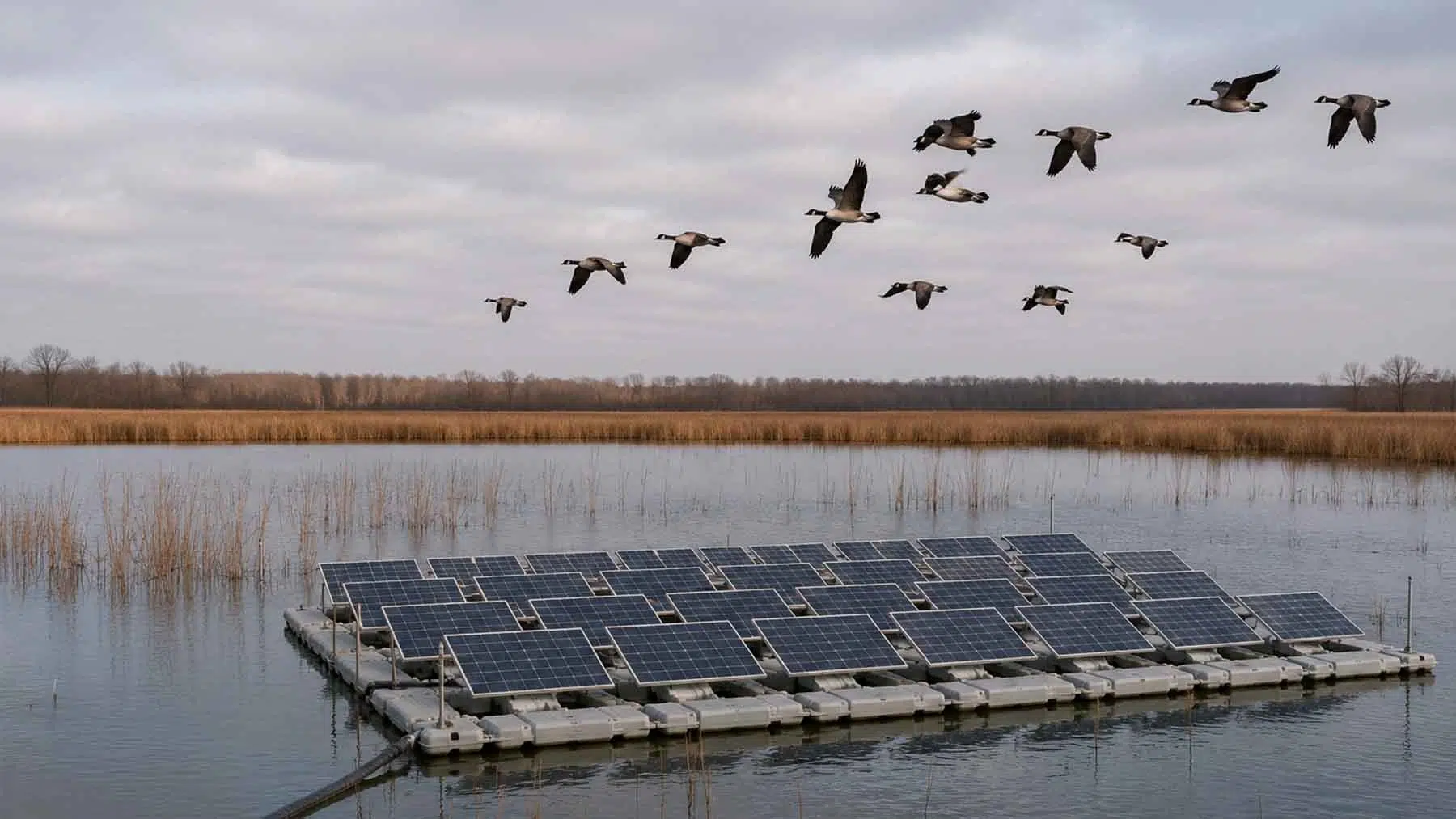
A new floating solar array is being tested at the Rice Research and Extension Center in Stuttgart, Ark. The installation consists of 96 floating panels on a small portion of a 40-acre reservoir that is used for agriculture. Floating panels could generate electricity without taking farmland out of production.
Located in the Arkansas Delta, the center sits along the Mississippi Flyway.
One question has very little to do with producing electricity.
How will migrating birds respond when they encounter a reservoir covered with floating solar panels?
Solar projects often compete with farmland
Typically, renewable energy companies are looking for large flat parcels of land that have been cleared of trees. In rural areas, especially agricultural ones, that can put them right in competition with local growers who need that space to plant crops. The Rice Research and Extension Center in Arkansas is hosting the project.
Scientists are testing whether irrigation reservoirs could serve as an alternative location for solar panels. Floating solar systems are already used in other parts of the world. Arkansas researchers are testing how the technology performs under local conditions.
One goal is to generate electricity without giving productive farmland over to solar development. The project is also expected to provide practical information about operating and maintaining floating solar systems.
Researchers are also watching to see how the floating system affects the reservoir itself.
Particular attention is being paid to evaporation and reservoir management.
The installation may help show how floating solar systems function on agricultural reservoirs. Only .01 acres of the 40-acre reservoir will be occupied by the floating solar array.
They also want to know whether the concept makes economic sense under Arkansas conditions.
The reservoir sits beneath a major migration route
Researchers are also interested in whether the floating panels can reduce evaporation and limit erosion around the reservoir. Reducing evaporation could help conserve water stored in irrigation reservoirs.
The floating panels may also help limit erosion around reservoir embankments. Arkansas is home to the Mississippi Flyway, one of North America’s most important migration routes for waterfowl.
Migratory birds pass through the Arkansas Delta along the Mississippi Flyway. Because of this location, the floating solar array may end up being much more than just an energy-producing facility.
The University of Arkansas System is also studying the project’s broader impacts across the region.
The project is being watched for its economic and environmental effects.
Exactly how migratory waterfowl respond to the floating solar array remains largely unknown at this stage.
Researchers installed the array to help find out
It provided a unique opportunity for researchers to determine how migratory birds react to floating solar arrays in Arkansas. Currently, researchers cannot accurately determine how migratory birds will react when they encounter the floating solar array.
Once the panels begin generating electricity, researchers will be able to monitor how birds respond to the structure.
They will observe whether birds avoid it, ignore it, or otherwise interact with it.
This project was partially designed to enable researchers to answer that question.
What the project could reveal
Researchers hope the project helps expand the use of floating solar systems. Such systems could place less pressure on agricultural land.
That approach could appeal to farming regions where land is already in demand.
The project may provide insights beyond power production and water management.
As the floating solar array becomes operational, researchers will learn how it performs under Arkansas conditions. They will also learn whether it can peacefully coexist with wildlife that utilizes the reservoir.
These findings could also shape how floating solar projects are designed in places used by migratory birds.
Read the whole thing?
Get the week's signal, not the noise
Our sharpest reporting on energy, climate and nature — free, once a week.


