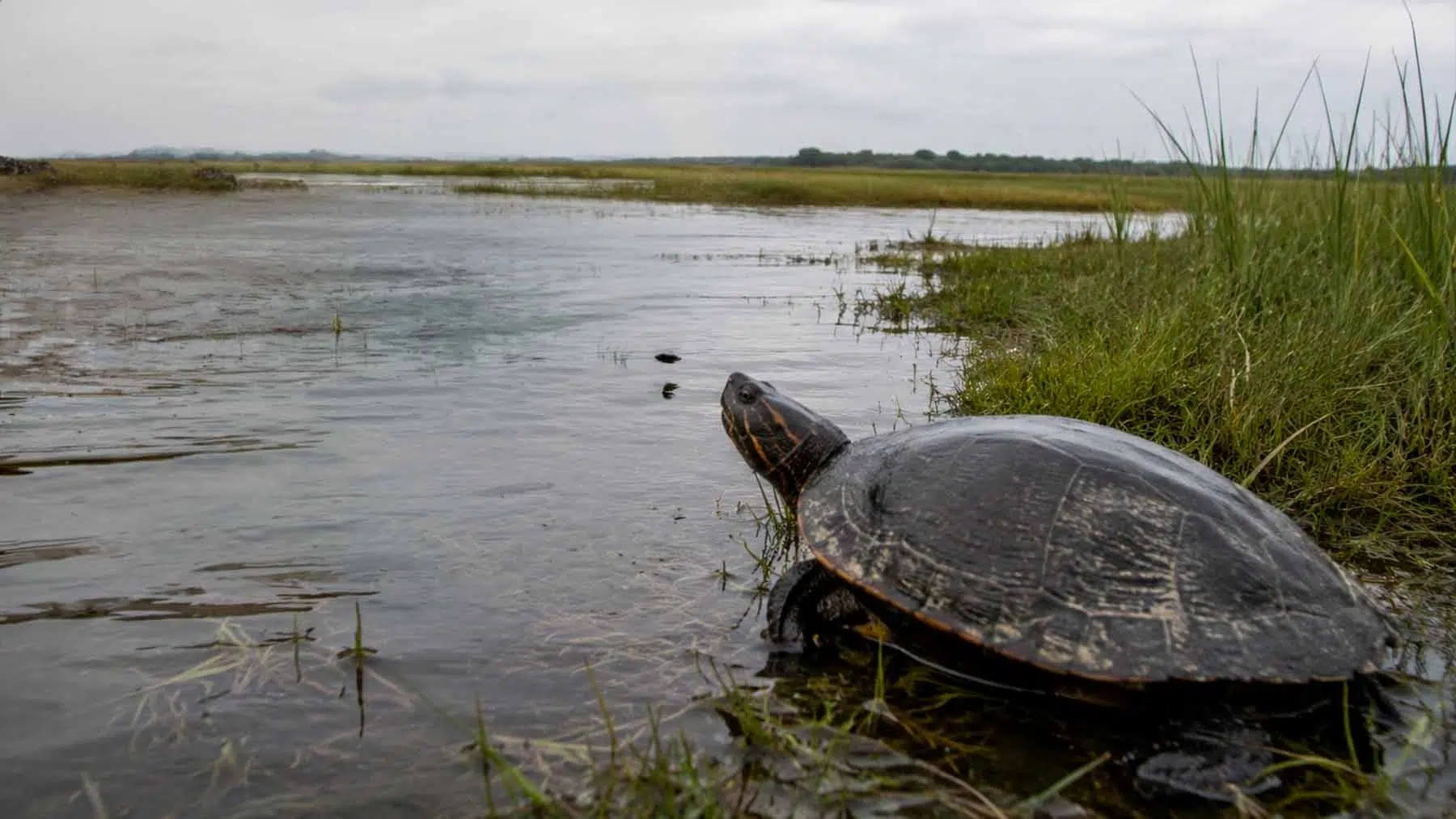
In the spring of 2010, a female Blanding’s turtle left the wetlands at Great Meadows National Wildlife Refuge in Concord, Massachusetts.
She traveled more than a mile to a nearby office park.
One of the hatchlings was a female weighing about seven grams. Stone Zoo staff collected her for a program that improved young turtles’ chances of survival.
In spring 2011, Ivy was returned to the refuge with a small notch in her shell for identification.
Then Ivy vanished for more than ten years.
The turtle that vanished after her release
Stone Zoo is part of Zoo New England’s Headstart Program, which raises Blanding’s turtle hatchlings through their first winter.
In the wild, hatchlings are about the size and weight of a quarter. By the time Ivy was released into the wild in 2011, she was much heavier, nearly a third of a pound.
Blanding’s turtles are considered endangered worldwide and threatened in Massachusetts. Adults can live 70 years or more, but during the first year of life, hatchlings are under heavy predator pressure.
Captive-raised turtles are about 40 times more likely to survive to adulthood than wild hatchlings.
Staff equipped her with a radio transmitter in hopes of locating her nest.
The program that turned one nest into hundreds of releases
The Headstart Program was initiated at Great Meadows in 2003. At the time, the refuge’s Blanding’s turtle population contained approximately 54 aging adults with very few juveniles entering the population.
Since that time, more than 800 headstarted turtles have been released in and around the wetlands at Great Meadows National Wildlife Refuge.
The process begins each spring when refuge staff find turtle nests and take measures to protect them from predators.
After the eggs hatch in early fall, field crews collect the hatchlings and transport them to partner schools. During the subsequent winter months, school students raise the turtles in warm aquariums with an unlimited food supply.
When spring arrives, the young turtles are typically too large to be preyed upon by many predators.
Since 2009, more than 22,000 Massachusetts students have participated in this program.
This program was originally conceived by Dr. Bryan Windmiller, who directed it for over two decades before retiring in 2026.
Partners include Zoo New England, the U.S. Fish and Wildlife Service, and the Town of Concord. The Government of Massachusetts also partners on this effort through the Division of Fisheries and Wildlife.
The effort also relies on land trusts and residents who allow female turtles to nest on their property. In Massachusetts, protecting Blanding’s turtles requires cooperation across both public and private lands.
Two of Ivy’s own hatchlings returned to the same wetland
In the spring of 2025, Senior Field Conservationist Jimmy Welch received a signal that Ivy was leaving the refuge in search of a nesting site. On nearby conservation land, Ivy selected a nesting site before dawn. Welch marked and protected the nest.
When it hatched, seven healthy hatchlings emerged. These were the first documented offspring from a turtle raised through the Headstart Program.
On June 25, 2026, two hatchlings were released into a wetland at Great Meadows National Wildlife Refuge, exactly one year after their mother laid the eggs.
About 40 people attended the release, including program founders, field technicians, students, and neighbors.
This release marked the first confirmed second-generation offspring from the Great Meadows conservation program.
His community-based conservation model is now being used elsewhere in Massachusetts.
The population at Great Meadows has grown from about 54 turtles in 2003 to an estimated 204 to 316 today. That represents a four- to sixfold increase and places the population above the 1970s baseline.
The next test is whether Ivy’s offspring will survive their own first years, return as adults, and produce a third generation.
Read the whole thing?
Get the week's signal, not the noise
Our sharpest reporting on energy, climate and nature — free, once a week.