

A call from a member of the public set this story in motion.
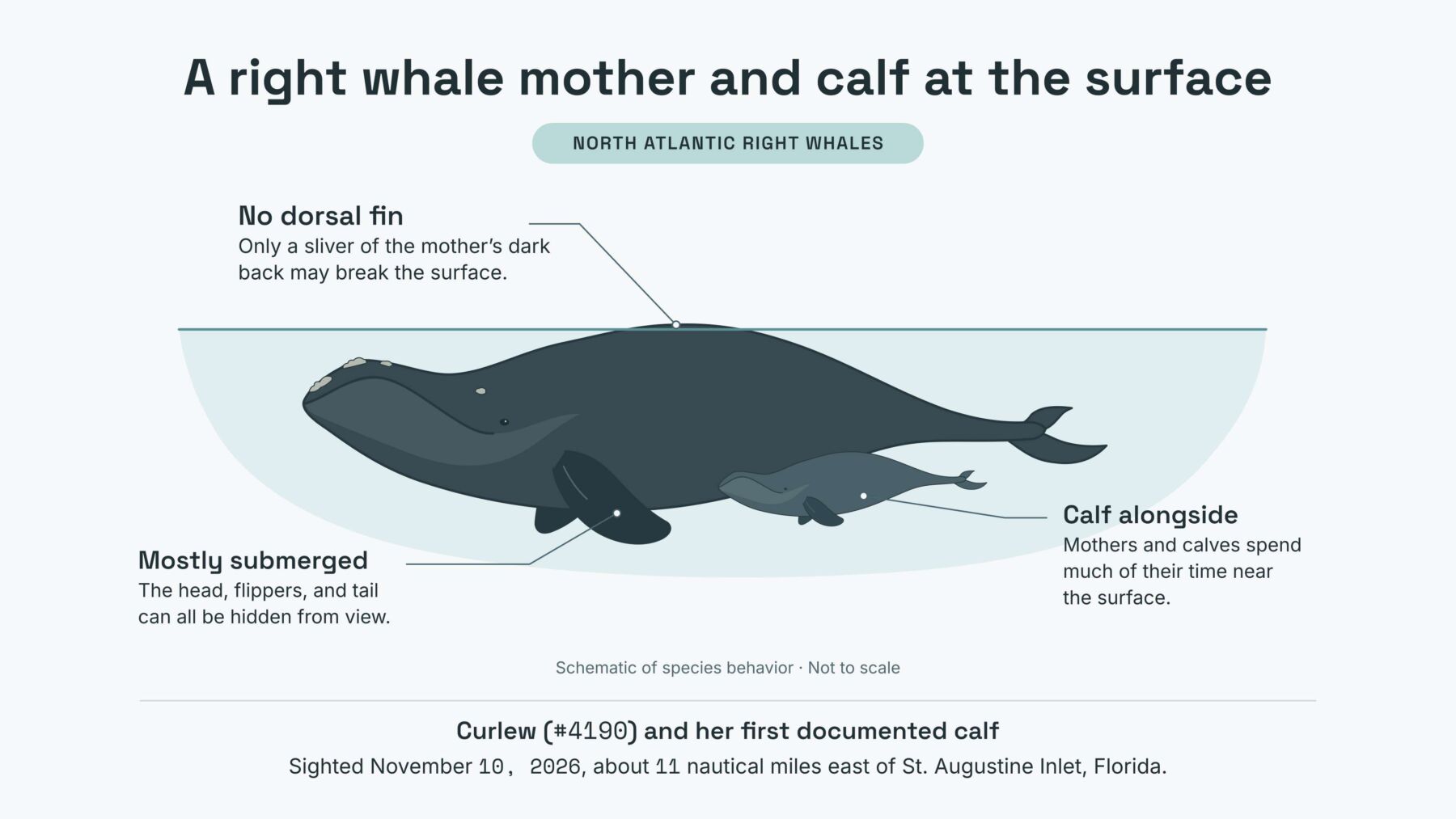
On 10th November 2026, a female North Atlantic right whale and her calf were spotted off Florida.
The female was subsequently identified as Curlew (#4190) in the Right Whale Catalog.
This happened approximately 11 nautical miles east of St. Augustine Inlet.
At 16 years of age, Curlew had given no recorded births before this.
By NOAA’s last communication in relation to the 2027 calving period, just one calf had been assigned.
Individual experience shapes each new life in the catalog
Each of the living North Atlantic right whales is allocated an ID number in the Right Whale Catalog.
Many also bear a name, often derived from one or more prominent features.
In Curlew’s case, she takes her name from a large wound across her posterior.
That mark is thought to be reminiscent of a Curlew, a type of wading bird.
She hatched in 2011 from a female called Tusk and has 3 sisters. No offspring have yet been attributed to any of these.
Breeding season puts focus on the next generation
The North Atlantic right whale faces severe threats across its range.
There are currently approximately 380 individuals estimated to be alive in the stock, with only approximately 70 capable breeding females.
The calving period attracts a high level of activity to identify as many breeding females and calves as possible.
Each female and calf plays a vital role in enabling the North Atlantic right whale to build its numbers.
Tracking whale movements gives further clues on behavior
Curlew’s movements prior to the current sighting saw her traverse a large proportion of the eastern seaboard in the preceding year.
She accompanied a second female, Koala, through the southeastern U.S. calving area.
Afterward, she made a protracted journey along the Gulf of America. Both were observed near Alabama, western Florida, and southwestern Florida before continuing as far south as the Bahamas.
That last stop was reportedly a ‘first’ for the stock.
Monitoring efforts still rely on wider coverage
NOAA Fisheries and other government bodies conduct aerial and at-sea surveys between North Carolina and Florida during the calving season.
Data collected includes location, habitat occupancy, number of calves, and any whales found deceased or caught in fishing gear.
A variety of passive and active technologies allow further insight into the biology and health of the stock.
Survival challenges persist for newborns in open waters
Newborn North Atlantic right whales do not escape peril once they hit the open ocean.
North Atlantic right whales have been affected by an Unusual Mortality Event (UME) since 2017. That has resulted in more than 20% of the total becoming ill, injured, and dying.
The vast majority of these incidents are due to interactions with fixed and mobile fisheries and shipping.
In the most recent 3 calendar years, the death rate has exceeded recruitment.
Mother and calf will also be spending a significant portion of their time in the upper water column.
Because they are dark in color and have no visible fin, they may go unnoticed by nearby vessels.
Females are generally considered to attain reproductive capability at around 10 years of age.
Following a gestation of more than 1 year, a female will give birth to a single calf.
Historically, the inter-calving period was approximately 3-4 years. Today, that interval averages 7-10 years.
Waiting to see if more calves follow in coming seasons
The next cohort of right whales will help decide whether the species can recover.
With Curlew now adding a calf for the 2027 season, we wait to see if more females join this list in coming seasons.
Getting that first newborn on the board early gives the calving window a needed lift.
For a species with so few active mothers left, every single sighting counts.
Read the whole thing?
Get the week's signal, not the noise
Our sharpest reporting on energy, climate and nature — free, once a week.


