

Out on the Sunshine Coast, past the break line of a busy stretch of coastline, a peaceful five-week experimental field trial was recently conducted.
Researchers installed acoustic alarms on two official shark control nets.
Like a type of underwater whistle, they work by producing sound waves. There’s no mystery here.
The goal is simply to track whether passing humpback whales hear these signals and adjust their swimming routes around the gear.
Funding a cleaner way to protect swimmers and whales
In order to provide safe swimming areas to beachgoers, governments have historically utilized shark control measures such as drum lines and submerged mesh nets.
While this traditional safety system has worked effectively at reducing interactions between humans and sharks, it also creates an unintended ecological impact. During peak migration season, humpback whales often follow the same coastal routes where the submerged mesh nets exist.
Occasionally, humpback whales get entangled in the static gear or strike it.
Under the Shark Management Plan 2025 to 2029, the Crisafulli Government initiated the largest source of funding in the history of the state’s shark control program.
Minister for Primary Industries Tony Perrett noted that the initiative prioritizes scientific research and equipment scientifically proven to reduce risks.
The plan supports research into technologies such as drone surveillance and modified acoustic deterrents alongside existing shark management measures.
Engineering acoustic hardware for open surf zones
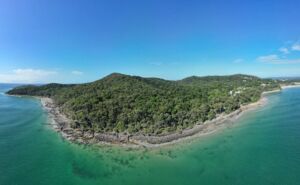
Noosa Main Beach provides an ideal location for studying marine mammal responses in a shallow coastal environment.
Each year, approximately 50,000 humpback whales pass through Queensland waters as part of their migratory route.
Historical Queensland Government records show that an average of only 0.02% of migrating whales interacted with shark nets in previous years.
Despite having such an incredibly low starting point, state officials and conservationists would like to see those numbers continue to trend closer to zero. When designing an acoustic alarm for use in open saltwater environments, researchers encountered several technical challenges.
Future Oceans CEO James Turner noted that delivering this specific acoustic output required considerable engineering.
Future Oceans designed a small, rugged device that could produce extremely specific acoustic outputs. This device operated on battery power and was designed to withstand repeated pounding in surf zones, where strong waves and changing ocean conditions place continuous stress on marine equipment.
These signals were intended to warn whales of potential danger. They were not intended to cause a panic reaction among whales.
Testing the whale deterrent in real time
To assess whether whales could detect or avoid the noise from the acoustic net, researchers needed to make independent observations of whales during testing.
The University of Queensland worked with state government agencies to develop a methodology for evaluating performance.
Land based observation platforms were established at the Noosa Headland by the research team.
Each group of whales that swam past the Noosa Headland was monitored in real time by observers who noted the direction, speed, and distance of travel of each whale from the acoustic net.
Backing up field trials with dedicated rescue teams
Funding was provided to establish specialist marine animal rescue teams.
Currently, there are 25 specialist officers employed by marine animal rescue teams located throughout the Gold Coast, Sunshine Coast, Redlands, and Mackay areas.
When a marine animal is detected interacting with coastal equipment, these teams will be deployed as quickly as possible.
The trial concluded on October 11, 2026.
This period was expected to coincide with the peak migration period of whales along the Sunshine Coast.
However, it should be emphasized that early results do not confirm long term changes in behavior.
Short-term studies typically only evaluate how animals respond when confronted with one obstacle.
Read the whole thing?
Get the week's signal, not the noise
Our sharpest reporting on energy, climate and nature — free, once a week.


