

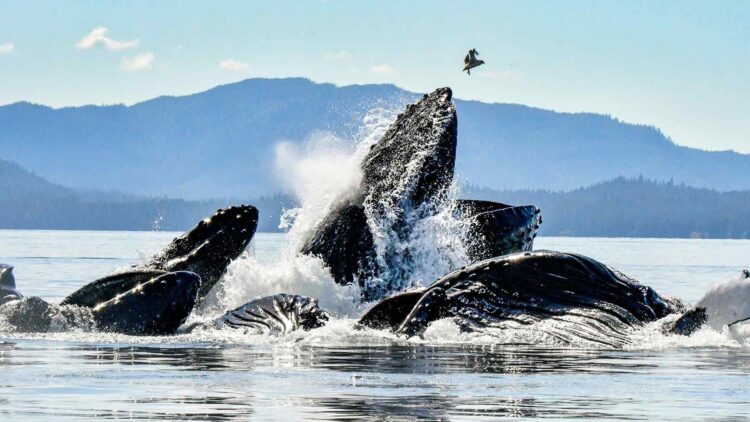
Thirteen whales suddenly changed direction across the Pacific Ocean.
They abandoned feeding areas and altered deep-diving patterns.
Researchers say the whales reacted like prey animals, detecting danger nearby.
But humans nearby heard absolutely nothing.
The sound existed beyond normal human hearing ranges.
Scientists now believe the reaction reveals how sensitive whales are to hidden ocean noise.
So what exactly were these whales hearing beneath the Pacific?
How scientists noticed whales suddenly changing course in the Pacific Ocean
A new study focused on deep-diving beaked whales in the Pacific.
These animals are already among the ocean’s most elusive species.
Researchers tracked 13 whales using satellite tags and underwater acoustics.
The whales normally followed predictable diving and feeding routines.
Then their behavior changed abruptly during sound exposure events.
Some whales stopped producing hunting clicks within minutes.
Others abandoned feeding dives and moved away rapidly.
Several abandoned feeding zones and continued fleeing.
The whales behaved almost exactly like animals escaping predators.
But researchers eventually ruled out orcas and natural threats.
Instead, another trigger kept appearing in the data.
And what it is may be a direct result of us as humans.
The invisible sound spreading through the oceans of the world
Whales rely heavily on sound to survive underwater.
Light disappears quickly in the deep ocean.
Sound becomes their primary way to navigate and hunt.
Sudden noise can interrupt feeding processes instantly.
Especially for deep-diving species.
The Pacific is vast and hides many of its lifeforms from humanity.
This particular sound has a far more human origin.
And proves one reality. Sound is changing the way that whales react.
Human beings above water usually cannot hear these sounds properly.
But whales detect the signals immediately.
Researchers say beaked whales appear especially sensitive to sonar.
Some react at surprisingly low sound levels.
Tagged whales changed direction within minutes of hearing the sound.
Several stopped foraging completely during deep dives.
Others surfaced early and fled the area. Was the odd sound a submarine in the area?
Scientists believe the whales interpret the sound like an approaching predator.
That response may be deeply instinctive.
The sound shares similarities with frequencies linked to danger in the ocean.
The whales behave like hunted animals. Scurrying to get away from this invisible predator.
Researchers say repeated disruptions may carry long-term biological costs.
And the issue has been detailed in the study, “Assessment of goose-beaked whale responses to mid-frequency active sonar using a hierarchical hidden Markov model,” published in Movement Ecology.
Why the whales fled across the Pacific Ocean like hunted animals
The strange sound was mid-frequency military sonar.
Military weapons often have an unintended impact on the environment around them.
A hidden trigger that changed the feeding and diving behavior.
The whales were not migrating normally.
They were actively avoiding the acoustic disturbance.
Scientists tracked 13 whales reacting to the sound across the Pacific.
Some exited rapidly from sonar zones after exposure.
Others stopped clicking and diving for prey altogether.
Which can interrupt feeding for hours at a time.
Beaked whales depend on deep foraging dives to survive.
Interrupting those dives affects feeding opportunities and energy balance.
Researchers say the fleeing behavior resembles anti-predator responses.
The whales act as though an invisible threat is getting perilously close.
That may explain why strandings sometimes follow sonar exercises.
Researchers worry repeated sonar exposure could consistently interrupt feeding behavior
The study adds to growing concerns about underwater noise pollution.
Shipping traffic, sonar systems, and industrial activity continue to expand globally.
For whales, sound is not background noise.
It is their entire sensory world.
Researchers say humans still underestimate how dramatically ocean noise reshapes animal behavior.
Especially for species living far below the surface.
The Pacific may sound empty to us.
But to whales, it can suddenly feel like a hunting ground filled with invisible predators.