
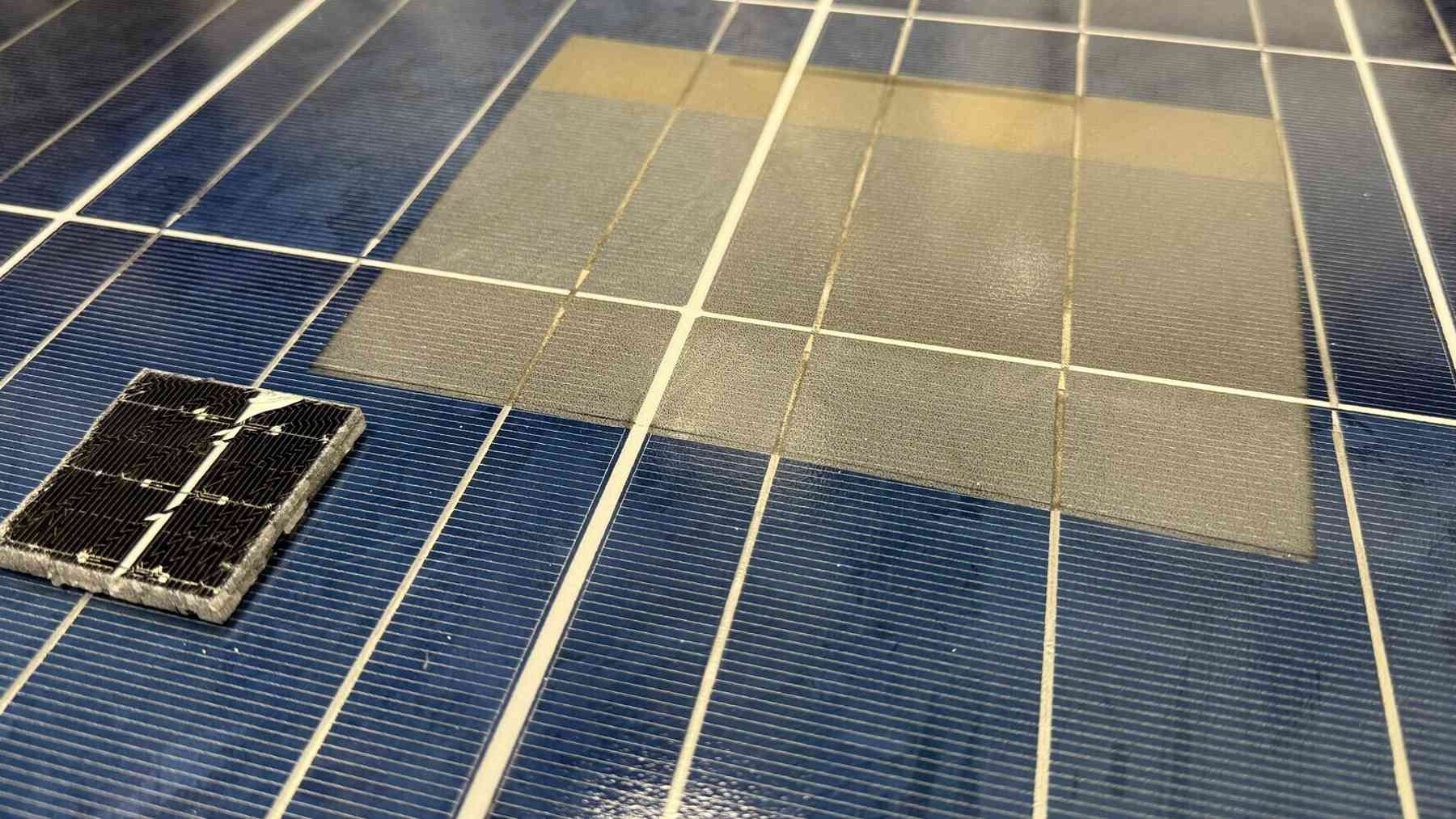
A green laser line flicks across a cracked solar panel on a lab bench.
There is no furnace glowing behind it.
There is no tank of acid waiting to dissolve anything.
Just a pulse of light moving over glass, and underneath it, a wafer of silicon quietly letting go of the glue that has held it for decades.
That small, almost boring scene is the whole story.
What makes a pulse of light strong enough to peel a solar cell apart without wrecking it?
How a beam of light pries a panel apart without touching it
A standard solar panel is built like a sandwich nobody expects to open again: glass on top, a thin silicon cell in the middle, a plastic encapsulant gluing it all together, and a backsheet sealing the bottom. That bonded layer stack is designed to survive at least 25 years of weather, which is exactly why it fights back once the panel is retired.
The method, developed at the Netherlands Organisation for Applied Scientific Research, fires short pulses of green or near infrared laser light through the transparent front of the module, so the energy lands on the silicon cell surface itself. These nanosecond pulses do the work the furnace used to do.
Instead of melting the whole sandwich or soaking it in solvent, the light does one precise job. It weakens the bond between the cell and its encapsulant and at the same time strips the silicon nitride anti reflective coating, which avoids a separate acid etching step some recovery routes require.
That double effect is what lets the glass and the cell come apart cleanly.
What a stack of old panels on a cart actually looks like up close
Picture a pallet of decommissioned panels, aluminum frames already stripped, surfaces dulled by years outdoors. Each one still holds a wafer of silicon worth far more per pound than the glass around it, plus a thin web of silver paste threaded across the cell face.
Conventional recycling usually shreds that whole stack into a mixed pile of glass, aluminum and crushed cell fragments. Shredding recovers bulk materials efficiently but tends to fragment or contaminate the smaller, higher value fractions, which make up only a sliver of a module’s mass and most of its recoverable worth.
That is the gap the laser aims at.
It opens a path to the two small, valuable fractions that shredders routinely lose, leaving the glass and frame to be handled the ordinary way afterward.
The hardest number: what came out of the lab tray
After the laser pass, the cells went through one wet chemical cleanup step before anything was weighed or tested. That step returned silicon at a near complete purity level with a 97 percent recovery yield, and silver at 99.7 percent purity, also at a 97 percent yield.
So material that normally disappears into mixed powder came back as two clean, separate streams. The institute says silicon recovered from discarded modules is already good enough for reuse in battery anodes, and describes its purity as still climbing toward full solar grade rather than there yet.
The energy side of the ledger is just as striking. The group reports less than 1 kilowatt hour per module for the laser step, against roughly 25 kilowatt hours for a conventional thermal route such as pyrolysis. That gap is why the team frames this as a fundamentally different approach to recycling.
Where the method still has to prove itself outside the lab
None of this has run at industrial scale yet. The researchers described the results as proof of principle and noted that the recovery routes were demonstrated at laboratory scale, not on a line that could process thousands of panels a day.
Even so, the work covered a range of real module types rather than one lucky sample, spanning PERC, TOPCon, Al-BSF, polymer frontsheet and recent IBC designs. That kind of versatility across formats matters because cell architectures have turned over several times in the past decade.
The hardware is not exotic either. Green pulses need roughly half the fluence to delaminate a module, but near infrared sources cost two to three times less, which the team argues makes the cheaper wavelength attractive once capital cost enters the picture.
Why a goldmine sitting in a landfill finally has a way out
The urgency behind this work is not abstract. One of the project’s research leads has described the silver and silicon still locked inside old panels as a potential goldmine of resources, and expects Europe to face a substantial wave of discarded panels by 2030, including arrays like the panel arrays now aging across airports and warehouses on both sides of the Atlantic.
Solar manufacturing has been a heavy pull on the metal, taking close to a quarter of newly mined silver in 2024. That demand has been falling since, as manufacturers thin the silver loading in each cell, which makes reclaiming what is already installed more interesting rather than less.
So the next steps are less about physics and more about logistics: building a line that can feed panel after panel under the beam, and proving the economics hold at full volume. That same push toward squeezing more value from hardware already in place shows up elsewhere, including the turbine tracking work on dammed rivers. If the laser route scales, the stack of retired panels behind a recycling yard starts looking less like trash and more like ore nobody had figured out how to mine yet.
Read the whole thing?
Get the week's signal, not the noise
Our sharpest reporting on energy, climate and nature — free, once a week.


