
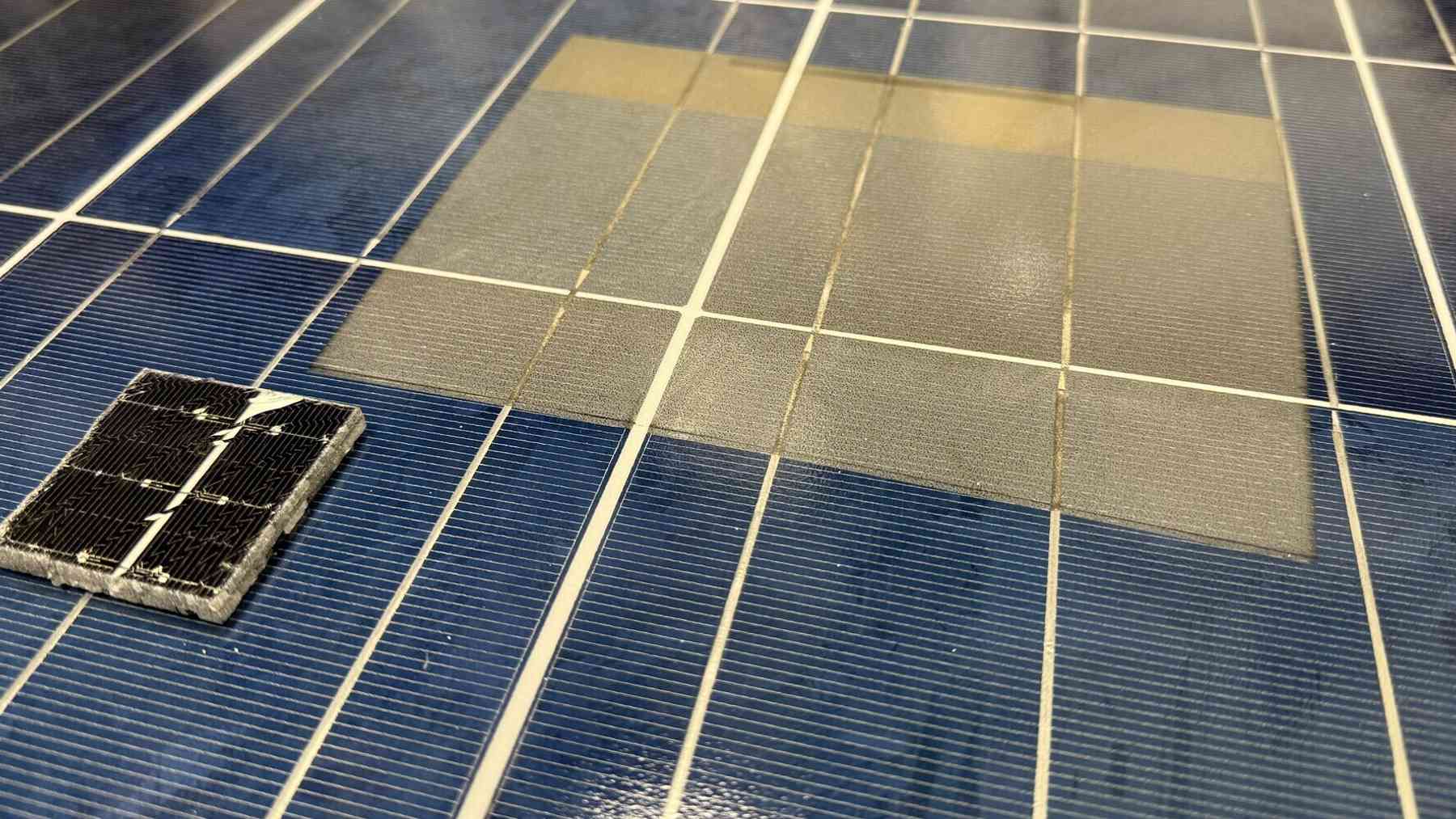
A solar panel looks sealed for good.
Glass on top, metal on the back, and in between a plastic laminate bonded tight enough to survive a quarter century of rain and hail.
That toughness is the whole point while the panel is working.
It becomes a problem the moment the panel stops.
In a lab in the Netherlands, researchers found a way to crack that seal without shredding the panel or soaking it in acid.
They used light.
How do you open a sealed solar panel without destroying what is inside
The trick is to aim a pulsed laser beam straight through the panel’s own front glass. Researchers at TNO, the Dutch applied science institute, send green or near infrared nanosecond laser pulses through the module’s transparent front layers, targeting the silicon cell surface directly. The glass barely notices the pulse. The silicon underneath does.
That targeted heating does two jobs at once. It weakens the bond between the cell and its encapsulant and removes the module’s anti reflective coating, avoiding the separate acid etching step some recovery routes still need.
One flash of light replaces what used to be a chemical stage entirely. Shredding and acid baths tend to mangle the very materials worth saving.
Picture the old panel on the bench, and the pulses crawling across it
Picture a retired panel laid flat under a bench mounted laser arm, its blue surface dulled by years outdoors. A technician walks the beam line by line across the cell grid, the same grid of hair thin silver wires that once carried current off the silicon. Each pulse lasts a few billionths of a second, but it is enough to loosen the bond beneath the glass without cracking it.
The glass comes through intact, with very little adhesive residue left behind, so the panel separates almost gently instead of collapsing into mixed fragments.
That gentleness matters. Silicon wafers are thin and brittle, roughly the thickness of a couple sheets of paper, and silver traces run across them about as wide as a human hair. Survive the separation and both materials keep their value. Fail, and they become dust mixed with glass cullet nobody wants to sort.
What the numbers actually showed in testing
In lab trials described in a 2026 conference paper on the laser process, a wet chemical step after the laser pass produced silicon purity up to 99.998 percent at a 97 percent yield, and silver purity of 99.7 percent at the same yield. The team called these results proof of principle, demonstrated at laboratory scale, though the method has already been tried on several commercial module designs.
Silver is the detail that raises the stakes. TNO puts the share of the world’s mined silver going into solar panels at roughly a quarter, and one of its research leads, Mirjam Theelen, has called end of life panels a potential “goldmine of resources.”
Pulling that silver back out of dead panels, instead of mining fresh ore, is the whole economic argument for bothering with lasers. TNO reports the laser system needs less than 1 kWh per module, against roughly 25 kWh for conventional pyrolysis.
Where the glare from these same panels meets a wing
Here is where solar panels brush against the living world in a way that has nothing to do with recycling. Flat glass reflects light in a polarized pattern that water seeking insects read as open water, and field tests on mayflies, caddis flies, dolichopodids and horseflies found panels polarizing reflected light almost completely, well beyond values typical of real water.
Whether migrating waterbirds make the same mistake is far less settled. The idea that birds confuse large arrays with lakes is a proposed lake effect hypothesis, suspected rather than demonstrated.
The same glass that fools a mayfly is the glass the laser must pass through cleanly. Work on panel sites described at the agrivoltaics solar farm tracks how those surfaces share ground with pollinators, a reminder that glass never behaves in isolation from the creatures around it.
What still has to happen before this leaves the lab
None of this solves the backsheet or the frame, and a full recycling line still needs a separate step for those parts, much like the solvent step described for the tough plastic film sealing double glass panels elsewhere.
The laser handles the silicon and the silver, not the whole panel. Even so, with a wave of panels installed decades ago now approaching the end of their working lives, a process that pulls out the two most valuable materials cleanly, using a fraction of the energy, is a genuinely useful piece of the puzzle.
The next step is scaling a laboratory setup into something a plant could run on thousands of panels a day, and that part has not been demonstrated yet.
Read the whole thing?
Get the week's signal, not the noise
Our sharpest reporting on energy, climate and nature — free, once a week.


