By employing general circulation models and reanalysis data, planetary scientists were able to characterize the circulation of airborne dust through equatorial regions and polar ice caps based on atmospheric datasets from orbiters over time.
The connection of atmospheric circulation and the dust storm phenomena was a subject of interest for planetary researchers for a long time.
Climate modeling shows that one overturning circulation cell is responsible for transport in the entire atmosphere throughout the year on Mars.
Such a planetary scale transport phenomenon results in the isolation of mid-latitudes and the transport of dust at altitude from pole-to-pole.
Modeling particle transport by atmospheric reanalysis
Multiyear dust opacity climatologies for transitions between seasons have been created using satellites equipped with infrared spectrometers.
Using atmospheric reanalysis models and Lagrangian particle tracking, researchers were able to create a model of the movement of individual particles through time.
While mapping is done from satellites to detect atmospheric temperature and dust opacity, computer modeling allows scientists to detect the exact pathway of dust movement caused by global circulation.
Through mapping of multiyear cycles, the scientists detected transport pathways that work regardless of large-scale global dust storms.
Identifying single-cell atmospheric circulation patterns on Mars
Earth has a complicated climate system with many convection cells in the atmosphere, which ensures even distribution of pollutants and moisture around various latitudes.
Mars has a simple one-cell Hadley circulation spanning thousands of miles from pole-to-pole.
In the summer hemisphere, warm air rises, moves along high altitudes, and falls down in the frozen winter hemisphere.
A one-cell overturning process leads to the creation of big thermal gradients, which determine the movement of small dust particles in the thin carbon dioxide atmosphere.
Circulation cells are created.
Planetary physicists monitored the process of seasonal heating, which made the overturning flow move from one side of the equator to another.
Discovering an atmospheric barrier in mid-latitudes
It has been found through particle-tracking experiments that the outer edge of the Martian Hadley circulation creates a barrier that greatly limits mixing of air masses.
Boundaries of the atmosphere limit mixing of air between the center of the air mass and areas surrounding it.
Only a small number of dust particles are able to penetrate through this atmospheric barrier during seasons.
It is mid-latitude isolation.
Lack of mixing is responsible for the stability of dust concentration in the region in spite of high temperatures on the surface.
Dynamic barriers make it impossible to have an even distribution throughout the globe.
Conducting high-latitude dust flow towards polar caps of Mars
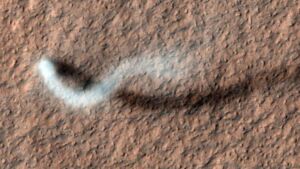
Although mid-latitude barriers confine the horizontal mixing process, high-latitude winds offer transport pathways directly towards polar zones.
Winds carry the fine mineral aerosols collected from summer high latitudes directly into polar winter vortices of the opposite hemisphere.
Pole-to-pole transport pathways offer possible corridors through which the tiny mineral dust particles will reach the polar zones, as reported by AGU — Journal of Geophysical Research: Planets.
Such a pathway offers a way of pole-to-pole atmospheric transport according to AGU-Journal of Geophysical Research: Planets.
Although the wind flow in the models can successfully transfer aerosols across the different hemispheres, more research needs to be done to determine their actual fallout onto ice caps or effects on polar albedo.
This is a modeled polar aerosol transport pathway rather than an actual coloring of ice caps.
The impact of large dust storms on global circulation
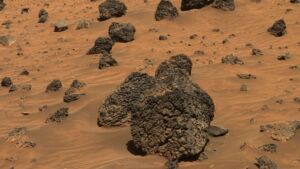
As large dust storms continue to play a vital role in atmospheric dynamics and dust lofting on Mars, recent studies point out the way that background circulation influences dust transport.
Instead of facilitating atmospheric mixing at all latitudes, single-cell Hadley circulation works as a filter by limiting horizontal mixing between mid-latitude regions while creating a direct vertical connection between polar regions.
This will help climatologists study the climate change processes and the evolution of Mars.
Read the whole thing?
Get the week's signal, not the noise
Our sharpest reporting on energy, climate and nature — free, once a week.