Three thousand three hundred light-years away, a region of gas and dust is doing what it has done for millions of years — quietly building stars. But on October 6, 2026, NASA’s James Webb Space Telescope pulled back the veil on NGC 7129, and what had been hidden became visible: jets of energy punching through luminous clouds, and pinpoints of stellar light buried so deep in cosmic dust that no telescope had ever reached them before.
For decades, the dense shroud of this stellar nursery kept its youngest inhabitants out of sight. Webb changed that.
A nursery hidden in plain sight
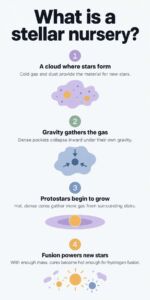
NGC 7129 sits in the constellation Cepheus, roughly 3,300 light-years from Earth. Astronomers classify it as a stellar nursery — a region where dense clouds of gas and dust collapse under gravity to form new stars. These environments rank among the most scientifically valuable in the galaxy, but also among the hardest to study. The same thick material that feeds star formation blocks the visible light that traditional telescopes depend on.
Before Webb, astronomers knew NGC 7129 existed and suspected it harbored young stellar objects. Ground-based and earlier space telescopes had detected signs of activity at the cloud’s edges, but the deeper interior stayed frustratingly opaque. The region had drawn scientific interest for years precisely because of what it might be hiding — and because those hidden objects could hold clues about how stars like our Sun first came to life.
What Webb’s infrared eye revealed
Webb’s ability to see in infrared light is what makes observations like this possible. Infrared wavelengths pass through dust clouds that would completely block optical light. Where a visible-light telescope sees only a dark, featureless wall of gas, Webb sees through it, revealing structures and objects embedded within.
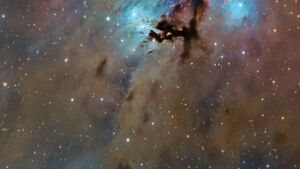
The newly released image shows a striking scene. Stellar jets cut through glowing nebular gas, tracing the paths of young protostars still buried inside their dusty cocoons. Bright knots of light mark stars in the earliest stages of formation, while the surrounding nebula glows with reflected and emitted energy, shaped by the activity happening inside it. Alyssa Pagan at the Space Telescope Science Institute processed the image, under the collaborative banner of NASA, ESA, CSA, and STScI.
Those jets deserve particular attention. They’re high-speed streams of gas ejected from the poles of young protostars as material falls inward and excess energy is funneled outward — not just dramatic, but diagnostic. A jet’s length, speed, and direction can tell scientists about the mass and rotation of the star producing it, and how far along that star is in its formation.
Stars caught in the act of being born
What makes NGC 7129 especially valuable is the variety it offers. The image doesn’t show a single star at one moment in time — it captures multiple stars at different stages of formation, all within the same region. That’s rare, and scientifically significant, because it lets researchers compare objects side by side and build a more complete picture of how stellar birth unfolds from early collapse to something resembling a true star.
The jets do more than mark where young stars are hiding. As they push through surrounding gas, they compress nearby material, which can trigger the collapse of additional clouds — essentially, one star’s birth can spark the next. This feedback process may explain why stellar nurseries tend to produce clusters rather than isolated individuals.
Understanding this sequence matters well beyond NGC 7129. Scientists believe our own Sun formed in a similar environment, surrounded by sibling stars in a now-dispersed cluster. Every observation of a stellar nursery is, in a sense, a look back at our own origins.
Webb’s growing catalog of cosmic creation
NGC 7129 is the latest addition to a growing portfolio. Since beginning science operations, Webb has trained its infrared eye on several other stellar nurseries — the Carina Nebula, the Rho Ophiuchi cloud complex, among others. Each image has revealed previously unseen detail and added new data points to scientists’ evolving models of star formation.
No single nursery tells the whole story. Different regions carry different densities, chemical compositions, and ages. By comparing them, astronomers can identify which features of star formation are universal and which depend on local conditions — Webb’s ongoing survey is building that comparative database, one image at a time.
The October 6, 2026 release of the NGC 7129 image signals that Webb’s productivity shows no signs of slowing. Years into its mission, the telescope keeps finding new things in places astronomers thought they understood. That’s worth sitting with — the idea that the universe still holds so many rooms we haven’t yet opened, and that we now have a tool capable of turning the handle.
Read the whole thing?
Get the week's signal, not the noise
Our sharpest reporting on energy, climate and nature — free, once a week.