A bucket tips sideways over a creek bank in western Oregon.
Something long and dark slides out, curling once before it vanishes into the current.
It is June, and the water is shallow here in Lane County, southwest of Eugene.
The fish sliding into it has already traveled farther than most Oregonians will drive this month.
It came by truck, from dams on the Columbia, by way of a waterfall near Oregon City.
Its kind has not been a regular sight in this watershed for seventy five years, and that absence is exactly what the next section explains.
A truck does what the river can no longer do
The fish are Pacific lamprey, a jawless, eel shaped species that the Columbia River Inter-Tribal Fish Commission calls the oldest fish in the Columbia system, appearing in the fossil record some 450 million years ago. The adults in this batch were originally sourced at Willamette Falls, the wide natural cascade near Oregon City where tribal fishers have caught lamprey by hand for generations.
That drive replaces what the lamprey can no longer do alone. Dams built across the basin last century left parts of the Long Tom watershed out of reach for a fish that climbs rather than leaps, clinging to rock with a sucker mouth instead of vaulting a barrier the way salmon do.
So biologists became the migration.
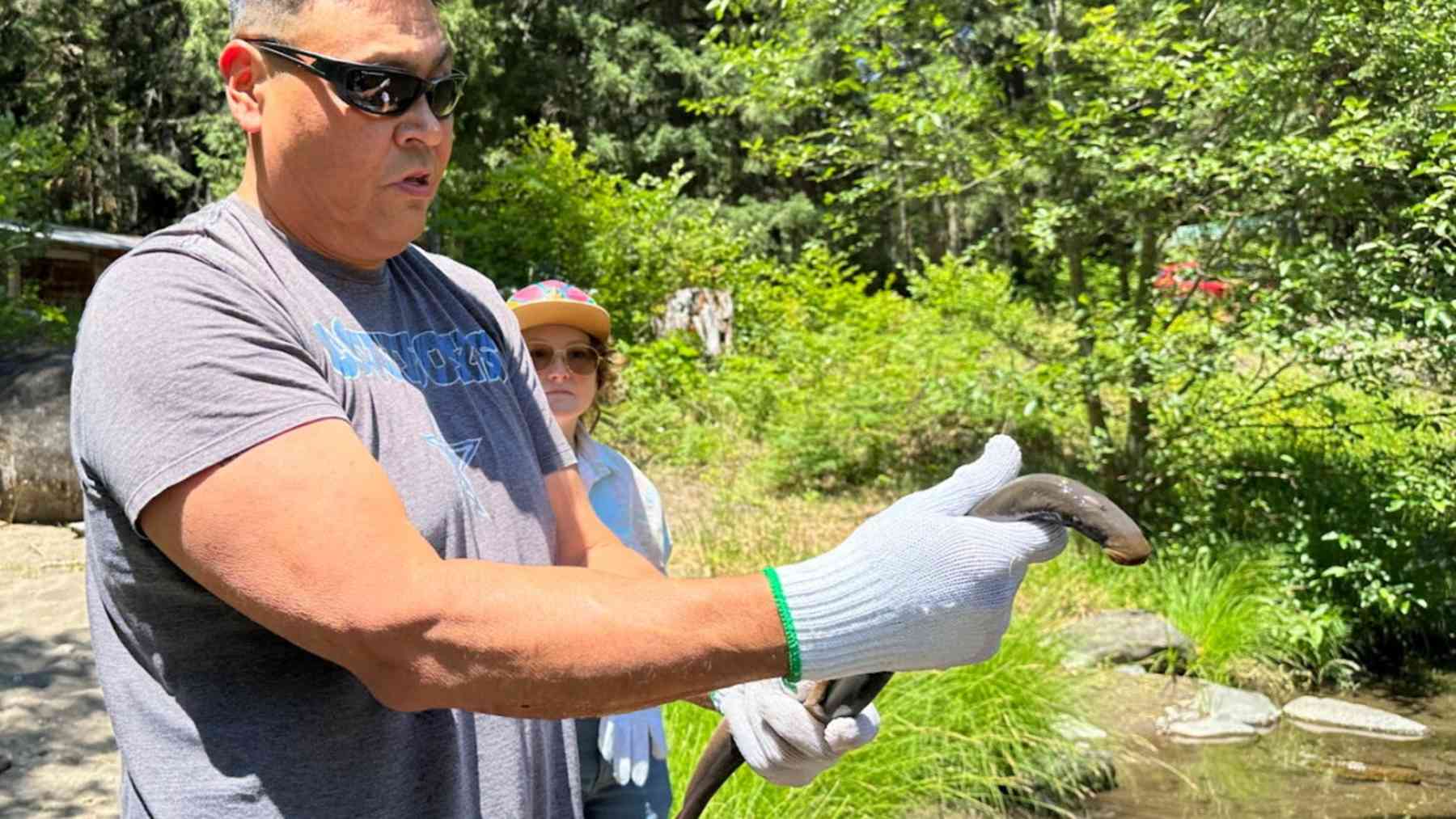
Technicians from the Confederated Tribes of Warm Springs carried the fish down the bank in plastic buckets, followed by a line of local participants doing the same, each one handing off a small piece of a very old migration.
About 100 fish reached Coyote Creek and the Long Tom in June
On June 17, crews brought about 100 adult lamprey to be released into Coyote Creek and the nearby Long Tom River. Fifty of them went down to Coyote Creek in buckets, hauled by the fisheries crew and members of the Long Tom Watershed Council’s Traditional Ecological Inquiry Program, who had come to learn what the fish mean to Native people.
Those are modest numbers next to a salmon run. Yet the significance sits less in the count than in the silence it broke, since the fish have not been a regular sight in these waters for 75 years.
A release the previous summer put adults into the upper Long Tom River, which the McKenzie River Trust described as the first time the fish had swum that stretch in nearly 100 years. Nez Perce and Umatilla fisheries staff carried out that work, collecting a DNA sample from each fish before letting it go.
Dams built in the 1950s cut lamprey numbers to 23,000 by 2010
The gap traces back to a wave of dam building. Construction of U.S. Army Corps of Engineers dams took place in the 1950s, with 16 alone above Willamette Falls, according to the Columbia River Inter-Tribal Fish Commission, which coordinates the translocation work with its four member tribes. None of those dams were built with lamprey passage in mind, and the fish’s breeding cycle was disrupted.
Returns that once reached into the millions fell to a record low of 23,000 in 2010, according to the commission’s recovery and reintroduction plan. Tribes and biologists treat the species as an indicator of wider river health, not a curiosity, and the plan sets the scale of what has been lost.
This was not a one time rescue either. Translocation has been used in the Columbia basin for close to two decades, since the Nez Perce Tribe began moving adults into Snake River country in 2007, and genetic analysis later confirmed a translocated adult had produced an offspring that returned on its own.
Crowds at the bank have grown for five years straight
The crowd on the bank is the newer part. “This is only the fifth year, and each year it gets bigger and bigger,” said Five Crows, a Nez Perce tribal member at the Coyote Creek stop, where the crew let participants hold the remaining lamprey before release.
Public interest is climbing elsewhere too, with more than 1,200 people signing up for the annual Yakama Nation Willamette Falls Lamprey Celebration at an Oregon City RV park, an event built around the same fish being carried here in buckets. Interest like that does not change the slow arithmetic of lamprey biology, since these fish will not produce returning adults for years. Similar patience has paid off before, including the way a roughly 600 mile freshwater round trip brought Deschutes basin steelhead back in numbers not seen since the dams went in.
The next adult returns are not expected until the mid 2030s
If the released fish spawn successfully, their offspring face a long apprenticeship before anyone can measure results. Biologists at the release said lamprey put into Coyote Creek and the wider Long Tom area should start migrating to the Pacific around 2030 and come back as adults four years after that.
That means nobody at the June release will know whether it worked until the middle of the next decade. The same long view shapes conservation work elsewhere in the region, where a narrow Sierra foothill river has shown how small tributaries can carry outsized importance for a whole basin’s fish runs.
The longer term goal is steep: 1 million adult lamprey returning each year to Bonneville Dam by 2035, a target measured against the 23,000 logged at the low point. For now the measure of success is smaller, a bucket, a bank, a creek that can hold this fish again.
Read the whole thing?
Get the week's signal, not the noise
Our sharpest reporting on energy, climate and nature — free, once a week.