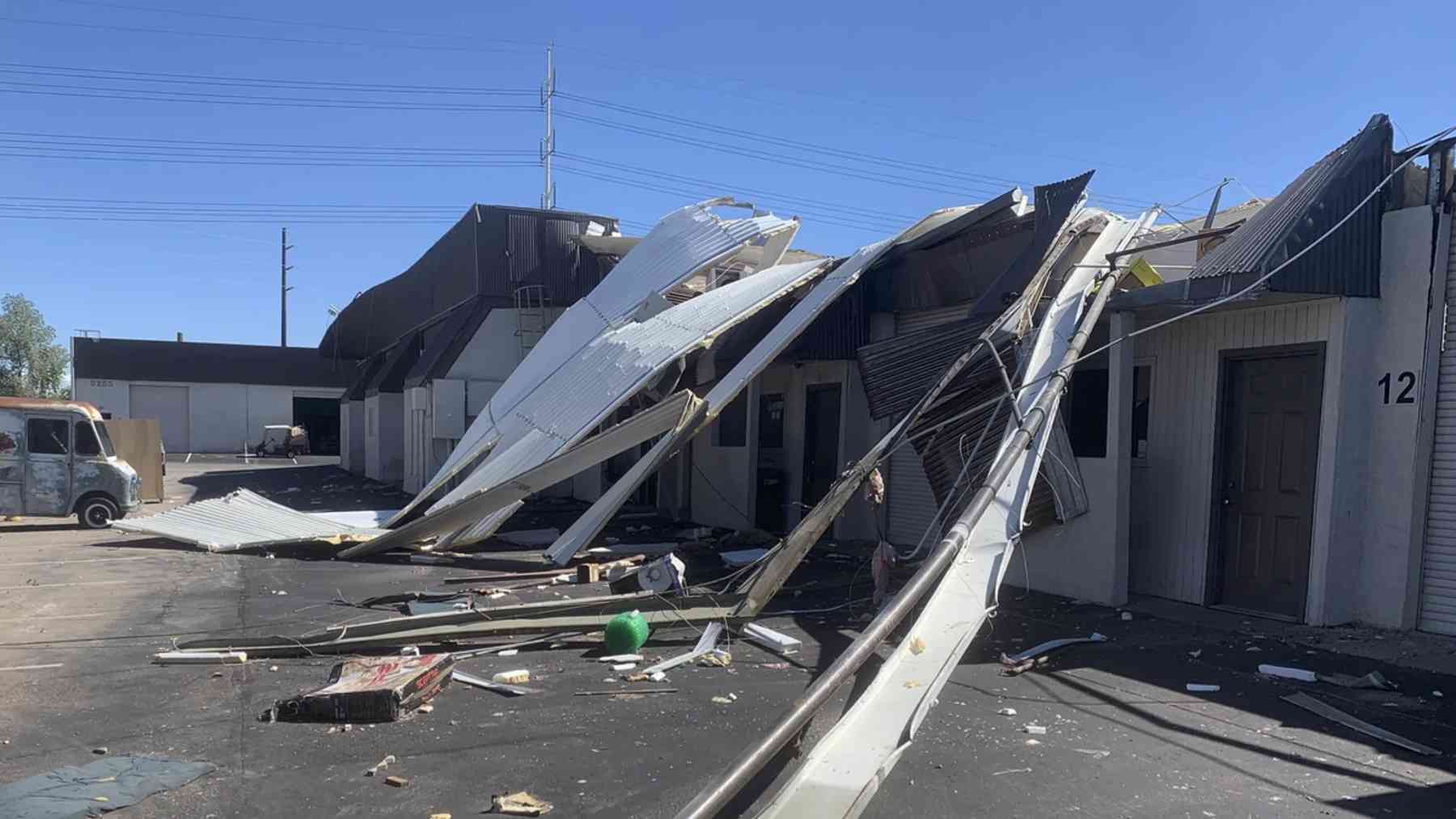
A row of steel columns standing plumb in a parking lot, anchor nuts tight, paint unmarked.
Hanging off them, the frame they used to carry, corkscrewed along its length.
The storm crossed this lot shortly after one in the afternoon on Monday, October 13, 2025.
The work was finished. Crews were waiting on the final steps before turning the system over.
Afterward the lot looked random, and it was not.
Because a structure like this fails in a fixed order. Which part goes first, and why?
Why a flat deck goes before 1 column
A carport is two structures bolted together, and they are loaded in completely different ways.
The panel deck is a broad shallow plane. Wind crossing it behaves the way it does over a wing, pulling upward across the whole area at once, which is why a canopy is governed by uplift rather than by sideways push.
The purlins are the horizontal members carrying that plane. They take the lift in bending along their length and in twist as the deck tries to peel, and they have no depth to spare.
Columns have a different job entirely. They resist overturning, a moment about the base, and they are sized with a long lever arm and a concrete footing to match.
So past the design load the deck goes first. And the moment it goes, the sail is gone, which drops the load on the columns before they ever reach their own limit.
The wreckage is not random. It is the design order, running in reverse.
20 minutes across a 3 mile wide path
The storm was a microburst, which is a column of sinking air that hits the ground and spreads outward in straight lines.
That is the opposite of a tornado. Debris gets pushed away from a point rather than drawn into a spiral, and the weather service confirmed straight line winds rather than any rotation.
The survey put the damage path at 8 to 10 miles long and 3 to 5 miles wide, running from about one o’clock to twenty past, across Guadalupe, Tempe and Scottsdale.
On the ground that afternoon it took roofs off buildings and moved mobile homes off their foundations. More than 130 people were displaced.
Power went out for somewhere between 22,000 and 34,000 people.
The carport was one lot inside that.
80 to 90 mph measured against 115 believed
Two wind numbers are circulating and they are not the same kind of number.
The weather service survey found widespread damage consistent with 70 mph, with the worst local damage at 80 to 90, and a peak recorded gust of 91.
The company’s founder puts a different figure on it. He says the carport was designed for 105 mph, and that given what he saw he believes the wider area may have been above 115.
That second number is an inference from damage, not a measurement, and he offers no reading for the site itself.
He also says he has built these same systems in Arizona for twenty years and has never seen a structurally complete one destroyed like this.
What failed was listed plainly. Purlins twisted, panels broke, security fencing was damaged, and the footings held.
A finished building that 0 policies covered
Here is the part the wind did not decide.
The builder’s liability insurer looked at it and declared the company not at fault, in the way that a failed span or a folding rotor turns into somebody’s problem.
But title had not transferred to the owner yet, so the property policy that would normally cover a finished structure had not started running on it either.
A completed building sitting in that gap belongs, for insurance purposes, to nobody, and the trade account is where that detail sits.
So the two sides split the repair cost between them. The customer was described as understanding, with no accusations either way, and the storm coverage carries the survey behind it.
The builder now carries special excess insurance.
What the next 4 carports get instead
This was the second of six carports for the same customer, and the other four are still coming.
The customer asked for them to be over engineered for high winds, which is a reasonable response and also an expensive one, because uplift resistance on a canopy is bought in steel.
Nobody has said the change would survive another microburst, and nothing in the record claims it would.
What the lot actually proved is narrower and more useful. The columns and footings were right, the deck was the weak plane, and the gap that cost real money was a paperwork date rather than a load case.
A solar carport can be finished and still belong to nobody.
That is the part worth insuring.
Read the whole thing?
Get the week's signal, not the noise
Our sharpest reporting on energy, climate and nature — free, once a week.