A steel pipe fourteen feet across runs down a Sierra Nevada hillside above the North Yuba River.
On a February afternoon, it split open.
Water that had been sealed under pressure found open air instead.
Within hours, something strange showed up far downstream.
The river itself seemed to lose its pulse.
Nobody at the dam had touched a valve to make that happen.
The outage traveled downstream to a second powerhouse
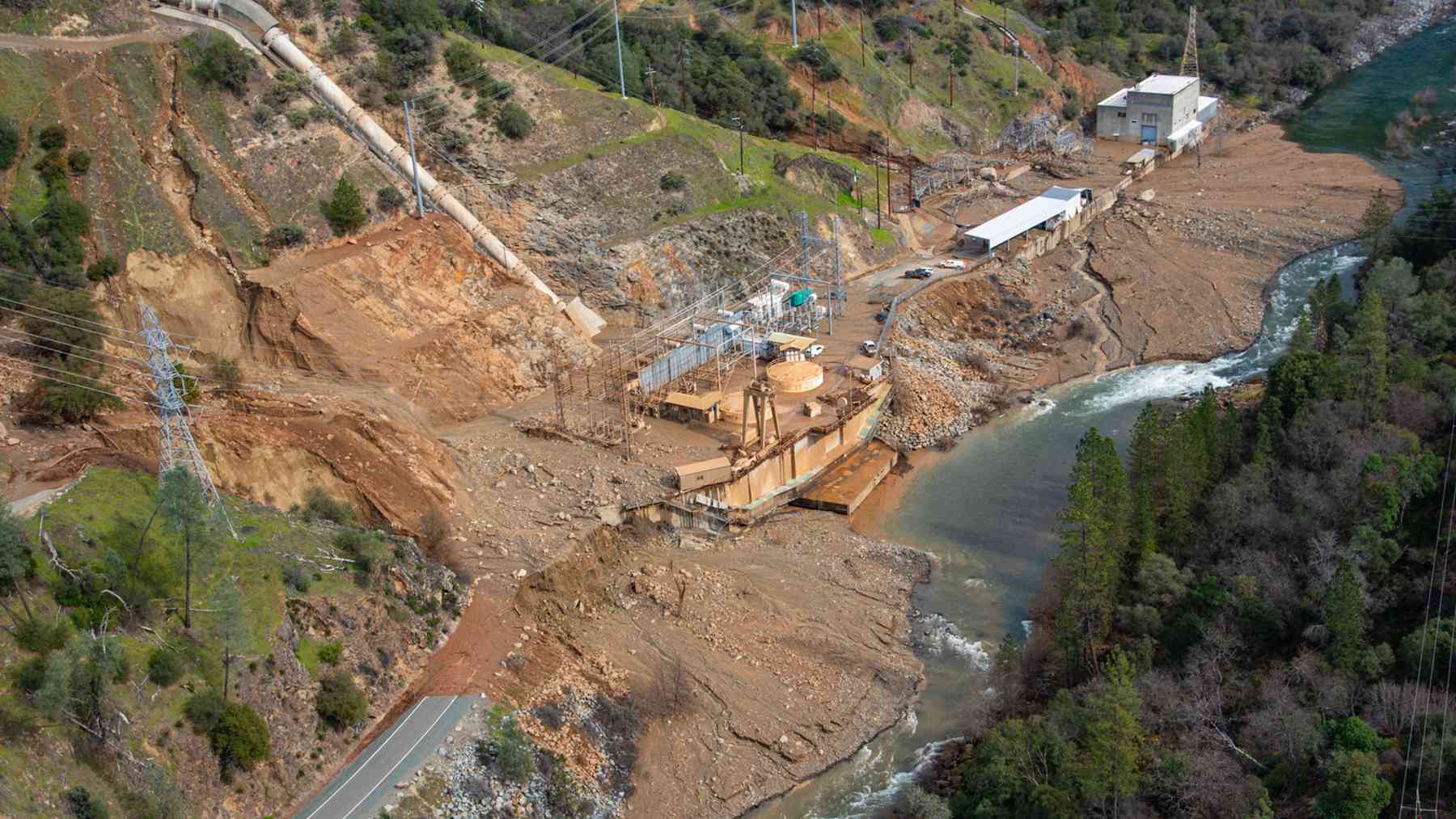
The penstock at New Colgate Powerhouse near Dobbins, California, ruptured just before 3 p.m. on February 13. Yuba Water Agency says roughly 400 acre feet of water came down the hillside, tearing up the slope and damaging the powerhouse, several switchyards and Lake Francis Road. That alone reads like the whole story, a burst pipe, a muddy slope, a mess to clean up. But the sharper number sat miles downstream.
On the lower Yuba below Englebright Dam, the South Yuba River Citizens League recorded flows falling to 560 cubic feet per second from 1,400, where they held for about an hour before climbing back. The agency describes the whole reduction as lasting about two hours.
The link between the two is electrical, not hydraulic. The incident knocked out power at the agency’s Narrows powerhouses below Englebright Dam, and Narrows 1 and Narrows 2 are operated in coordination with New Colgate. An operator at New Colgate would normally open a bypass valve to push more water into the lower river, but that worker was evacuating. So a pipe meant to spin turbines in one canyon pulled a separate power station out of service downstream, and the river’s own current dropped by more than half with no gate or release on the lower river having moved at all.
The powerhouse sits five miles from its own dam
New Colgate is an unusual plant. Instead of standing at the foot of its dam, it is fed from an outlet in New Bullards Bar Dam, from which water runs horizontally for nearly five miles before reaching the surface, and from there the penstock drops about 800 feet over roughly a mile to the turbines.
That geometry put the broken section on a ridge beside the canyon rather than next to a reservoir. State water regulators place the failure roughly 800 feet above the Yuba River and the powerhouse, on a steep slope directly upstream of Dobbins.
The release did not spread out gently.
It came down as water, mud and debris, burying parts of the generating site deep enough that crews later measured sediment more than thirteen feet thick in places.
Testing of a newly installed section came first
The timing matters here. The penstock had been out of service for months of maintenance work, and the agency’s general manager has said crews were filling the penstock and the tunnel and planning a final inspection when it burst, so the water standing in the five mile rock tunnel and the one mile penstock, about 400 acre feet, ran straight down the hill.
The cause has not been settled. Forensic engineers were still investigating through the year, with findings expected in the fall, and the agency has not attributed the failure publicly while that work continues.
One contract worker was seriously injured and was later reported to be in stable condition.
Debris and oil reached the river within hours
Water was not the only thing that moved. Sediment, woody debris and oily material entered the river upstream of Englebright Lake, an oil sheen was reported where the river enters the lake, and crews installed an oil boom while the agency began collecting daily water samples.
The watershed group sampling alongside them measured dissolved oxygen, temperature, pH, conductivity and turbidity, documenting a nine day stretch of elevated turbidity, between 31 and 99 NTU, in the lower Yuba below Englebright Dam. Independent laboratory panels for PCBs, petroleum hydrocarbons and volatile organic compounds did not detect concerning levels downstream.
The flow drop did its own damage.
Thousands of juvenile spring and fall run Chinook and steelhead were stranded in the cobbles along the banks when the river fell, a risk familiar to groups that also document river turbines built to keep migrating fish moving safely through hydropower systems elsewhere.
A multi year rebuild now stands on the same hillside
About 60,000 cubic yards of sediment washed into the river below the powerhouse, crews removed an estimated 45,000 cubic yards from around the powerhouse and the channel, finishing in water work in early September, and the agency awarded a $13.9 million contract for hillslope stabilization around the penstock and powerhouse.
The powerhouse remains offline. The agency expects generation there to be suspended for several years while the penstock is rebuilt and the site restored.
Boating advocates monitoring the river note that flows on several reaches of the Yuba will be significantly different while that work runs, the same way utilities elsewhere now design turbine blades so that worn sections can be repaired without replacing the whole structure. What the rupture leaves behind is a reminder that a single buried pipe can hold enough leverage over a river that when it fails, the flow downstream can stutter before the mud ever arrives.
Read the whole thing?
Get the week's signal, not the noise
Our sharpest reporting on energy, climate and nature — free, once a week.