A lot of folks think of a drinking-water storage facility as having one job. To hold water.
It just sits there until a community wants some. That’s why one water-reservoir in Ohio is unique.
Twin Lakes Reservoir is helping out with something the average person wouldn’t normally connect to a drinking-water supply source.
Once you know what that is, it will be hard to stop wondering why more locations aren’t taking the same approach.
Most places would have stopped right there
In addition to providing the City of Lima with its main source of drinking-water, water from the reservoir passes through a treatment plant.
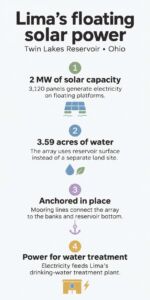
The plant produces approximately 14 million gallons of water per day for approximately 35,000 residents. However, the reservoir is now performing a secondary function.
A floating solar array located in the reservoir provides direct electrical power to the City of Lima’s water-treatment plant. As such, this is where the story gets even more interesting.
That’s when a different problem started to emerge
Typically, physical infrastructure related to water management and physical infrastructure related to energy generation are considered to be separate systems.
Moreover, solar-generation projects are generally assumed to require their own plot of land. This seems obvious until space becomes limited.
Cities have streets. Buildings take space. Parks take space. They have unlimited demand for space and therefore, numerous competing interests for space.
Approximately four acres of the reservoir surface are covered by the floating solar array at Twin Lakes.
A comparable ground-mounted solar-generating system would need approximately ten acres of land.
Given that difference, it explains why the reservoir was identified as part of the answer.
Ultimately, at some point, the discussion ceases to revolve around whether solar-generated power is beneficial but rather revolves around where it can physically be placed.
The solution turned out to be hiding in plain sight
Twin Lakes essentially solved this riddle by examining existing infrastructure and how it could potentially accommodate new development.
Rather than attempting to identify additional land for which to develop a solar project, the City of Lima chose to utilize the surface area of the existing reservoir as part of the solution.
The floating solar project was developed by D3Energy. Funding support was also provided through the U.S. Department of Energy.
The surface area used by the floating solar array is part of pre-existing infrastructure associated with the existing use of the reservoir.
That minor adjustment alters virtually all aspects of the conversation regarding this topic.
One example doesn’t answer every question
That does not suggest that every reservoir is automatically capable of hosting a floating solar array.
Different types of reservoirs provide different services to communities under varying environmental conditions. Thus, what proves effective in one locale may not prove effective elsewhere.
Twin Lakes should be regarded as an exemplary model rather than a universally applicable template.
When considering widespread implementation, this distinction becomes critical.
There was more happening beneath the surface
Electricity generation is only part of the story. The floating-solar system may assist in reducing evaporative losses while supporting more consistent water temperatures within portions of the reservoir.
Additionally, shade created by the floating-solar array may assist in controlling algal growth during warmer seasons in various areas of the reservoir.
All of these advantages occur in conjunction with the electricity being produced to operate the treatment plant.
The surface area of the reservoir is supporting more than one type of public good service.
Now imagine that challenge showing up across the country
Municipalities worldwide are searching for ways to expand renewable energy while trying to find enough land to build on.
Twin Lakes suggests that some opportunities may already exist inside infrastructure cities have been using for decades.
Water reservoirs were built to fix one problem. Projects like this hint that they may also be able to help fix another.
Read the whole thing?
Get the week's signal, not the noise
Our sharpest reporting on energy, climate and nature — free, once a week.