Every week, tens of millions of Americans drop one into the dishwasher, press a button, and walk away.
The little pod dissolves, the machine hums, the dishes come out clean and gleaming.
It feels like the most efficient thing in the kitchen, no mess, no measuring, no second thought.
But something is left behind once the water drains, and it does not stay in your home.
A wrap that seems to vanish
The film encasing a dishwasher pod is made from a synthetic plastic called polyvinyl alcohol, or PVA.
The selling point is compelling: drop it in and the film dissolves completely in water, as if it never existed.
It does dissolve, but dissolving and biodegrading are two different things.
When the pod meets water, the PVA film does not break into solid fragments, it solubilizes into a plastic solution that goes straight down the drain.
Once dissolved, that polymer solution passes through your plumbing as an invisible chemical presence, not a visible particle, but not gone either.
From there, it heads straight toward your local treatment plant.
The treatment plant problem nobody talks about
Wastewater treatment plants are designed to catch a lot, but PVA is a uniquely difficult target.
Very few municipalities have treatment plants that can fully degrade PVA, because extremely specific conditions are needed, including specialized microbes adapted to digesting it.
Those microbes also require extended retention times, and most plants simply do not run long enough or hot enough to finish the job.
About 75 percent of PVA passes through treatment plants without fully degrading, entering rivers, oceans, and soils across the country, according to a 2021 peer reviewed modelling study in the International Journal of Environmental Research and Public Health.
The industry group representing cleaning product makers disputes this, arguing that detergent grade PVA biodegrades safely under typical treatment conditions and does not behave like a microplastic.
Critics also note that the 2021 study was commissioned by Blueland, a manufacturer whose own products compete directly with PVA based pods.
Where it ends up and why it sticks around
Once PVA reaches a river or lake, researchers are concerned it may interact with other contaminants already present in the water.
It has the potential to attract and hold onto toxic chemicals, antibiotics, and heavy metals, though scientists note this behaviour has been better demonstrated for solid PVA particles than for fully dissolved polymer.
Some research has found that solid PVA has a higher adsorption capacity for lead and cadmium than other types of microplastics studied, though whether dissolved detergent grade PVA behaves the same way remains contested.
That means PVA’s role as a potential carrier for pollution already in the water system is a live scientific question, not a settled one.
Researchers estimate that approximately 7,000 metric tons of PVA per year remain untreated by wastewater treatment plants in the United States alone.
Because PVA does not form visible chunks, it is far harder to track than the plastic bag caught in a reed bed.
The creature absorbing all of it downstream
This is where the story moves from the drain to the river, and from chemistry to a living animal.
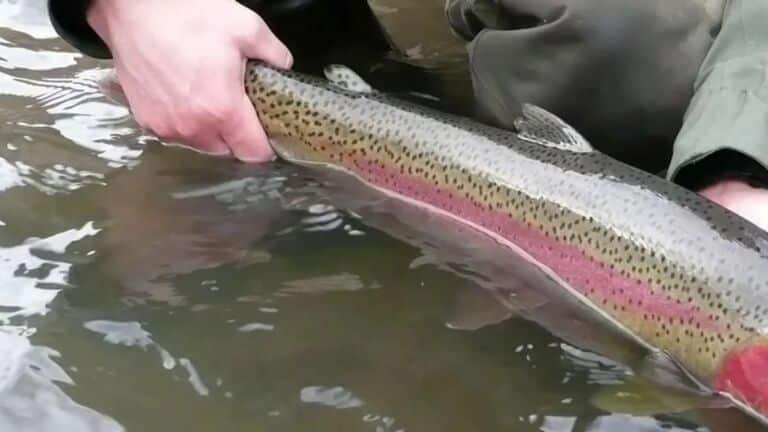
PVA has been shown to be ingested by animals, and to affect fish health, including growth rate, metabolic rate, and the ability to fight infection.
Fish mistake the particles for food, or simply cannot avoid them while filter feeding.
Microplastics can cause physical harm to freshwater animals, including blockages in digestive tracts, reduced feeding, and impaired reproduction.
A single spawning season disrupted by reduced fertility can echo through a river population for years.
That kind of invisible pressure, accumulating wash cycle by wash cycle, is what makes this particular problem so hard to see until the damage is already done.
The American Cleaning Institute maintains that detergent grade PVA is safe and biodegrades properly, and researchers on both sides agree that far more data is needed before the full picture is clear.
Scientists who study freshwater ecosystems point to a parallel crisis in ocean animals, where dissolved pollutants are shrinking squid brains and stripping away their ability to hunt, as evidence that what enters the water column rarely stays harmless for long.
The story is strikingly similar, and the scale of both problems keeps growing with every load.
Researchers studying plastic products sold as low impact have repeatedly found that the real cost only becomes visible once the material is already moving through living ecosystems.
A small shift that reaches further than the sink
The good news is that the alternatives are genuinely easy to find and use.
Loose powder detergents, compostable cardboard tablets, and refillable concentrate systems all skip the PVA film entirely and perform comparably on everyday loads.
No single household switching detergent will clean a river on its own, but the math changes when millions of households make the same small adjustment.
Scientists who wade into streams counting fish populations tend to say the same thing: aquatic ecosystems are far more resilient than we fear, but only when we stop adding to their load.
The dishwasher pod is not a villain.
It is simply a product designed to solve one problem, and no one thought hard enough, yet, about where the wrapper goes once it disappears from sight.
Read the whole thing?
Get the week's signal, not the noise
Our sharpest reporting on energy, climate and nature — free, once a week.