Solar panels rests on one simple assumption: the more sunlight a panel receives, the better.
For a vineyard, the picture is quite different.
Grapevines depend on the sun to grow, but increasing heat waves are becoming a bigger problem, placing vineyards under pressure.
In Toledo, Spain, a solar development has been built to try mitigate this issue.
But how exactly does a power plant help a heating vineyard?
How solar helps an overheating vineyard
Spain has the world’s largest vineyard area, accounting for a huge 13 percent.
Their wine is cultivated from these numerous vineyards and is enjoyed by drinkers across the globe.
But rising temperatures and increasingly frequent heat waves are threatening their crops.
In the town of Guadamur, in Toledo, those who own vineyards are looking for a way to combat this heat.
One company, Iberdrola, has a potential solution.
As an energy company, its suggested approach is agrivoltaics, where the same area is used to produce both solar energy and agricultural crops.
Iberdrola has started to pursue low-cost, environmentally friendly ways to combine solar energy with farming in rural areas.
They believe agrovoltaics has the potential to improve farm efficiency, competitiveness and sustainability.
Spain’s first smart agrovoltaic plant
In September 2022, Iberdrola started its first pilot project called WineSolar.
The project came out of PERSEO, Iberdrola’s international program for start-ups.
This was the first ever smart agrivoltaic plant in Spain.
The plant has a capacity of 40 kilowatts, and the wineries use all of its electricity themselves.
This lets them cut emissions and energy costs.
But what does smart agrovoltaic actually mean?
With the rise of technology in the current age, the project has managed to include an artificial intelligence algorithm as a controller.
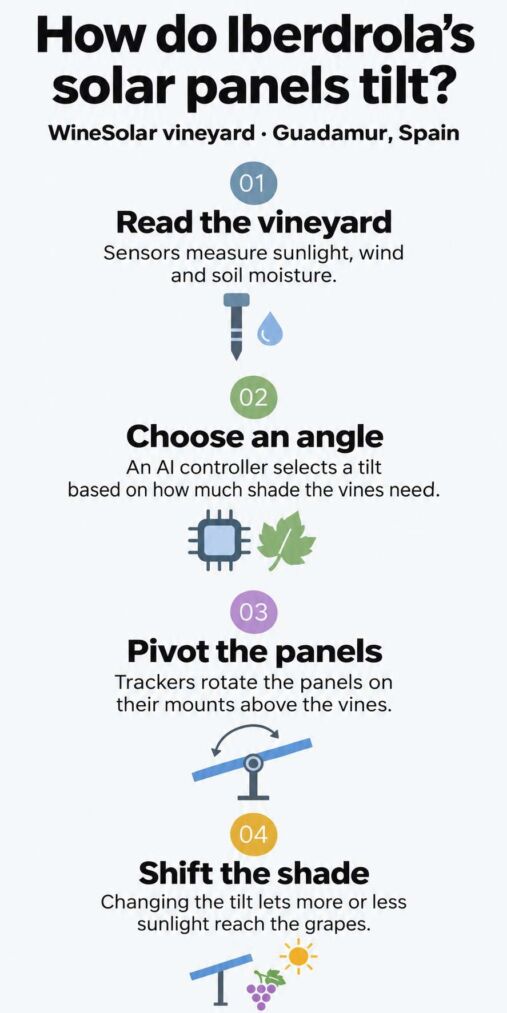
The solar panels are placed on mounts that are able to change angle, controlled by this AI. Hence, smart agrovoltaics.
Two partners contributed: Techedge supplied the technology, and PVH made the trackers and structures that hold the panels.
This AI algorithm relies on sensors around the vineyard, which track solar radiation, soil humidity, wind conditions, and the thickness of the vines.
It then uses this data to decide how to tilt the panel and where to let it cast shade.
This shade then regulates the warmth that vines and soil receive, and can assist in blocking too much sun during heat waves.
So, the sensors give the algorithm a detailed picture of conditions in the vineyard.
Iberdrola said it would monitor the results over the following year in order to keep refining the system.
Solar and agriculture working together
The aim of these solar panels now goes beyond just collecting the most sunlight.
Now, the panels are set on looking after the vineyard as well, to optimise both solar and agriculture.
This project is similar to these floating solar panels that provide important shade to algae, to avoid their evaporation.
Iberdrola says that the vines should thus cope better with the rising temperatures and increasingly frequent heat waves with this added movable shade.
Furthermore, the vineyard’s resilience to high temperatures should effectively increase, allowing crops to remain successful throughout the seasons.
In effect, the needs of the vines determine the position of the panels through the use of AI, and this allows for better heat resistance.
Whether this project will be successful is dependent on longer-term results, as this pilot project is only one example.
If this pilot project is successful over time, the plan is to replicate the plant in other Spanish vineyards. Solar plants and agriculture will not need to be separated anymore, and other areas facing hotter summers could adopt this method. Agrivoltaics are also being designed for certain conservation efforts, like this.
Read the whole thing?
Get the week's signal, not the noise
Our sharpest reporting on energy, climate and nature — free, once a week.