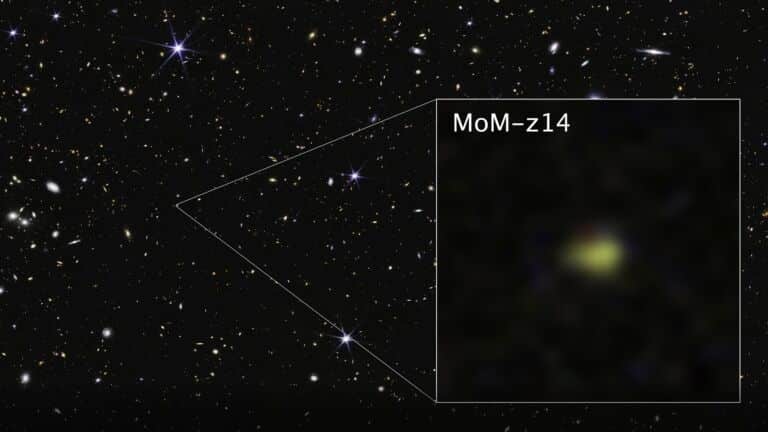
An ancient fast radio burst may have changed our understanding of how these mysterious signals are produced.
Using the James Webb Space Telescope, the most distant known fast radio burst host galaxy was traced to a dwarf galaxy when the universe was only about 3 billion years old.
Finding the source of the signal should have been straightforward.
There was only one problem. No host galaxy was visible anywhere near the source of the signal.
The signal led astronomers to an empty patch of sky
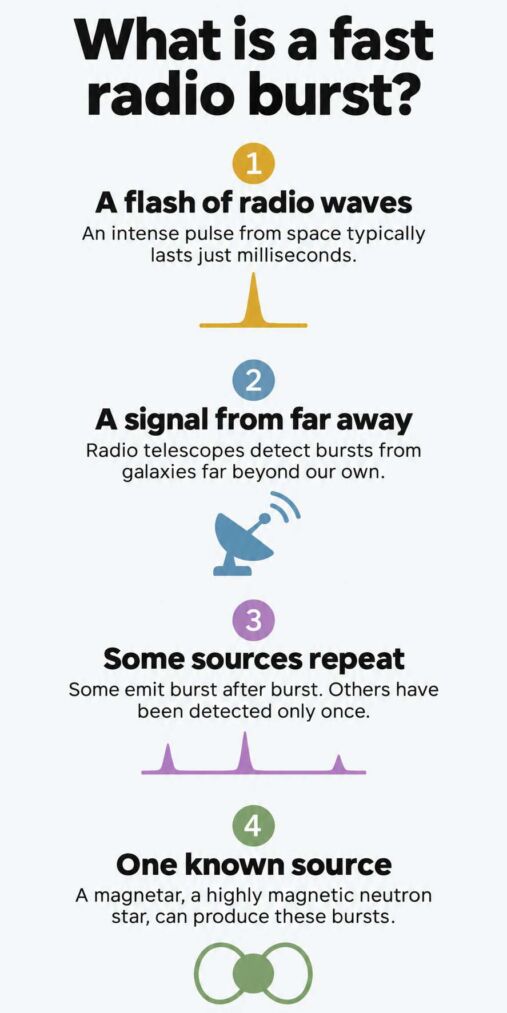
The mystery of fast radio bursts (FRBs) has been ongoing since their first detection in 2007. Each emission lasts a fraction of a second. The majority of FRBs have occurred once.
In March 2024, an extraordinary signal known as FRB 20240304B was detected.
This signal had traveled farther than any previously detected FRB and was also found to originate at a precise position.
Using optical telescopes, no galaxy or other bright objects were visible at this position.
The non-detection provided additional information but also deepened the mystery.
Eventually, the investigation led to another instrument, the James Webb Space Telescope.
Webb eventually found what ground telescopes could not
Webb’s instruments detected a faint galaxy at the exact location where the original burst took place. This galaxy’s redshift was determined to be 2.148.
This corresponds to a timeline that would be around three billion years after the Big Bang, placing FRB 20240304B as the most distant known fast radio burst host galaxy yet observed.
But then came the biggest surprise of all. Scientists believed they would discover an extremely large and active galaxy that would have formed many stars.
Instead, Webb showed them that the galaxy hosting FRB 20240304B was quite small – only 1,000 times smaller than predicted.
The tiny galaxy created a much bigger question
A very important aspect of galaxies is their evolutionary history and age.
Both proposed mechanisms for generating FRBs, neutron star mergers and magnetar activity, occur on completely different scales.
Knowing how old a galaxy is may therefore help scientists narrow down which hypothesis may be applicable. This also makes the host galaxy especially important.
Discovering that the new host is a dwarf galaxy therefore became more significant than simply identifying the most distant one recorded.
One explanation fit the evidence more comfortably
Many of the stars produced by this galaxy were likely produced in a relatively short period of time.
This would be consistent with the environment where magnetars are thought to be generated.
Magnetars can form in the aftermath of a massive star exploding as a supernova. Neutron star merger events typically require larger time scales.
The two dead neutron stars must first spiral toward each other before they collide.
This discovery favors magnetars as an explanation and makes a merger origin for this specific FRB appear less likely, a finding echoed by the University of California, Santa Cruz.
Other structures appeared along the signal’s path
Fast radio bursts are often referred to as “cosmic flashlights”.
As they travel through space, they collect signatures of otherwise unobservable structures.
Data indicate that it collected signatures from a previously unknown galaxy cluster and that of the nearby Virgo Galaxy Cluster.
In addition to revealing details about the galaxies responsible for creating the signals, the record-breaking burst also captured information about the intergalactic medium.
This included material located between galaxies along its path to Earth.
Future discoveries may push even farther back in time
Given its great distance, it is doubtful that FRB 20240304B will hold the title for long.
Future observations could lead to the identification of additional bursts that originate farther away in space.
Each new detection will provide another opportunity to discover host galaxies from the early universe.
Those discoveries could potentially shed light on one of astronomy’s oldest unanswered questions.
Read the whole thing?
Get the week's signal, not the noise
Our sharpest reporting on energy, climate and nature — free, once a week.