Solar mirrors are often the main cause of concern when discussing the impact of renewable energy developments on wildlife.
However, at one solar facility in California, researchers wanted to test whether that assumption held.
The answer turned out to be somewhere few people were looking.
A review into wildlife mortalities at the Genesis Solar Energy Project set out to evaluate which specific facility features posed the greatest threat to bats.
Many different features were monitored across the solar site
There are multiple features within the Genesis project.
It includes solar collector arrays, power blocks, evaporation ponds, fencing, and transmission equipment.
The artificial ponds are designed to hold and evaporate process wastewater created during solar power generation.
Mortality-monitoring data helped reveal which parts of the facility were associated with the most wildlife deaths.
One part of the site stood out more than expected
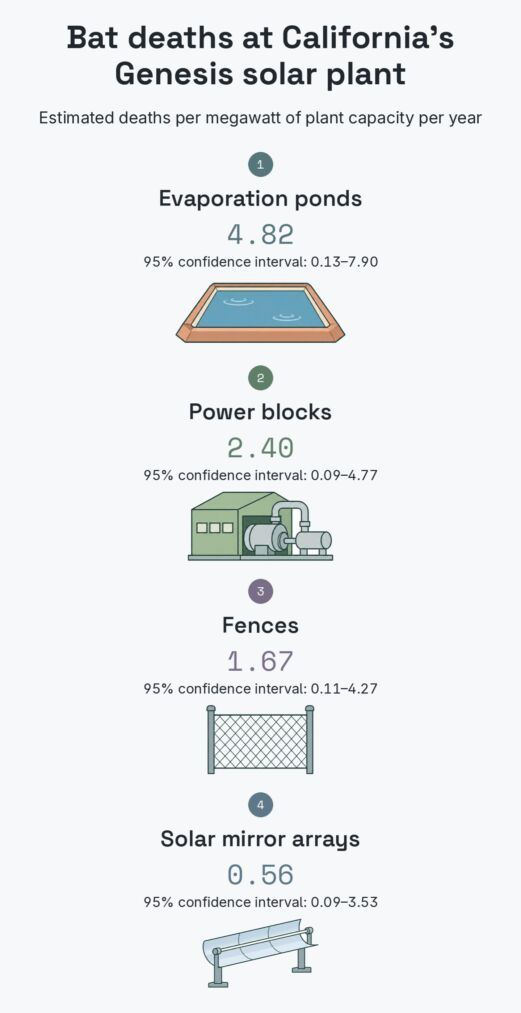
Upon comparing the bat mortality estimates, it was seen that the evaporation ponds had the highest estimate.
This was an estimated 4.82 bats per megawatt per year around the evaporation ponds.
Power blocks were associated with an estimated 2.40 bat fatalities per megawatt per year.
Fencing was associated with an estimated 1.67 bat fatalities per megawatt per year.
Solar collector arrays were associated with an estimated 0.56 bat fatalities per megawatt per year.
This contradicted the assumption that solar mirrors would cause the most risk to bats.
There was more to the story than the ponds
Evaporation ponds were not the only factor linked to mortality.
The review showed that there are multiple ways that solar developments can cause risk to flying wildlife.
Previous research has shown that bats can mistake reflective surfaces for bodies of water and can change their behavior around reflective surfaces.
In desert environments, open water sources can draw wildlife into an area and alter patterns of movement and behavior.
Several different project features were linked to wildlife mortality.
However, evaporation ponds remained strongly associated with bat mortality.
To understand the exact causes further research is needed.
Similar patterns started to emerge beyond Genesis itself
The findings from Genesis were not looked at alone in the review published in The Journal of Wildlife Management.
The review looked at reports from 14 solar projects across California.
After taking into account factors like detection probability and body size it can be seen that wildlife mortality is often underestimated.
Overall, the review highlighted that some impacts are not being picked up or underestimated at solar developments.
Some of the monitoring processes varied between projects.
This can have an impact on how much wildlife mortality is recorded.
Direct mortality was only part of the picture
The study highlighted that direct mortality is only part of the story.
Large solar developments require large amounts of land clearing.
The analysis found that wildlife could be lost due to habitat loss similar to, or even higher than, the operational mortality.
It was estimated that due to the amount of solar capacity installed in California, almost 300,000 birds could be impacted by habitat destruction.
This means the conversation is moved onto how solar developments impact the habitat.
Better decisions may begin with more effective monitoring
The evaporation ponds at Genesis show that assumptions about wildlife risk are not always correct.
By improving monitoring, collecting more accurate data, and looking into individual features, it could help to identify which areas have the most wildlife impact.
Improving the placement of the projects and having a better understanding of wildlife behavior could also help to reduce future impacts.
As solar developments grow, knowing why a pond may be riskier than a field of mirrors could become increasingly important to future developments.
Read the whole thing?
Get the week's signal, not the noise
Our sharpest reporting on energy, climate and nature — free, once a week.