

Eastern Bluebirds primarily make their homes in cavities.
These can include holes in trees, old woodpecker excavations, or nest boxes maintained by conservation organizations.
That is why multiple nesting locations in areas lacking those traditional features were unexpected.
The discovery took place during surveys of birds at solar-energy facilities in New York.
It raised new questions about how Eastern Bluebirds choose nesting sites.
The nesting sites were not what anyone expected to find
Surveys were conducted at thirteen photovoltaic solar facilities across New York and Massachusetts during the 2022 breeding season.
During this time, breeding Eastern Bluebirds were found at two facilities in eastern New York.
Both of these sites lacked the usual tree cavities and nest boxes that are commonly associated with bluebirds.
Instead, the birds nested directly on top of and inside the solar panels at each site.
One nest appeared in a particularly unexpected location
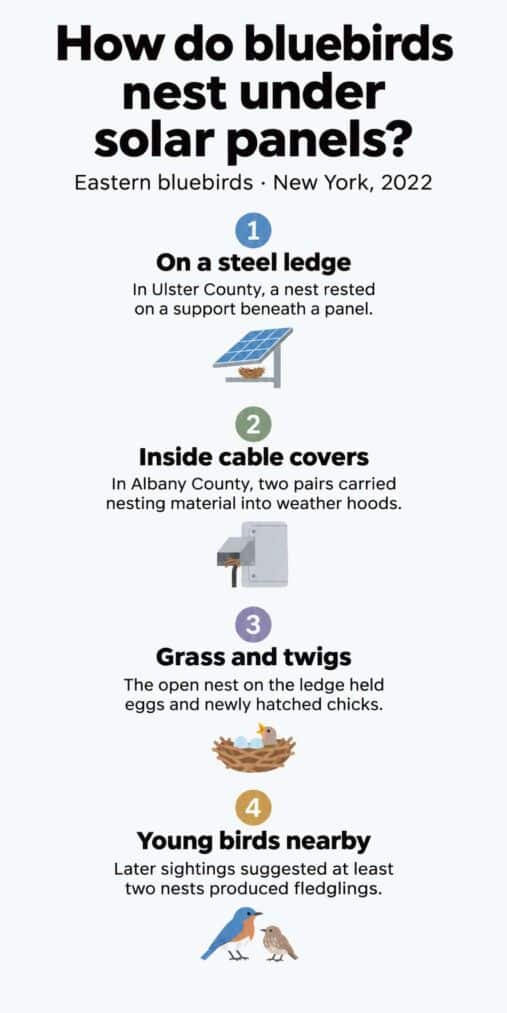
The most unique nesting location was identified at a facility in Ulster County.
There, a female bluebird was photographed with her brood, including two eggs and multiple newly hatched chicks, on top of a steel support beam for a large number of solar panels.
The area was approximately 65 cm (25 inches) off the ground.
According to the researchers, the nest consisted of “loosely constructed” twigs and grasses, leaving part of the lower portion exposed to the underlying steel support beam.
Historically, it has been difficult to document examples of Eastern Bluebirds building open cup-type nests.
What happened next was even more encouraging
The female bluebird also appears to have raised her offspring successfully, according to observations reported by the U.S. Forest Service.
When the same location was revisited several weeks after the nest was first identified, it was empty.
At another nearby location, adults were observed feeding three fledged young.
While it cannot be determined whether the nest was continuously monitored, the presence of adults and young suggested that it may have been successful.
A second facility revealed a different approach
The second facility sampled yielded a completely different approach to locating nesting sites.
At the Albany County facility, researchers documented two additional nesting attempts, as described in Northeastern Naturalist.
Unlike the earlier example, these nests were not as visible.
Thy were constructed under the weather hoods that protected electrical cabling.
Both pairs of adults entered and exited these weather hoods carrying nesting material.
A subsequent inspection confirmed that at least one of the nests contained twigs and grasses.
Adult Bluebirds continued to frequent this area for the duration of the research project.
Young birds were subsequently seen here as well. The adults remained near the nests throughout multiple survey visits.
Activity continued from late May through mid-July.
The solar fields offered more than open space
Eastern Bluebirds prefer habitats that are relatively open and where they can hunt for insects from low perches. Solar facilities can provide those exact kinds of environments.
The infrastructure can also create sheltered locations that would not otherwise exist in open habitat.
In one instance, a forest canopy that once covered the site had been removed.
The altered environment created by development may have established conditions conducive to attracting Eastern Bluebirds.
And finally, the structures present at the solar facility provided nesting locations for bluebirds where none previously existed.
Eastern Bluebirds may be more flexible than anyone expected
Conservationists have long recognized the importance of nest-box programs for Eastern Bluebirds.
The observations suggest that Eastern Bluebirds may be more flexible in their nesting behavior than previously believed.
Nevertheless, the observations suggest that at least some solar facilities may provide viable nesting sites for Eastern Bluebirds while generating renewable energy.
Read the whole thing?
Get the week's signal, not the noise
Our sharpest reporting on energy, climate and nature — free, once a week.


