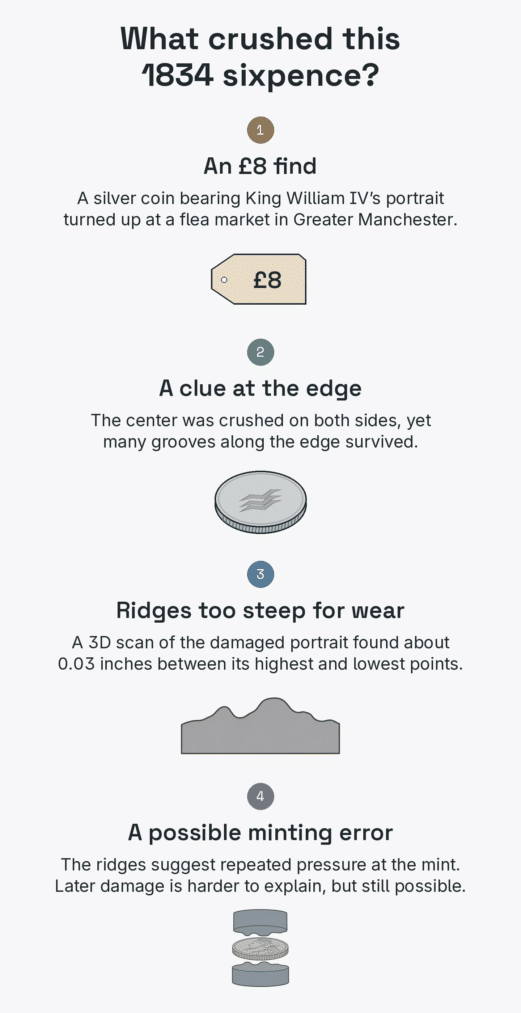
Tucked into an album at a Greater Manchester car boot sale, an 1834 British silver sixpence sat with an £8 price tag and a surface that looked like something had gone catastrophically wrong. Its central face was grotesquely crushed and distorted — ridges pushed into overlapping layers, metal displaced in patterns that ordinary wear, corrosion, or a stray impact struggled to explain.
What caught a researcher’s attention wasn’t the damage itself, but its peculiar geometry: severe compression at the center, yet the outer rim and edge grooves largely intact. That contrast suggested the coin might carry a physical record of something that went wrong nearly two centuries ago — and that modern science could still read it.
A damaged coin that refused to be ignored
The 1834 William IV silver sixpence was priced at just £8 when a researcher spotted something that didn’t add up. The central surface was crushed and distorted in ways that ordinary explanations couldn’t comfortably fit. Corrosion dulls and pits. Circulation smooths. A stray impact leaves a different kind of mark — and none of those stories matched what was visible here.
The detail that made the coin impossible to set aside was a specific contrast: the outer rim and the small grooves along its edge remained largely intact while the center bore severe, layered deformation. That combination prompted a formal scientific investigation drawing on multiple analytical techniques.
What 3D surface mapping revealed beneath the damage
Optical surface profilometry gave researchers their clearest look at the damage, according to the study published in Heritage Science. The technique maps a surface in three dimensions, translating physical features into precise height data. What it revealed was striking: steep depressions, raised ridges, abrupt changes in surface height, areas where metal had been pushed into overlapping layers.
Across the damaged portrait area, the difference between the highest and lowest measured points reached approximately 0.02 inches. For a thin silver coin, that’s substantial. Gradual wear smooths surfaces rather than carving sharp depressions, so that explanation was ruled out. A single free-impact blow would let metal spread outward freely. Here, the metal appeared compressed repeatedly, with lateral movement partly restricted.
Chemical clues hidden in the metal’s composition
Scanning electron microscopy combined with energy-dispersive X-ray spectroscopy — SEM-EDX — added a chemical dimension to the picture. In areas that had escaped the worst damage, testing identified the expected underlying alloy: silver and copper, consistent with the coin’s known composition.
The severely distorted regions told a different story. Those areas showed lower silver concentrations, elevated copper levels, and chemical signatures associated with corrosion and contamination — concentrated inside the depressions rather than spread uniformly across the surface. Corrosion had clearly affected the coin over nearly two centuries, but researchers concluded it couldn’t account for the depth, shape, or distribution of the distortions.
The evidence pointed toward repeated, highly concentrated compression with restricted lateral movement.
A rare survivor from the age of steam-powered minting
By 1834, Britain was producing coins with steam-powered presses — mechanized efficiency that still carried the vulnerabilities of any industrial machinery. Presses could malfunction, dies could misalign, coins could be struck incorrectly. Mint inspections were designed to catch exactly these failures, and defective silver coins were routinely melted down before reaching the public.
If this sixpence slipped through that recall process, it may represent a manufacturing failure preserved almost by accident. The study acknowledges the difficulty honestly: historic objects accumulate changes over decades, and severe deformation can obscure the physical clues needed to pinpoint an origin with certainty.
How AI played a supporting — not deciding — role
Before any laboratory results arrived, large language models helped the study’s author, A. Ikraam of IA STUDIO, organize observations, generate competing hypotheses, and identify what physical measurements would be needed to test them. Those hypotheses were recorded before independent laboratory work was commissioned from Brunel University’s Experimental Techniques Centre and Oxford’s Department of Materials. Once the results came in, computational tools helped organize the data and compare findings against earlier explanations — but the evidence itself, and the conclusions drawn from it, remained in human hands.
“The important sequence was hypothesis first, independent laboratory measurement second,” Ikraam said. “The models could support the reasoning process, but they could not decide what happened to the coin.”
That sequence offers a transparent model for how AI might assist heritage science without displacing the physical evidence at its center.
What this coin might still teach us
The sixpence’s story isn’t fully closed. The study favors a rare minting anomaly — repeated, highly concentrated pressure during original production — but stops short of claiming certainty about every detail.
Non-destructive techniques like optical surface profilometry and SEM-EDX can extract meaningful information from historic metal objects without causing further damage. As these tools become more accessible, distinguishing manufacturing defects from later damage gets easier in cases where visual inspection alone offers no clear answer. Other puzzling coins sitting in collections may carry their own records of long-forgotten industrial accidents, preserved by chance across nearly two centuries.
Read the whole thing?
Get the week's signal, not the noise
Our sharpest reporting on energy, climate and nature — free, once a week.