November is here, and manatees begin their migration. The gentle giants are put through their paces.
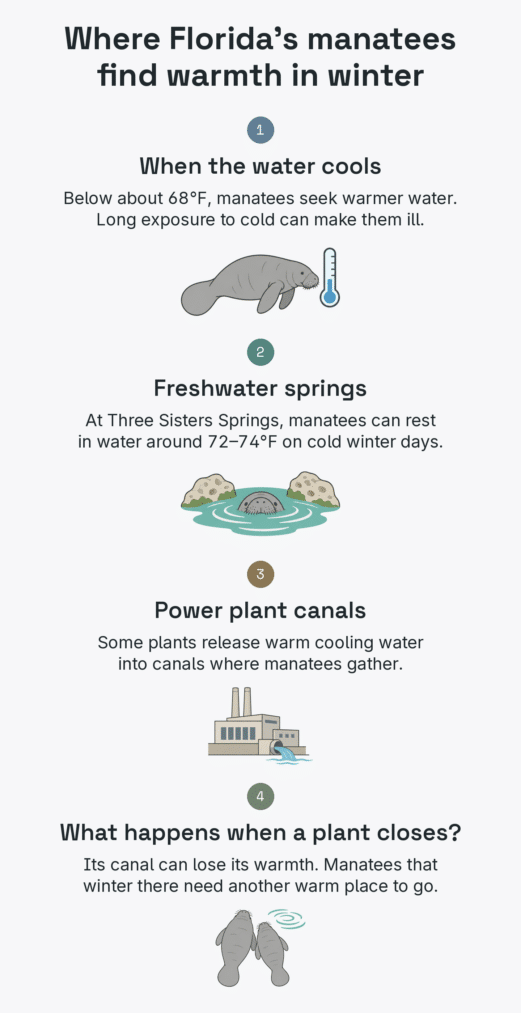
Manatees living in Florida have a tough time of it during the winter when the water temperature drops to below around 20 degrees Celsius (68 degrees Fahrenheit).
Thousands will begin to head towards warmer waters, including springs, power station canals, and others throughout the state.
Dropping water temperatures trigger dangerous cold stress
Manatees can often be found in tropical and subtropical waters. However, they are very sensitive to cold water.
They are less tolerant of cooler waters than many marine mammals.
If the water is too cold and they stay in it for long periods of time, they can suffer from cold stress.
This causes issues with thermoregulation and digestion. In extreme cases, they can die.
As a result, they will move away from their usual summer home as temperatures start to drop.
Natural freshwater springs and power plants offer warmth
There are a few different warm refuge areas in Florida. Some are natural sources.
Freshwater springs and sulphur springs provide manatees with water that remains fairly constant throughout the year. Others are man-made.
Power stations and energy plants emit warm water, which manatees have learned to use during the cold winter months. The most important thing is that the refuge remains reliably warm.
Variation in temperatures may result in fewer manatees being present in the area.
Crowded winter refuges put boats near hidden swimmers
Manatees will be present in areas which are likely to have human interaction.
Boaters are more likely to come across them, as are personal watercraft users, according to the Florida Fish and Wildlife Conservation Commission.
However, this can cause problems. Fully grown manatees can be quite large and can be difficult to spot above the water.
They often spend a lot of their time just under the surface. So, you may only get a glimpse of their nose, tail, back, or just a small splash.
It’s important to be careful when moving around areas where they are known to congregate.
Healthy seagrass beds sustain entire coastal food webs
There are other factors that can affect water temperature. Manatees are herbivores.
They have a large requirement for freshwater vegetation, seagrass, and aquatic vegetation.
These plants support fish, wildlife, and the wider aquatic ecosystem.
They also help maintain healthy aquatic environments that many other species depend upon. Their importance extends far beyond manatees alone.
If the water quality decreases or plants are removed, it will impact more than one species.
Healthy habitats will be lost, meaning fewer resources for the manatees.
Groundwater demand and aging plants threaten winter shelters
Refuge areas face challenges of their own. Natural spring systems can be affected by water flow.
With human demand for groundwater, some areas will have less warm water.
A large portion of the population now relies on man-made refuge areas provided by industrial sites.
Some of these locations can support hundreds of animals during the winter season.
That dependence makes the future of these sites particularly important. As a result, large numbers gather at these sites during the cooler months.
Protecting spring habitats secures long-term winter survival
Historically, manatees would have used natural warm-water refuges. Today, many rely on artificial ones.
Some of these refuges are linked to facilities that may not operate forever.
If some of these hotspots are lost, reliable alternatives will be needed.
Protecting these spring areas is now vital. Doing so ensures manatees still have a warm habitat and reliable food sources.
Without these reliable winter refuges, one of Florida’s most iconic animals would have far fewer safe places to survive.
Read the whole thing?
Get the week's signal, not the noise
Our sharpest reporting on energy, climate and nature — free, once a week.