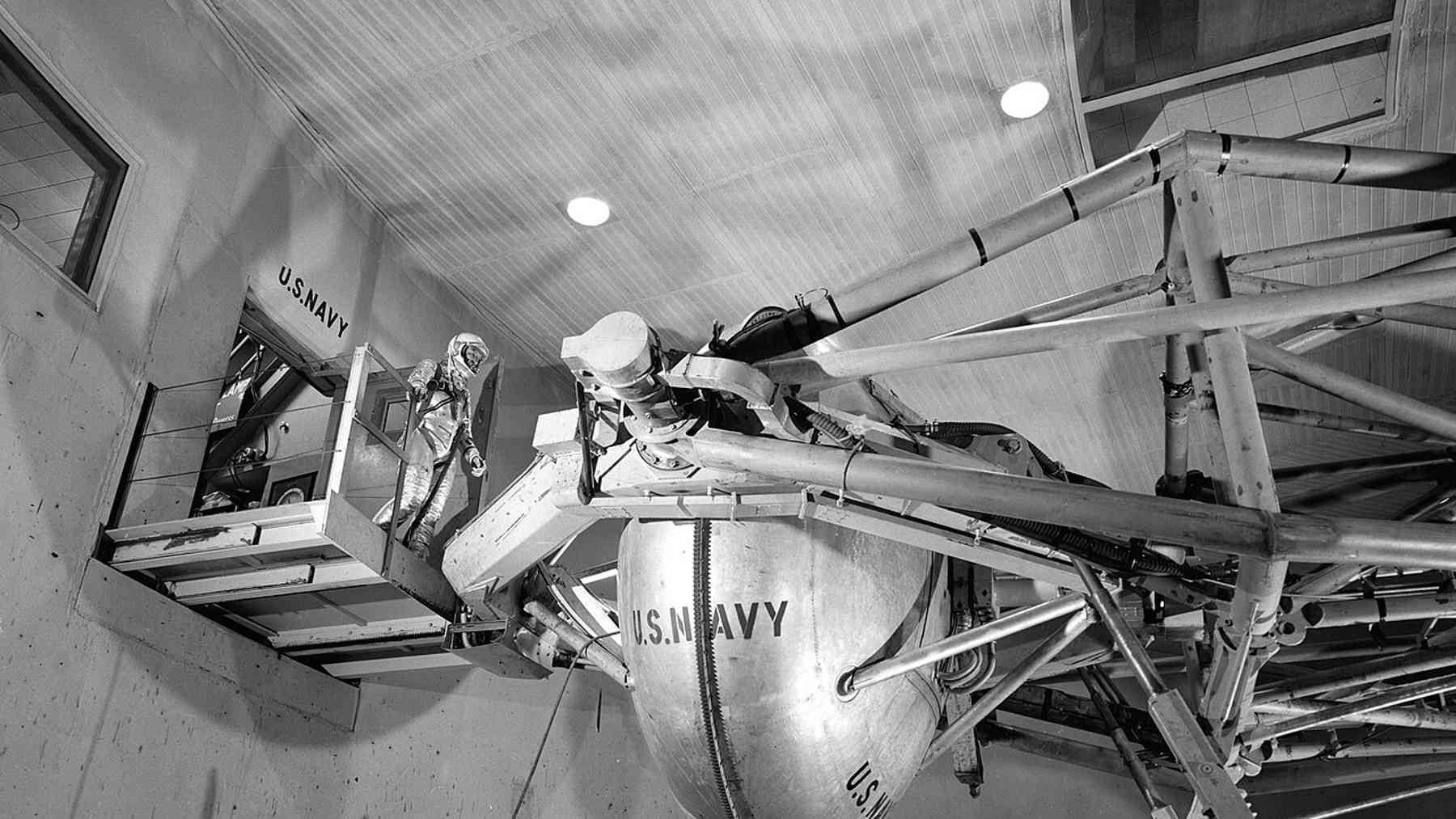
A small electric stove was fitted inside a swinging steel capsule.
The capsule hung from an arm fifty feet long.
Inside sat a researcher, reclined, strapped in, cooking his own dinner.
The arm kept turning.
It did not stop for a full day and night.
What his body did next became one of the strangest endurance records in American aerospace medicine.
A steady push, not a sudden slam, is what the body actually had to survive
Most centrifuge work chased a single violent spike, the kind of force that blacks out a fighter pilot pulling out of a dive in a few seconds. This experiment did the opposite, holding the rider at a constant twice normal gravity for a full day and night. That load seemed gentle enough to survive, yet relentless enough that nobody knew what it would do to a heart, a bladder, or a night’s sleep.
So the real question was not whether the body could take a jolt. It was whether a slow, grinding, unbroken gravitational tax on every organ would wear a person down over hours rather than seconds.
Blood has to work harder to climb to the brain under that load, and the diaphragm has to push against lungs that effectively weigh twice what they should. Even sitting still becomes work when apparent body weight doubles.
That distinction mattered because engineers were eyeing a very different kind of flight. A spacecraft that accelerated steadily instead of coasting might reach Mars in days rather than months, provided a human being could tolerate the sustained low level force the whole way there.
A fifty foot arm in Pennsylvania turned an ordinary recliner into a 24 hour cell
The machine doing the spinning sat in Warminster, Pennsylvania, at the Navy’s Aviation Medical Acceleration Laboratory. Known as the Johnsville centrifuge, its fifty foot arm could generate forces far higher than this test ever touched, and it trained the first American astronauts before any of them left the ground.
For this run the rider was Carl Clark, who headed the laboratory’s biophysics division. He settled into a reclining chair fitted inside the gondola, the same swinging capsule that normally carried test pilots through short, brutal bursts.
Engineers added the small stove so he could cook and eat. He had a radio for company, and he used it more than he expected to.
He worked, ate, and eventually slept, all while the arm kept him pinned under double gravity, an extraordinary span for a machine built mostly for encounters measured in seconds.
One side effect showed up after 24 hours, and it was ordinary fatigue
When the run finally ended in the late 1950s, the first study of long duration acceleration had its answer, and the answer was an anticlimax. Clark came off the machine reporting mild fatigue as his only side effect.
He had lost interest in the tasks he brought aboard, passing much of the time listening to the radio and napping. Written up by Clark and his colleague James Hardy, the ride was presented as evidence that a steady, moderate load is a far easier thing for the body to absorb than a brief, violent one.
It also reframed how engineers thought about long duration spaceflight. A trip that accelerated the whole way no longer looked like a guaranteed way to break a crew physically, at least not at this modest level.
The same machine chased 32 times gravity for just 25 seconds
Johnsville’s staff were already working on a separate question, the maximum jolt a body could survive at all. That search led toward an unlikely source of inspiration pulled straight from the ocean.
Researchers had noticed that fish tolerate high acceleration remarkably well, and proposed that encasing a person in water might spread the load the same way. The result was a water filled aluminum capsule nicknamed the Iron Maiden, in which a laboratory physician, R. Flanagan Gray, reached 32 times gravity for roughly 25 seconds and reported little worse than sinus pain.
The two experiments asked opposite questions of the same centrifuge, one about how long a body could endure a modest load, the other about how much force it could survive for a handful of seconds. That second question echoes a very different kind of endurance test, the one strangers shut away two to a hut once faced over ten days of close confinement.
Clark’s quieter ride, by comparison, barely left a mark. Had that same acceleration been applied in a straight line, he and Hardy noted, the day would have carried him 45 million miles at a speed of some 3.8 million miles per hour.
Decades later the same lesson still shapes how bodies are tested
Decades later, the lesson from Johnsville still informs research into both survivable acceleration and the limits of ordinary endurance. Modern centrifuges, including the ones used to study pilots and astronaut candidates, still treat short violent loads and longer, steadier ones as separate problems, because a body answers each kind of stress in its own way.
Some of that thinking echoes in work like the climbers who reach Everest’s summit without supplemental oxygen, another case where a body under sustained stress adapts in ways a brief shock never reveals.
Both stories turn on the same quiet truth, that duration changes physiology as much as intensity does. The centrifuge stopped running for the government in the 1990s, and the great arm now stands in Warminster rather than spinning.
Even so, the lone day Clark spent pinned in a reclining chair under double gravity remains a small, odd data point, proof that sometimes the body’s biggest surprise is how little a long, steady burden actually costs it.
Read the whole thing?
Get the week's signal, not the noise
Our sharpest reporting on energy, climate and nature — free, once a week.